The Three-Word Ultimatum: How Spain’s Prime Minister Defied Trump and Risked Economic Ruin
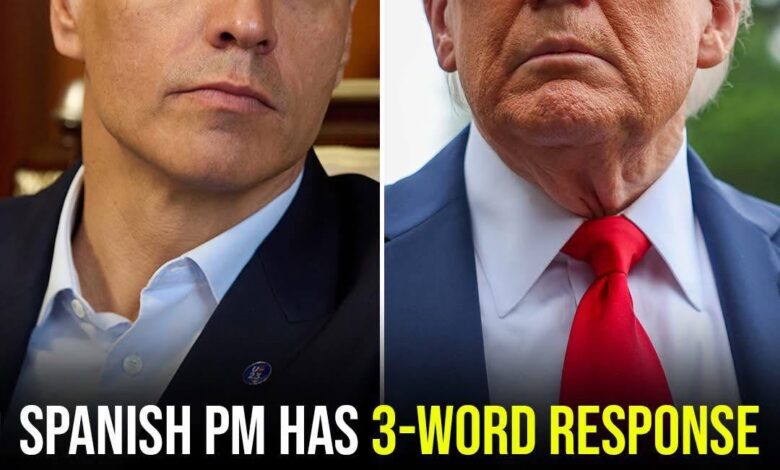
The transatlantic alliance is teetering on the edge of a total collapse, and one defiant sentence might be the final push that shatters decades of diplomacy. As tensions in the Middle East reached a fever pitch, with the smoke over Tehran marking a dark new chapter in global conflict, Spain took a stand that shocked Washington to its core. In a moment of pure, cinematic tension, Prime Minister Pedro Sánchez stared down the barrel of a multi-billion dollar trade threat from the American President. His response wasn’t a compromise or a negotiation. It was a cold, three-word rejection that changed everything.
The crisis began when the United States sought to utilize Spanish military bases as a strategic staging ground for potential strikes on Iran. For most global allies, such a request would be a formality—an expected extension of shared geopolitical interests. But Madrid refused to fall in line. Prime Minister Sánchez issued an uncompromising directive: Spain would not permit the use of its soil for military operations that did not explicitly align with the UN Charter and the foundational principles of international law. It was an assertion of sovereignty that the White House did not take lightly.
Donald Trump’s reaction was instantaneous and explosive. He framed the refusal not as a matter of legal protocol, but as a betrayal of the alliance. With the characteristic volatility that defines his foreign policy, the American leader threatened to freeze all trade relations with Spain. This wasn’t merely a rhetorical jab; it was a direct assault on the Spanish economy. The prospect of losing access to the sprawling American market sent ripples of panic through Madrid’s financial sectors, as business leaders and politicians alike realized that their Prime Minister had just initiated a high-stakes standoff with the world’s most powerful economic force.
Yet, when the cameras focused on Sánchez, there was no sign of diplomatic hedging or backroom scrambling. Instead, he stood before his people and the international press and issued a simple, undeniable retort: “No to war.”
With those three words, the Prime Minister stripped away the complex veneer of military strategy and economic blackmail. He wasn’t just talking about Iran; he was articulating a fundamental philosophy of governance. By prioritizing peace and international legality over the threat of economic reprisals, Sánchez made a moral calculation that placed the dignity of the Spanish state above the fear of American retribution. He knew that by digging in his heels, he was painting a target on his nation’s back, but he also recognized that capitulating to pressure would render Spain a mere vassal to Washington’s changing whims.
This collision has exposed a deep, structural fissure that has been widening within the transatlantic partnership for years. The era of blind, automatic alignment with American military interventions is clearly drawing to a close. European nations, once comfortable being the junior partners in a US-led security apparatus, are increasingly finding their own voices. They are tired of being dragged into conflicts they did not sanction, wars they did not want, and humanitarian crises they are expected to clean up after the dust settles.
For the American President, the confrontation is a test of power. He views the global order through a lens of transactional loyalty: if you benefit from the US security umbrella, you must be prepared to follow the US lead without reservation. When a nation as significant as Spain dares to dissent, it is viewed as a breach of contract. For the Europeans, however, the dissent is a matter of self-preservation. They have watched the cycles of intervention and withdrawal with growing skepticism, and they are now asserting their right to curate their own foreign policy priorities.
Spain’s decision has acted as a lightning rod for this growing unease. Other capitals across the European Union are watching the standoff with bated breath. They see a nation that refused to flinch even when faced with the potential collapse of its trade agreements. Sánchez’s government has essentially issued a challenge to the rest of the continent: is the price of our autonomy really an economic blockade? If Spain can stand its ground, why can’t France? Why can’t Germany? Why can’t Italy?
The brilliance of the “No to war” mantra lies in its simplicity. It transcends the technicalities of military base access and UN resolutions. It is a rallying cry that resonates with a public that is increasingly wary of global adventurism. In the halls of power in Washington, the focus remains on the leverage: tariffs, import quotas, and supply chain disruptions. In the halls of power in Madrid, the focus has shifted to the cost of silence. Sánchez has wagered that the Spanish people will prioritize their national values and their commitment to peace over the short-term pain of a boycott.
As the smoke continues to drift over the Middle East, the political fallout continues to harden. We are witnessing a rapid fracturing of alliance politics. It is a moment where principles are being weighed against pocketbooks, and the outcomes are anything but certain. Washington is doubling down on its hard-line strategy, convinced that economic pain will inevitably lead to political submission. But the leadership in Madrid seems equally convinced that the leverage has a shelf life, and that a nation that trades its moral standing for market access will eventually lose both.
Whether this standoff ends in a back-channel reconciliation or a full-scale trade war remains to be seen. But the line has been drawn. Prime Minister Sánchez has signaled that Spain is no longer a silent partner in America’s military theater. By speaking without flinching, he has invited a storm of economic consequences that could reshape the relationship between the two nations for a generation. It is a dangerous, bold, and unprecedented gamble. Spain has decided that its dignity is not for sale, even when the price is a war of a different kind—a trade war that could turn the transatlantic alliance into a relic of the past. As the world watches, one thing is certain: the era of automatic compliance is over, and the three-word response from Madrid will be remembered as the moment the status quo was finally shattered.