The Betrayal of a Lifetime: How a Single Banking Alert Brought Down a Deceptive Duo
The text message arrived at 2:07 on a Tuesday morning, a digital guillotine that severed twenty-three years of marriage in one heartless sentence. “I ran away with your best friend. We’re never coming back.” Beneath the chilling words was a photograph of my husband, Ethan, standing barefoot on a sun-drenched beach in Cancun, his arm around Rachel—the woman who had sat at my dinner table every Sunday and held every one of my deepest secrets. In the photo, they were clinking champagne glasses toward the camera, and my heart nearly stopped: Rachel was wearing the sapphire necklace I had given her for her forty-fifth birthday.
I stared at the screen until the initial, suffocating shock hardened into something far colder, far sharper, and infinitely more useful. My mind began to race, cataloging the facts: Ethan’s construction company had been teetering on the edge of insolvency for months, and Rachel had been unemployed for over a year. There was no way either of them could afford the luxury resort in the background of their boastful photo. Driven by a sudden, icy clarity, I opened my banking app. What I found was a systematic pillaging of my life’s work. Thousands of dollars in charges for private yachts, oceanfront dinners, boutique hotel suites, and high-end spa treatments flooded the screen—all billed to supplementary cards attached to my personal account. Before the sun had even touched the horizon, I had canceled every single card, changed every password, secured every financial asset, and hired a locksmith to rekey my entire home.
I am forty-five years old and work as a senior accountant for a major logistics firm near Columbus, Ohio. I know better than most exactly how quickly careless spending can metastasize into total financial ruin. For years, I had quietly subsidized Ethan’s struggling business, covered the bulk of the household expenses, and allowed him the convenience of a credit card linked to my personal line. Rachel, too, had retained an emergency card I had issued her years ago after she lost her wallet during a trip overseas. I had simply never gotten around to removing her as an authorized user—a mistake that would prove to be her undoing.
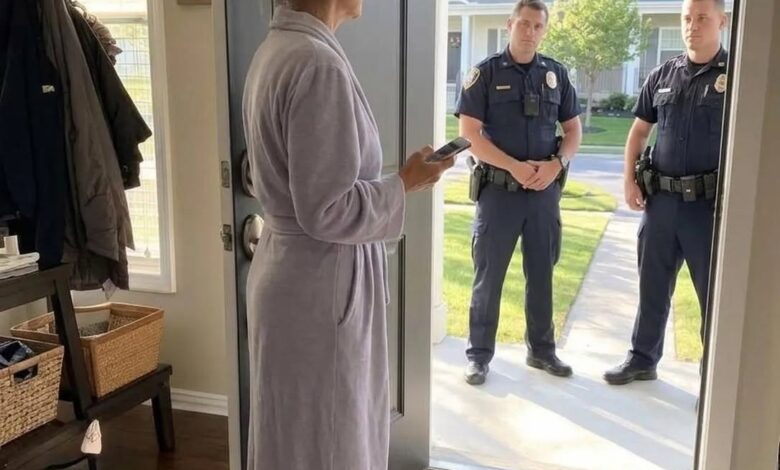
The brick house that Ethan had long referred to as “ours” was, in reality, purchased in my maiden name using a $310,000 inheritance from my grandmother just six months before we were married. I had never added him to the deed or the mortgage. At 7:18 that morning, two police officers arrived at my front door. Ethan had called them, desperate and indignant, claiming that I had illegally frozen joint assets and locked him out of his marital home. I didn’t panic. I calmly ushered the officers into my office, where I laid out the property documents, the exhaustive list of unauthorized charges, the message announcing his desertion, and the incriminating photograph from Mexico. Officer Daniels, after reviewing the records, looked at Ethan’s frantic text messages and then back at me. He agreed immediately that I had every legal right to secure my own property and revoke access to cards issued solely in my name.
As I walked the officers through the recent, suspicious transactions, I noticed something that made my blood run cold: an unfamiliar $8,000 electronic transfer disguised as a business reimbursement. Curiosity turned to a frantic, methodical search. I dove deeper into the digital history and uncovered a pattern of systematic theft—transfers of $6,000, $4,500, and $9,200, all routed to the same obscure external account over the course of ten months. By noon, nearly $40,000 in missing funds had been traced, along with payments for a luxury downtown apartment and a deposit on a high-end vehicle. There were even recurring “consulting” fees listed that had absolutely nothing to do with Ethan’s legitimate business.
I immediately called Lauren Hayes, a top-tier financial litigation lawyer who had a reputation for following money trails that other people hoped would stay buried. She arrived at my home with her laptop before the afternoon was over. Working with surgical precision, she tracked the digital authorizations back to Ethan’s office. It turned out that someone—undoubtedly Ethan—had taken my electronic signature from an old, discarded tax document and used it to forge approvals for these massive transfers without my knowledge or consent. The lease for the downtown apartment was in Rachel’s name, meaning I had been unknowingly financing the illicit love nest where my husband had been meeting my closest friend for nearly a year.
As we continued to document the fraud, a security alert blinked across my monitor, signaling repeated, failed attempts from a Cancun IP address to access my cloud storage and bank records. They weren’t just spending my money; they were trying to scrub their tracks. Lauren finally closed the laptop, looked me directly in the eyes, and delivered the final blow. “They didn’t run away for love, Olivia,” she said, her voice grim. “They ran because they believed they had already stolen enough to start over. They weren’t just seeking a new life; they were building one on the foundation of your bankruptcy.”
The realization didn’t break me—it galvanized me. For years, I had played the role of the supportive wife and the generous friend, believing that I was the one holding everything together. I hadn’t realized that the people I trusted most were merely waiting for the right moment to hollow me out. Now, with the evidence secured and the bank accounts locked, the power had shifted completely. I wasn’t just a victim of a spouse’s midlife crisis or a friend’s betrayal; I was a woman who had just uncovered a criminal conspiracy. Ethan and Rachel had wanted a fresh start on my dime, but as the lawyers prepared their filings, they were about to discover that the price of their vacation was going to be significantly higher than they had ever anticipated. Their expensive champagne was about to leave a very bitter taste.