How The Shy Bullied Boy From Oklahoma Transformed Himself Into The Ultimate Global Martial Arts Icon
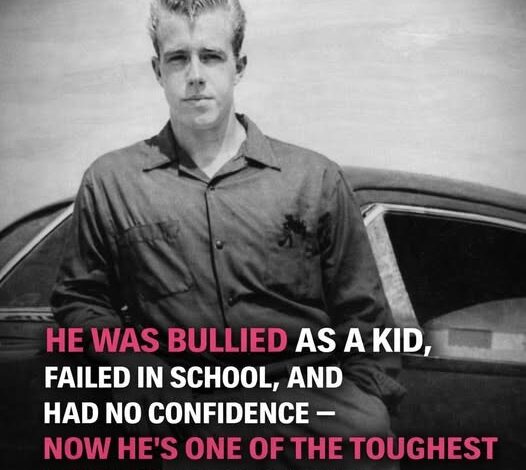
The image we hold of Chuck Norris today is one of immovable strength and mythic toughness, a figure whose very name has become shorthand for invincibility. Yet, the reality of his beginnings stands in stark, almost unbelievable contrast to the icon he became. He was not born into a life of ease, nor was he the golden child destined for stardom. His early years were defined by instability, a profound lack of direction, and the crushing weight of being an outsider. His journey from a painfully shy, insecure boy in rural Oklahoma to one of the most recognizable martial arts legends in history is not merely a tale of fame; it is a masterclass in the power of discipline, persistence, and the internal decision to never accept the limitations imposed by others.
Born on March 10, 1940, in the small town of Ryan, Oklahoma, Chuck Norris entered a world where the future seemed perpetually uncertain. His childhood was marred by the instability of his parents’ marriage and the heavy shadow of his father’s struggles with alcohol. This lack of a stable foundation created an environment where a young boy could easily feel lost, and for Norris, that feeling was all-consuming. He was not the athlete, the class leader, or the boy with the magnetic personality. He was the quiet child who faded into the background, the one who struggled with his studies and lacked the drive to distinguish himself. Most significantly, he was a target. The persistent bullying he faced in his youth left him feeling invisible and deeply insecure, a psychological burden that stayed with him long after he left the classroom.
Life eventually shifted when his parents divorced, leading to a move to California with his mother and brothers. While the change in location offered a literal change of scenery, it did not solve the internal search for purpose. He was still a young man without a compass, drifting through his post-high school years with no grand vision of his future. Fame, fortune, and the glitz of Hollywood were not even on his horizon. In 1958, seeking order in a life that lacked it, he joined the United States Air Force. It was this singular decision that inadvertently placed him on the path to greatness.
Norris was stationed in South Korea, and it was here, in a foreign land far from the comforts of home, that the dormant force of his spirit was finally ignited. He discovered Tang Soo Do, a traditional Korean martial art, and for the first time in his life, he found a structure that resonated with his own need for internal consistency. The shy, insecure boy who had spent years trying to avoid notice now found himself spending every waking hour training. He practiced his strikes, kicks, and defensive maneuvers with a relentless, obsessive focus. With each repetition, the boy who once lacked confidence began to disappear, replaced by a man who was finding his physical and mental strength in equal measure.
Martial arts provided more than just a technique for self-defense; it provided him with a sense of identity. He realized that martial arts was not simply about combat; it was about the refinement of character, the cultivation of self-respect, and the unwavering pursuit of excellence. This transition was the catalyst for his entire life. When he returned from the Air Force, he didn’t return to the driftless existence he had left behind. He was now a disciplined, driven professional. He opened his own chain of martial arts schools and began the arduous process of competing on the professional circuit.
Success did not come overnight, but it came as a result of his unwavering discipline. Norris rose to the top of the competitive martial arts world, winning multiple championships and defeating the toughest fighters of his era. His fighting style, characterized by a calm, controlled intensity, commanded respect. He had transitioned from being the bullied student to the master, eventually teaching celebrities and athletes who sought out his expertise. However, just as he had conquered the world of competitive fighting, destiny arrived in the form of a fellow martial artist: Bruce Lee.
Their connection was immediate and profound, built on a foundation of mutual respect. Lee saw something in Norris—a combination of raw potential and technical precision—that the rest of the world hadn’t yet recognized. This friendship provided Norris with his first significant entry into the world of film, culminating in a legendary fight sequence in the 1972 classic Way of the Dragon. The scene, which pitted Norris against Lee in a battle of titans, burned itself into the consciousness of global audiences. It was the moment the martial artist officially became a film presence.
What followed was a steady, calculated climb. Norris didn’t rely on luck; he brought the same work ethic that he had learned in his martial arts training to the film set. He starred in a string of action films that cast him as the moral center—a man of justice, strength, and resilience in a broken world. His appeal went beyond the choreography of his fights; it was his demeanor. He exuded a quiet, unshakeable dignity that set him apart from the frantic, hyper-kinetic action stars of the time. This trajectory eventually led him to the television screen in Walker, Texas Ranger, a show that ran for nearly a decade and solidified his place as a household name across the globe.
In his later years, Norris shifted his focus toward philanthropy, family, and the promotion of fitness and martial arts education for youth. He became as committed to building the character of the next generation as he had been to honing his own craft. He stepped back from the relentless pace of Hollywood, finding contentment in a life structured by the same values of respect and discipline that had guided him since his time in Korea.
The legacy of Chuck Norris is not found in the fight scenes or the box office returns; it is found in the trajectory of the man himself. He serves as a living, breathing testament to the idea that strength is not an innate quality—it is a result of consistent, daily action. He transformed the pain of his childhood bullying into the fuel for his lifelong pursuit of mastery. By choosing to step into the ring, he chose to step into his own power. He reminds us that the most significant battles we face are often the ones within our own minds, and that the process of becoming is far more important than the destination of fame. From the insecure boy in Ryan, Oklahoma, to a global symbol of resilience, Chuck Norris proved that the only limitations that truly matter are the ones we place upon ourselves.