The Uninvited Guest: When a Stranger Claimed to Be My Grandmother’s Lost Daughter at Her Milestone Birthday
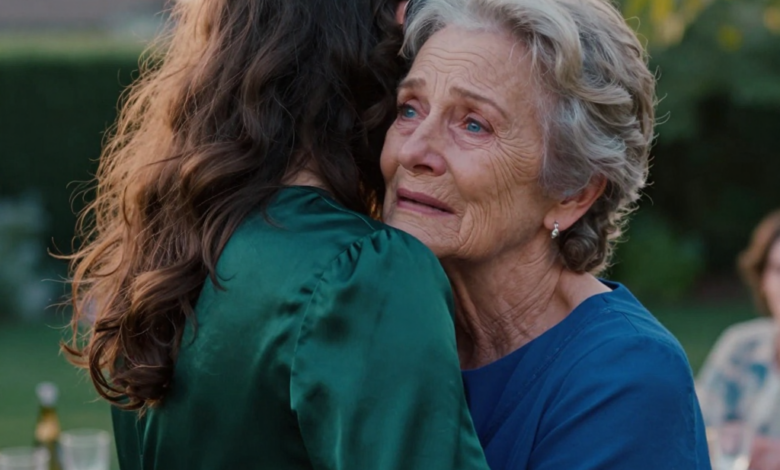
Agnes Miller’s 85th birthday was supposed to be an ode to enduring love. It was meant to be the crescendo of perfectly orchestrated joy—a symphony played out in her sun-drenched backyard, filled with the clinking of heirloom silverware, the scent of rosemary and aged vanilla wafting from the buffet table, and the warm, resonant laughter of her entire clan. For nearly eight decades, Agnes had been the unwavering anchor of her family: the matriarch whose wisdom felt as solid as the oak beams supporting her home; the keeper of recipes whispered down through generations; the woman whose gentle hands could mend a broken heart or perfectly fold a napkin. Today, however, that perfect tapestry was about to be ripped wide open by a single, unexpected thread.
The party buzzed with predictable warmth. Agnes sat at the head table, radiant in her sapphire blue dress, looking every bit the queen of her domain. Her children—Robert, Clara, and David—were navigating the well-wishes, their own life chapters intersecting beautifully beneath her watchful gaze. Young Michael was trying (and failing) to teach his cousins a complicated folk dance while little Eleanor expertly charmed her way through the cake sampling station. It was idyllic. It was *Agnes*.
Then, the quiet shifted. The low hum of conversation dipped into an anticipatory murmur, like the breath held just before a storm breaks. A figure drifted through the periphery, seemingly uninvited by the carefully curated guest list, yet possessing an undeniable magnetism that snagged every eye in the yard. She was tall, with a cascade of dark, wavy hair that seemed to catch the late afternoon gold light perfectly. Her dress—a deep emerald silk—was elegant but carried the air of someone who had traveled a long distance or waited a very long time for this moment.
As she approached Agnes’s side, her movements were imbued with a strange mixture of reverence and urgent excitement. She paused just beside Agnes’s chair, seemingly gathering the courage to speak into the ambient noise of celebration. Robert, who had been mid-sentence telling a hilarious anecdote about his college years, stopped dead, his smile freezing on his face. Clara leaned in, her hand instinctively rising to cover her mouth. David simply set down his glass, his expression morphing from contented ease to profound, cautious scrutiny.
The woman finally spoke. Her voice was low, smoky, and carried a melodic richness that made everyone pause, leaning in like rapt listeners. “Agnes… my dearest Agnes.”
Agnes’s own breath hitched. Her hand, which had been poised delicately over her teacup, trembled slightly. She lifted her head slowly, those bright, intelligent blue eyes focusing on the stranger, a flicker of deep confusion mingling with an undeniable spark of recognition.
“You…” Agnes murmured, her voice raspy, as if the word itself required immense effort to push out. “But… how?”
The woman’s expression softened into something heartbreakingly familiar—a mix of relief, longing, and decades of suppressed sorrow. She took a tentative step closer, allowing the scent of sandalwood and sea salt that clung to her to mingle with the smell of summer blooms.
“You remember me,” she whispered, reaching out one hand, not to shake, but simply to rest it against Agnes’s wrinkled, elegant sleeve. “It’s been so long. You are my mother.” The declaration hung in the air, heavy and absolute, silencing every chirp of the crickets, every burst of laughter.
“My… mother?” Agnes repeated, a small, stunned sound escaping her lips. She looked past the woman to Robert, Clara, David—her children. Their faces were masks of disbelief struggling to crack into shock.
“Who are you?” Robert demanded, stepping forward slightly, his protective instincts immediately kicking in. His tone wasn’t aggressive, but it was charged with incredulity.
The woman turned her gaze toward him, and a genuine, brilliant smile broke across her face—a smile that seemed to hold the memory of sunshine itself. “My name is Isolde. And I am your grandmother’s daughter.” She then turned back to Agnes, her grip tightening gently on the sleeve, her eyes shining with unshed tears.
“I was… I was lost,” Isolde confessed, her voice gaining strength, finally finding its rhythm amidst the stunned silence of the party. “Or rather, *taken*. When your father and you were newlyweds in ’58. They never knew where I went. To a distant cousin’s farm up north. A misunderstanding, they said. An adoption paper slip-up. But I found proof recently. Records matching Agnes Miller. The name is undeniable.”
The ensuing silence was deafening. It wasn’t just the lack of sound; it felt like the world itself had paused its rotation to witness this seismic shift in the fabric of their lives.
Agnes, after a long moment that stretched into an eternity, finally managed to touch Isolde’s cheek. Her fingertips were surprisingly warm against the stranger’s skin. A single tear tracked a path down Agnes’s weathered face, but it wasn’t a tear of despair—it was one of overwhelming, unbelievable recognition.
“Isolde,” Agnes breathed out, testing the name. “Oh, Isolde. My sweet girl.” She squeezed her hand, pulling her closer, as if afraid this beautiful apparition might vanish into the golden light around them at any second. “All these years… all these seasons… you were walking beside us, hidden in plain sight?”
The children reacted next, a flurry of emotion erupting simultaneously. Clara rushed forward, tears already streaming down her face, pulling Isolde into a fierce embrace. David stood slightly back, his jaw set, absorbing the impossible reality while searching Isolde’s features for corroborating proof—a birthmark, a familiar tilt to the chin, an echo of Agnes’s own expression.
Robert approached last, slower than the rest. He stared at Isolde, seeing not just a stranger in emerald silk, but a missing piece of his own ancestral puzzle, a shadow from his childhood stories that had always felt slightly incomplete. He reached out, hesitantly, and touched her forearm. His touch was hesitant, almost reverent.
“But… you look so much like your mother,” Robert managed, his voice thick with emotion. “The eyes… they’re exactly hers.”
Isolde smiled again, a deeper, more profound expression this time. She turned her head slightly toward Agnes, mirroring the familiar curve of her grandmother’s own lips. “And you have her strength, Robert. The same stubborn grace when things get tough. And… well, look at your mother’s eyes, David. They always had that particular glint of fierce amusement.”
The narrative spiraled outwards from the epicenter of this revelation. Conversations, previously flowing like a gentle stream, abruptly became rapids. Whispers broke out among the aunts and uncles. Cousin Beatrice gasped so loudly she nearly dropped her champagne flute. Michael stopped dancing instantly, his mouth agape in awe.
Agnes, meanwhile, was experiencing an emotional supernova. She wasn’t just happy; she was *reunited*. The grief of a lifetime—the quiet ache that sometimes settled over the dining room when they discussed ‘what ifs’ or ‘her story’—was suddenly being washed away by this glorious, unexpected presence.
“Tell us everything,” Agnes commanded softly, her tone shifting from stunned wonder to maternal directive. She leaned in close to Isolde, brushing a stray strand of dark hair from her temple. “The journey. The farm. How did you find out? What were your parents like?”
Isolde began to speak, and the details poured out—tales of a life lived under the vast, open sky of the Midwest, where she learned to plant tomatoes in stubborn soil and chase fireflies across dew-soaked fields. She described her own upbringing with Agnes’s steady patience mixed with Robert’s spirited humor. She spoke of being fiercely loved, yet forever existing slightly outside the perfect circle of family knowledge.
The children exchanged meaningful looks. They were piecing together fragments of their lineage that had been considered folklore—tales of a ‘secret aunt’ or a ‘child who vanished young.’ Suddenly, these vague anecdotes snapped into sharp focus, given flesh and breathing presence in front of them.
Clara reached out again, this time not just holding Isolde’s hand, but stroking her back gently. “You never told us,” Clara whispered, overwhelmed with the intimacy of the revelation. “We always wondered who that little girl used to sneak into our summers…”
David stepped beside Robert, placing a grounding hand on his brother’s shoulder. His initial skepticism was dissolving rapidly, replaced by a profound sense of belonging. He looked at Isolde, really *saw* her—the way she held herself with quiet dignity, the intelligence that sparked in her eyes when Agnes spoke her name, the undeniable echo of their grandmother’s spirit.
“You are real,” David murmured, a small, triumphant laugh escaping him. “Absolutely, undeniably real.”
The climax arrived not as a dramatic shout or a crashing sound, but as a profound, resonant stillness that enveloped them all. Isolde paused mid-sentence while describing the day she discovered her mother’s faded photograph tucked into an old hymn book in her aunt’s attic. She looked around the yard—at Agnes beaming with incandescent joy; at Robert, whose protective stance had softened into welcoming pride; at Clara, whose tears were now flowing freely in a beautiful torrent; and at David, who stood utterly captivated.
Isolde turned back to Agnes one last time. The years of separation felt negligible against the weight of this shared history. She didn’t need to speak. Her entire being communicated gratitude, belonging, and homecoming.
Agnes, sensing the perfect moment, slowly raised her own hands, palms open towards Isolde—a gesture of blessing, acceptance, and fierce maternal love. The sunlight seemed to catch in Agnes’s sapphire dress just right, illuminating the deep creases around her eyes as she gazed at her long-lost daughter.
The air fractured with sound: a chorus of delighted gasps, Robert letting out a loud whoop, Clara sobbing into Isolde’s shoulder, and even Michael pausing his dance to simply stare, utterly awestruck.
Agnes leaned forward, pulling Isolde into the strongest embrace possible—the kind that says, *You are home. You are safe. You have always been mine.*
As Agnes held her daughter close, whispering nonsensical assurances of love and longevity into her hair, Robert finally broke protocol, wrapping his own arms around both mother and daughter in a tight, encompassing circle. David joined them, completing the triangle of profound family connection.
The birthday party hadn’t ended with a fizzled candle or an awkward lull; it had detonated in a beautiful, joyous burst of recognition. The mystery was solved, not with a whodunnit flourish, but with a tender, undeniable embrace. Isolde Miller wasn’t just *a* guest; she was the missing vital organ that had been quietly sustaining Agnes’s heart for decades, and now, she was fully, beautifully beating within it once more.