The Paper That Broke Us: How a Single, Misplaced Letter Kept My Father Silent For Two Decades
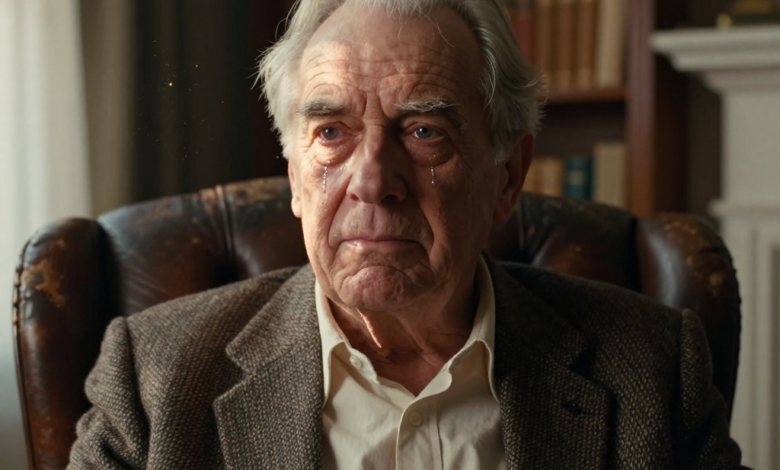
The silence wasn’t sudden. It didn’t crash in like thunder on a summer afternoon. It was insidious, slow-moving, and utterly suffocating—a creeping fog that settled over the meticulously kept garden of our family life. Twenty years. Two decades of unspoken words hanging heavy between my father, Arthur, and me. A chasm carved not by grand betrayal or catastrophic failure, but by something far smaller, far more deceptively fragile: a single sheet of aged, cream-colored stationery.
When I was fifteen, the world felt boundless—a vibrant palette splashed across suburban normalcy. My relationship with Dad was my anchor. He was the steadfast lighthouse in my turbulent teenage years; his booming laugh could chase away existential dread, and his advice, always delivered over a mug of lukewarm tea, felt like distilled wisdom. We communicated in inside jokes, shared silences that were comfortable, and long, meandering conversations about everything from astrophysics to why socks always disappeared in the dryer.
Then came the letter. It was addressed to him, written by my mother just weeks before her own quiet battle with a relentless illness began to rage through her veins. She had penned it during one of those rare moments of profound peace, sitting beside his worn leather armchair, sunlight streaming across the room, illuminating dust motes dancing like tiny galaxies.
The letter was beautiful. The handwriting—his wife’s script, elegant yet slightly rushed with underlying worry—flowed across the page. It wasn’t about bills or appointments. It was a confession of fear, a testament to decades of quiet contentment, and most powerfully, it contained an admission: that she felt sometimes, deeply, profoundly alone in the magnificent structure of our life together. She wrote, ‘Arthur, even when you are loudest with laughter, there are moments when the echo in this house feels too vast for just two people. I love your strength, but oh, how I yearn to know the quiet landscape of your heart.’
My father read it aloud that evening, his voice thick and uneven. He looked at Mom, a deep furrow etching itself between his brows, acknowledging the vulnerability she’d exposed. Then, he turned to me, sitting cross-legged on the rug, my adolescent self mesmerized by the gravity of the moment. His expression was unreadable—a mask that suggested joy battling with an ancient, weary resignation.
‘It is a lovely thing,’ he murmured, his gaze fixed not on Mom, but seemingly through her, into some distant horizon only he could see. ‘A very honest thing.’
The conversation continued normally for another hour. We debated the merits of classic rock versus indie folk. He teased me about my questionable taste in eyeliner. Everything seemed to be right. Perfect, almost painfully perfect.
But then, a week later, during a mundane Tuesday dinner where Mom had mentioned her anxiety spiking again, Dad paused mid-bite of his roast chicken. His eyes flickered toward the spot on the mantlepiece where the letter was carefully tucked into a protective sleeve. He didn’t look at Mom, and he certainly didn’t look at me. The silence that followed wasn’t comfortable; it was pressurized. It felt like the air itself had suddenly turned viscous.
‘Are you alright, Dad?’ I asked, my voice too bright, too eager to snap him out of his trance.
He merely nodded, a jerky motion. ‘Fine. Just… reflecting on things.’
The reflection never lifted. It settled deep into the foundations of our home, hardening into an impenetrable barrier between us.
Mom tried. Oh, how she tried. She’d bring up passages from the letter—’Remember what you said about the echo?’ or ‘When did your heart feel most alone, Arthur?’ He would answer with monosyllables: ‘It is fine,’ or ‘Sometimes.’ But the conversation always stalled there, circling that pivotal confession.
My mother was fading. Her energy waned, her grip on witty anecdotes loosened, and she began to withdraw into the gentle fog of illness. The unspoken words became a tangible weight in every shared glance, every awkward holiday gathering. It felt as if the letter—that single testament to vulnerability—had triggered something seismic within him that he couldn’t seem to contain.
As Mom slipped away in the spring of my nineteenth year, she managed one last, weak squeeze of my hand. Her eyes, though clouded with fatigue, held a plea for connection, a silent demand: *Tell him*.
In the funeral wake, surrounded by relatives who looked at Dad with a mixture of sympathy and bewildered pity, I finally mustered the courage. ‘Dad,’ I whispered, gripping his elbow so tightly my knuckles turned white. ‘What did you think when Mom wrote that? About feeling alone?’
He flinched, a visible ripple running down his powerful frame. He avoided meeting my eyes, instead focusing on a wilted spray of lilies.
‘It was… premature,’ he finally grated out.
Premature? The letter wasn’t a complaint; it was an offering! An opening!
‘But she was telling you her deepest fear!’ I pressed, my own grief fueling a desperate need for clarity.
He finally looked at me, and in his eyes, I saw the ghost of that initial discomfort, magnified by two decades of forced restraint. ‘Fear is not something to be named so easily, child. It is a current. One does not simply name a river; one learns its flow.’
And just like that, the silence reasserted itself, deeper and more absolute than before.
The years bled into each other: graduation parties where he offered a tight, formal smile instead of his usual roar of pride; holidays where our exchanges were reduced to logistical updates (‘Did you pay the electric bill?’ ‘Yes.’). We navigated life like two satellites in orbit around each other—present, yet eternally distant.
The catalyst for the eventual thaw came ten years later, when I was twenty-nine and navigating a particularly messy professional breakup. The world felt loud, chaotic, and entirely too unforgiving. I found myself staring at my reflection one rainy Tuesday morning, feeling utterly adrift, wishing for Dad’s grounding voice to pull me back from the edge.
‘Dad,’ I called out into the kitchen, ‘I feel completely untethered right now. Like I’ve been sailing without a rudder.’
He was in his study, surrounded by stacks of old books—his sanctuary. He didn’t immediately answer. The delay felt monumental. My stomach tightened, that familiar, agonizing knot forming.
Finally, he spoke, his voice raspy from disuse in deep conversation. ‘The rudder is often less important than the sails.’
It was a poetic response, beautifully phrased—a snippet of the wisdom I remembered from our earlier years. But it wasn’t *Dad*. It felt like an eloquent stranger mimicking him.
‘But what about the rudder?’ I insisted, walking into the study. ‘The direction? The steady point? What if you lose sight of where you’re going entirely?’
He sighed, a long, theatrical expulsion of air that seemed to contain twenty years of suppressed monologue. He finally turned fully in his leather chair, and this time, he didn’t look away.
His eyes—they were the same deep, warm brown, but they held shadows now, maps etched by silence. They looked tired.
‘The rudder,’ he said, his voice cracking slightly on the word, ‘is only useful if you believe in the destination.’
He paused. This time, it wasn’t a strategic pause; it was a moment of sheer internal struggle. He lifted a hand, rubbing the bridge of his nose, as if warding off a physical pain.
‘My mother… she spoke about the echo,’ he finally whispered, and my breath hitched. ‘About feeling alone in the great expanse.’
I leaned against the doorframe, suddenly breathless with hope. This was it. The dam was cracking. ‘And what did you think?’ I prompted, my voice barely audible.
He closed his eyes again, a shudder passing over him. When he opened them, they were glistening.
‘I thought,’ Arthur confessed, the word escaping like a trapped bird finding flight, ‘that she was wrong about one thing.’
My heart hammered against my ribs. Was it that she *was* alone? That the house *did* echo too much? Or something else?
He leaned forward, placing both hands on his knees, forcing himself to meet my gaze again. The veneer of stoicism finally fractured. Tears welled in the corners of those usually impenetrable eyes.
‘She wrote that even when you are loudest with laughter… there are moments when the echo feels too vast.’ He swallowed hard, the sound loud in the quiet study.
‘But,’ he continued, his voice gaining surprising strength, a resonance that vibrated right through me. ‘The letter didn’t just tell me she was alone. It showed me *why* she felt alone.’
He paused again, this time allowing the silence to be meaningful rather than menacing.
‘She felt alone because she thought I only valued the noise,’ he explained, his voice softening into a rich, familiar baritone—the Dad-voice. ‘The success, the career momentum, the booming pronouncements at dinner parties.’ He shook his head slowly.
‘But in that letter… she showed me the quiet landscape of my heart. She revealed the moments I think *I* hide from her: the paralyzing fear of failing her, the deep-seated worry that my ambition is somehow drowning out our connection.’
He finally let a single, fat tear trace a path down his weathered cheek. ‘She didn’t just ask if she was alone, my love. She asked if I felt *seen* enough by her own unspoken fear. And for twenty years, Arthur the provider, Arthur the strong pillar, I had been terrified to admit that sometimes… I needed her gentle recognition more than her applause.’
The confession hung there, luminous and complete. The entire edifice of his silence—the rigidity, the evasiveness, the polite distance—dissolved in a rush of emotional relief so profound it felt physical.
‘So, the echo,’ he murmured, reaching out tentatively to cup my cheek. ‘The echo wasn’t the house being too big for us. It was the sound of my own fear reverberating back at her.’
He pulled me into an embrace that felt less like a hug and more like coming home after a decade-long journey across barren terrain. He smelled of old paper, pipe tobacco, and the familiar comforting scent of his own skin—the smell of safety.
‘You always knew,’ he whispered into my hair, the words muffled but vibrating with absolute sincerity. ‘Even when you were too young to understand the vocabulary, you felt the gravity.’
And in that moment, holding onto the man who had been a beautiful, heartbreaking statue for two decades, I finally understood. The letter hadn’t demanded an answer; it had provided the *question*—the one he was too afraid, perhaps too proud, to ask himself: ‘Am I enough of a human being, or just enough of a strong provider?’
The silence didn’t vanish entirely, because true connection is never silent. But it transformed. It ceased being a weapon wielded against me and became the deep, resonant hum beneath our shared existence—the space where vulnerability was finally permitted to breathe. We began to talk again, not in surface-level updates, but in confessions: about career anxieties, about loneliness amidst crowds, about the terrifying beauty of an unfulfilled dream. The conversation flowed like a powerful river after a drought, clearing silt and revealing stones polished smooth by time.
The garden of our life was no longer meticulously curated; it became wilder, more genuine, filled with bursts of unexpected color—the vibrant orange of his old favorite sweater reappearing in the closet, the sound of his deep chuckle erupting unprompted across the dinner table. We learned to listen for the quiet currents beneath the surface noise.
I never found a definitive closure ceremony, no grand speech about forgiveness (though that was certainly implied). Instead, the resolution arrived subtly, woven into the fabric of our everyday ritual. One crisp autumn morning, Dad woke up before me, walked into the living room where Mom’s favorite armchair sat empty, and instead of staring at it with his customary melancholic distance, he simply picked up a worn copy of her poetry anthology.
He read aloud—a poem about light breaking through winter clouds. His voice was steady, rich, imbued not with resignation, but with deep, hard-won peace. When he reached the final stanza, he didn’t stop and look at me for validation. He simply finished, letting the last word hang in the air, perfectly balanced.
Then, he smiled—a genuine, unguarded smile that crinkled the corners of his eyes until they looked entirely young again. ‘See?’ he said to the empty chair. ‘The echo… sometimes it’s just anticipation for a better sound.’
The weight lifted from me, a monumental release. The letter hadn’t been an accusation; it was an invitation. It wasn’t about one wrong word or one missed opportunity; it was permission—permission to be flawed, permission to be terrified, permission to simply *be* seen by the person you love most.
We are still here, twenty years later. We laugh loudly, we argue over minor political gaffes, and yes, there are moments when silence settles between us, heavy and vast.
But now, that silence is sacred. It’s not a barrier; it’s the space where we choose to lean in, ready to hear whatever fragile, beautiful truth the other person finally dares to whisper into the quiet.