The Mysterious Round Scar On Your Arm Reveals A Dark History You Likely Never Knew
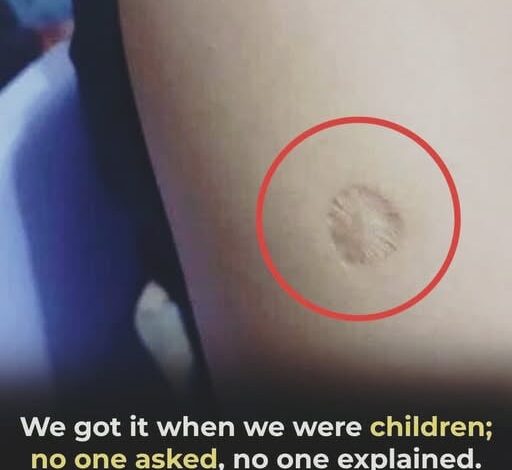
You might have noticed a small, circular scar on your upper arm and dismissed it as a simple, permanent mark from your childhood, but its origins are far more chilling than you ever imagined. This faint, indented blemish is not just a random imperfection on your skin; it is the physical remnant of a terrifying, global war against a disease that once held humanity in a state of absolute, paralyzing fear. Millions of people carry this mark today, completely oblivious to the fact that it serves as a haunting, permanent record of a time when the world stood on the edge of extinction.
The realization often hits us when we notice the exact same mark on the arm of a total stranger. It is a striking sight: the same size, the same precise placement, and the same quiet, circular history etched into the skin of two different people. When I finally asked my mother about the origin of this mark, her answer was brief, yet it carried the crushing weight of an entire generation. She looked at me and said, with a somber gravity, that it was from the smallpox vaccine. For those born before the early 1970s, this scar is a nearly universal feature, a physical relic of a period when the world lived under the looming shadow of one of the most lethal and feared diseases in human history.
Smallpox was not merely a tragic illness; it was a societal specter that haunted the corridors of every civilization on earth. It began with a crushing, unrelenting fever and bone-deep exhaustion, followed by a devastating, painful rash that erupted into disfiguring, fluid-filled lesions. It left its survivors scarred for the rest of their lives and claimed the lives of countless millions, turning homes into islands of fear and uncertainty. To contract smallpox was to face a potential death sentence, and the dread of an outbreak could freeze an entire community in its tracks, stripping away the comfort of normal life and replacing it with the desperate, frantic struggle for basic survival.
The scar itself stands as a testament to the unique, almost primitive-sounding method that was used to deliver the life-saving vaccine. Unlike the fast, relatively painless, and precise injections that we are accustomed to in modern medicine, the smallpox vaccine required a specialized, two-pronged needle known as a bifurcated needle. A medical professional would puncture the skin multiple times in a highly concentrated area, intentionally triggering a localized immune response at the site of the entry. This process would form a small bump, eventually developing into a blister, and finally a scab that, once healed, left behind that signature, indented, circular mark. It was a badge of protection, a deliberate, calculated sacrifice of a small patch of skin to ensure the long-term survival of the whole.
The existence of that scar is a quiet, profound victory for the progress of human science. In 1980, the World Health Organization officially declared smallpox to be eradicated—the first and only human disease to be completely wiped off the face of the earth through a global, coordinated, and relentless human effort. When you look at that mark today, you aren’t just looking at a blemish from your past; you are looking at the remnants of a total war that humanity actually won. It is one of the most successful public health achievements in our history, a moment when the nations of the world set aside their differences to fight a common, microscopic enemy and emerged on the other side of the fire, forever changed.
It is a poignant reminder that history is not always trapped in the pages of dusty textbooks or displayed behind the sterile glass of a museum exhibit. Sometimes, history is written directly onto our bodies. It is a testament to the stubborn resilience of our ancestors and the immense power of collective action when we decide to move as one. That small circle on your arm, or on the arm of a loved one, is a permanent record of a time when we stood together against a common threat. It proves that we are capable of overcoming even the most daunting, lethal challenges if we are persistent, brave, and committed to the survival of our species.
So, the next time you happen to catch a glimpse of that faint, round scar, look a little closer at the story it tells. It is much more than just a mark; it is a story of survival, a triumph of rigorous science, and a quiet, enduring link to a world that was radically changed by the simple, brave act of being vaccinated. We often forget how fragile our progress is, but that scar is there to remind us of the reality of life before modern medicine. It serves as a bridge to a past that was riddled with uncertainty, showing us exactly how far we have come.
In a world that is increasingly fractured by misinformation and skepticism, the smallpox scar stands as a tangible, irrefutable argument for the value of public health. It is a symbol of the progress that we have collectively achieved and a marker of the dangers we have managed to successfully leave behind us. Every time someone carries that scar, they are carrying a piece of a global victory that redefined the possibilities for human life. We are the beneficiaries of that past, the lucky ones who have never had to know the true terror of a smallpox epidemic, and we owe it to the people who came before us to respect the history that is literally etched into our skin. That small circle is not just a mark of the past; it is a silent, enduring witness to our capacity to heal, to protect, and to ultimately conquer the horrors that once threatened to tear us apart.