The Miracle at the Playground: A Seven-Year-Old Boy’s Life Hung by a Thread After a Three-Inch Nail Pierced His Brain
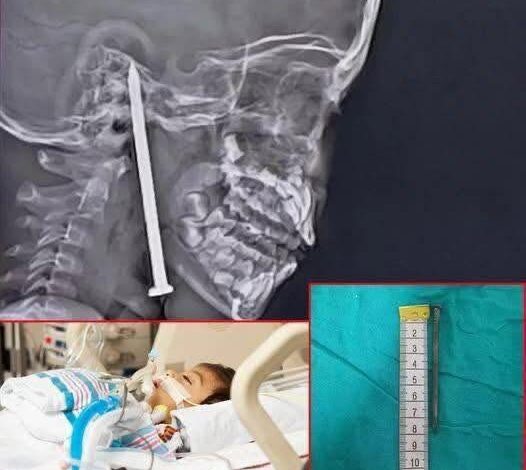
The afternoon at the playground began with laughter and sunlight, a typical scene for a seven-year-old boy simply looking for a place to play. In a heartbeat, the world turned into a waking nightmare that no parent should ever have to witness. A freak accident left the child with a three-inch nail embedded deep within his skull, a jagged metal intruder pressing against the most vital structures of his young life. Doctors were baffled by how he was still alive, let alone conscious, as the object pierced through his jaw and nestled against his brain. It was a race against death.
The incident, which occurred in Balrampur, sent shockwaves through the local community and eventually the global medical community. When the boy arrived at King George’s Medical University (KGMU), the emergency room became a scene of intense, focused desperation. Medical professionals moved with precision, immediately ordering high-resolution MRI scans to map the trajectory of the metal spike. What the images revealed was nothing short of miraculous. The nail had entered through the lower portion of the boy’s neck and jaw, traveling upward into the cranium with terrifying accuracy.
The scans showed that the metal had “barely missed” a major blood vessel—a singular, life-saving deviation of mere millimeters. Had the nail shifted even slightly during the boy’s initial fall or his transport to the hospital, it would have undoubtedly severed the vessel, leading to an immediate, catastrophic outcome. The medical team at KGMU, including specialists from both the Neurosurgery and ENT departments, realized that they were facing a surgical case that defied conventional logic. The nail was positioned in a perilously sensitive area, surrounded by vital nerve structures nestled between the oral cavity and the brainstem.
The surgery was a high-stakes, four-hour ordeal that required the steady hands of seasoned professionals. Dr. Sandip Tiwari, one of the lead surgeons, recounted the tension in the room during an interview. “It was during the investigation that we discovered the nail had gone from the neck to the brain, narrowly missing a blood vessel,” he explained. The surgical team had to operate with absolute precision, navigating a labyrinth of delicate anatomy where one wrong move could have resulted in permanent paralysis, severe developmental damage, or death. Every second spent in the operating theater was a testament to the expertise of the staff, who worked in absolute silence, cognizant of the fact that the boy’s entire future rested on their ability to extract the object without causing further trauma.
Professor Samir Misra, a senior faculty member at the Trauma Surgery Department, described the gravity of the operation, emphasizing the extreme nature of the challenge. “The procedure required utmost precision,” he noted. “One wrong move could have had devastating consequences.” The surgeons navigated the path of the nail, carefully separating tissue and bone to ensure a clean extraction. When the nail was finally removed, the entire medical team was faced with the reality of just how narrow the margin of survival had been.
Following the successful extraction, the young boy was transferred to the Pediatric Intensive Care Unit (PICU) for recovery and intensive monitoring. The initial days were a blur of neurological checks and stabilize-and-observe procedures. Medical staff, who had prepared for the worst, were increasingly optimistic as the child remained stable, his body beginning to heal from the trauma of the accident. According to reports from the Hindustan Times, doctors are now expecting the child to make a full recovery, a prognosis that feels almost impossible given the severity of the initial injury. While he remains under careful observation to detect any potential long-term neurological or developmental complications, the boy’s resilience has become a beacon of hope for his family and the staff at KGMU.
The significance of this case has not been lost on the medical establishment. KGMU’s Medical Superintendent has characterized the procedure as a major milestone in the field of pediatric emergency surgery. Because of the sheer rarity and complexity of the trauma, the hospital is currently preparing a detailed case report for publication in an international medical journal. The goal is to provide a roadmap for surgeons worldwide, ensuring that if such a rare and terrifying incident were to occur elsewhere, the medical community would have a precedent to guide their efforts.
For the family of the boy, the experience was an unimaginable test of faith and endurance. While they have chosen to keep their privacy and remain out of the media spotlight, the gratitude they expressed to the medical team was profound. Community members in Balrampur have hailed the hospital staff as heroes, acknowledging that the swift, multidisciplinary approach taken by the doctors saved a life that was effectively balanced on the edge of a knife.
This harrowing incident serves as a stark reminder of the unpredictability of childhood and the vital importance of rapid, expert intervention in trauma care. It highlights the indispensable role of skilled, multidisciplinary teams who can adapt to life-threatening, “freak” injuries that fall outside the bounds of typical surgical training. The success of this case is not merely a testament to the technology used at KGMU, but to the dedication and courage of the healthcare professionals who stood in that operating room and refused to let a tragic accident define the end of a young life.
As the boy continues to recover, his story stands as a testament to the miraculous intersection of human skill and sheer luck. It is a story of survival that will be studied in classrooms and medical conferences for years to come, reminding us all that even when faced with the most devastating of circumstances, life often finds a way to endure. The boy’s recovery is a victory for his family, for the hospital that saved him, and for the medical community that works tirelessly to ensure that even the rarest of accidents does not mean the end of a beautiful future.