The Midnight Call That Saved My Life: My Husband Was a Stranger, and He Had a Terrifying Plan for Our Son
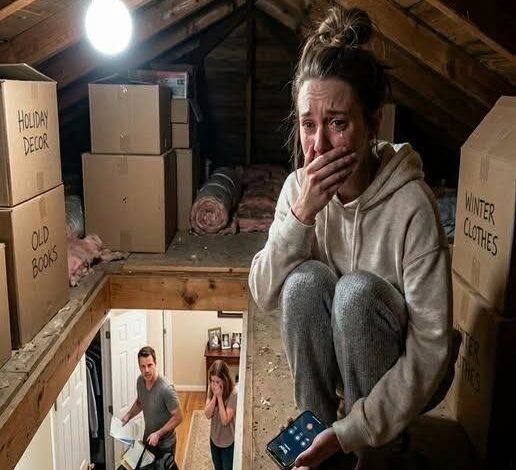
The phone vibrated against the nightstand at 12:08 a.m., a jagged intrusion into the silence of my suburban bedroom. I almost let it go to voicemail, thinking it was a wrong number, but the caller ID stopped my heart—it was my sister, Mara. Beside me, my husband, Caleb, was breathing in deep, rhythmic cycles of sleep. The house was locked, the rain was tapping a hypnotic rhythm against the glass, and our toddler, Noah, was safely away for the weekend. I swiped to answer, but before I could even say hello, Mara’s voice cut through the darkness like a blade.
“Listen to me, and listen carefully,” she whispered, her tone stripped of all warmth. “Turn off every light in that house. Silence your phone. Get into the attic and lock the door from the inside. Do not, under any circumstances, let Caleb know you are awake.”
I sat up, the sheets pooling around my waist, my pulse hammering against my ribs. “Mara? You’re scaring me. What is happening?”
“Elise, I don’t have time to explain. Just go!”
I obeyed. I moved with a phantom’s grace, killing the hallway lights, the kitchen lamps, and finally the glow of the digital clock. I reached the attic stairs, my heart soaring into my throat with every floorboard that threatened to groan under my weight. I scrambled inside, pulling the heavy door shut and sliding the bolt home just as Mara had instructed.
“Don’t hang up,” she breathed into the line. “And stay away from the window.”
Then, the connection went dead.
For sixty seconds, the silence was absolute. Then, the sound of movement drifted up from the kitchen. It wasn’t the sleep-heavy shuffle of a man waking up; it was precise, alert, and terrifyingly cold. Caleb’s voice floated up the stairwell, stripped of the tenderness I had known for years. “The lights are out,” he said.
A second voice, gravelly and unrecognizable, answered from the shadows, “Then she knows.”
I pressed my face to the narrow gap in the attic floorboards, my eyes straining against the gloom. Below, in the pale moonlight filtering through the kitchen window, I saw Caleb. He was holding my laptop, his expression devoid of the warmth he usually reserved for me. Beside him stood a stranger in a heavy black raincoat. The man handed Caleb a sleek leather case. Inside, I saw three passports. None of them bore our names. None of them looked remotely familiar.
My stomach turned to ice. “The Bureau moved faster than expected,” the stranger muttered, his eyes darting toward the ceiling.
“How close?” Caleb’s jaw was a rigid line of steel.
“Close enough that your wife’s sister may already know.”
I gripped my phone, my knuckles white, praying for a signal. Below, Caleb let out a dry, humorless laugh. “She never checks the encrypted files. Even if she did, she wouldn’t understand the layers.”
“You chose your cover well,” the stranger chuckled.
Caleb’s voice dropped, turning sharp and predatory. “That wasn’t part of the plan. But the kid… the kid complicates things.”
Noah. They were talking about our son.
“Don’t worry,” the stranger replied. “Your parents are already moving him to the border.”
I bit down on my knuckle, the taste of copper filling my mouth as I fought the urge to scream. They weren’t his parents. They were accomplices. My phone chimed, a single, piercing vibration. Mara’s text message glowed in the darkness: FBI and local police are two minutes out. Stay hidden. Noah is safe. We intercepted the car.
Safe. The word felt like a lifeline. But downstairs, the tide was turning. Caleb’s phone rang, and as he answered, I watched the color drain from his face. “What do you mean they took him?” he roared. His eyes, cold and calculating, lifted suddenly—locked directly onto the attic door.
“Elise?” he cooed, his voice shifting into a sickening, coaxing imitation of the husband I thought I knew. “Baby, come on out. Where are you?”
The attic steps groaned under his weight. I huddled into the corner, my breath shallow, my entire life collapsing. Then, the night erupted. Sirens, a discordant symphony of red and blue, shattered the silence outside. A megaphone boomed through the walls: “FBI! Open the door!”
The stranger in the raincoat vanished out the back. Caleb froze at the base of the stairs, staring up at the dark void where I was hiding. He didn’t run. He didn’t plead. He simply smiled, a terrifying, fractured expression that made my skin crawl.
“Your sister,” he whispered, his voice dripping with venom, “should have stayed out of this.”
The front door exploded inward under the force of a battering ram.
By sunrise, the man I had married was gone, led away in handcuffs. The truth came out in the sterile, fluorescent glare of an FBI conference room. His name wasn’t Caleb Morrison; he was Owen Price, a high-level operative in an international money laundering ring tied to stolen medical equipment. I hadn’t been a wife; I had been a “clean identity,” a carefully constructed cover used to authorize fraudulent accounts and move illicit funds.
Noah was returned to me at 6:40 a.m., clutching a stuffed fox Mara had bought him at a gas station. I held him until my arms ached, until he squirmed and whispered, “Mommy, too squishy.” I laughed, the sound breaking into a sob.
The recovery was a slow, agonizing process. There were lawyers, therapists, and a year of hearings that felt like walking through glass. But Mara was the anchor, coming over to make burned pancakes and reminding me every day that I was alive because I listened. Eventually, we moved to Richmond under my maiden name, Elise Harper. I chose a house without an attic, a deliberate act of claiming my space. People often ask me when I realized Caleb was dangerous. The truth is, I never did. He was a master of the role—he packed lunches, kissed my forehead, and whispered sweet nothings in the dark. But the man I loved never existed. He was a ghost in a mask. And because of one midnight phone call, my son and I lived to walk out of that shadow and into the light, where the name on my door finally belongs to me.