The Hidden Truth Behind the Three-Dot Tattoo Viral Warning That Has Everyone Panicking
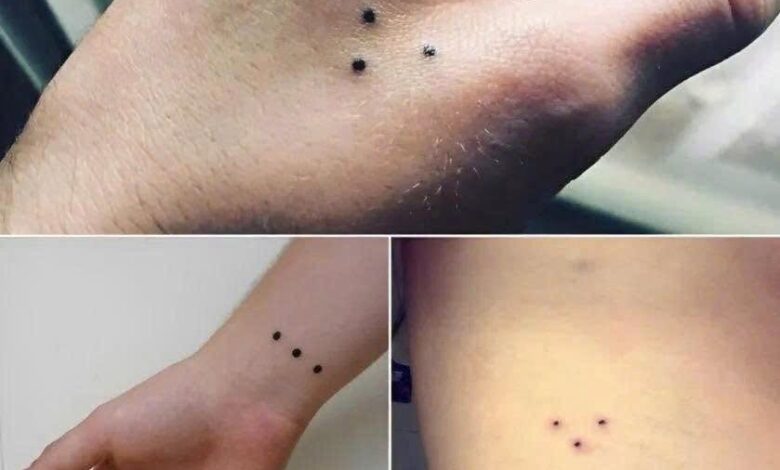
When viral internet posts started screaming that seeing a simple three-dot tattoo on a stranger’s hand meant you should run for your life, millions of people panicked. Social media exploded with terrifying claims that this tiny ink mark was a universal warning of imminent danger, lethal criminal gang initiation, and serious street violence. But as paranoia swept through online communities and caused everyday citizens to recoil in fear from harmless strangers, investigators uncovered a startling reality. The dark truth behind this widespread symbol isn’t what the sensational headlines claimed, exposing how a single viral lie almost ruined countless lives.
The internet excels at manufacturing sensational outrage, often taking tiny fragments of obscure truth and inflating them into widespread public panic. The dramatic “run as far as you can” warning regarding three-dot tattoos is a classic case study in online fear-mongering. For anyone who has ever spotted three small dots etched onto someone’s hand, wrist, or ankle, the idea that this subtle design automatically signals a violent criminal encounter is deeply anxiety-inducing. However, stripping away the clickbait headlines reveals a far more nuanced, fascinating, and overwhelmingly harmless story about human culture, artistic expression, and personal symbolism.
The three-dot tattoo, typically arranged in a subtle triangle or a straight line, is actually one of the most common, historical, and widely recognized minimalist tattoo designs in the world. Far from being a universal signifier of violence or criminal intent, its meaning is wildly diverse and depends almost entirely on the specific cultural background, geographic region, and personal story of the individual wearing it. To lump every person with three dots of ink into a single dangerous category is not only factually absurd, but it also paints innocent people with an incredibly unfair brush.
One of the most widely cited cultural interpretations of the three-dot triangle tattoo originates from Chicano and Mexican-American street culture, where it has historically represented the Spanish phrase Mi Vida Loca, translating to “My Crazy Life.” In this specific context, the mark is not inherently a threat or a call to violence against strangers. Rather, it serves as an autobiographical statement of survival, personal resilience, and navigating difficult or unpredictable life circumstances. For those who wear it within this tradition, the mark is a reflective symbol of where they have been and the hardships they have overcome, rather than a promise of future conflict.
Beyond its association with specific subcultures, the number three holds deep, universal significance across human history, making it a natural choice for minimalist body art. In numerology, sacred geometry, and various spiritual traditions, the triad represents balance, harmony, and completeness. For many individuals, three simple dots represent the Holy Trinity—the Father, Son, and Holy Spirit—making the tattoo a discreet, deeply personal expression of religious faith. For others, the three points symbolize the fundamental spiritual triad of mind, body, and spirit, serving as a daily visual reminder to stay grounded and mindful in daily life.
Additionally, the three points are frequently used to denote linear time and continuity, capturing the fluid relationship between the past, present, and future. People often choose this design during major life transitions to honor where they started, acknowledge where they are currently standing, and welcome whatever lies ahead. In a similar vein, many people choose a three-dot tattoo as an understated tribute to family and close relationships. The dots often represent three children, three siblings, a trio of lifelong friends, or lost loved ones, keeping their memory permanently close in a subtle way.
In contemporary culture, the explosion of minimalist tattoo aesthetics has driven countless people to choose small, geometric designs purely for their visual simplicity. For many younger individuals, a three-dot array on a finger or wrist carries no hidden subtext or secret societal code whatsoever. It is simply an aesthetic choice—a subtle accent piece that looks clean, modern, and understated. In an era where large, elaborate tattoo sleeves are common, minimalist dots offer a quiet, elegant form of self-expression that requires no grand explanation.
The viral claim that a three-dot tattoo is an absolute signal to panic stems from a distorted kernel of truth regarding prison and gang culture. It is true that in specific penal institutions and localized gang environments, inmates and gang members have utilized hand tattoos, including three-dot variations, to denote affiliation or time served. However, criminologists and body art historians consistently emphasize that context is everything. Seeing a hand tattoo on an individual in a very specific, high-risk environment carries an entirely different context than seeing a delicate three-dot design on a barista, a office worker, or a parent at a suburban playground.
Believing every alarming post on social media creates unnecessary division, anxiety, and prejudice in daily life. When people allow sensationalized headlines to dictate how they perceive others, a harmless tribute to three children can easily be misinterpreted as a threat. Sensational content thrives on fear because fear drives clicks, shares, and emotional engagement. Taking a moment to investigate claims before accepting them at face value protects communities from falling victim to baseless paranoia.
Tattoos are ultimately deeply personal forms of human expression. They are living canvases reflecting personal memories, artistic choices, spiritual beliefs, and individual journeys. While a three-dot tattoo can carry specialized meanings depending on who wears it, it is overwhelming evidence of a rich, diverse symbol rather than a universal reason to flee. Understanding the full picture replaces fear with empathy, reminding us that an innocent mark on someone’s skin is rarely a reason to run away.