The Heartbreaking Reason You Might See a Purple Butterfly Sticker Near a Newborn’s Bed—And Why It’s Changing Lives Forever
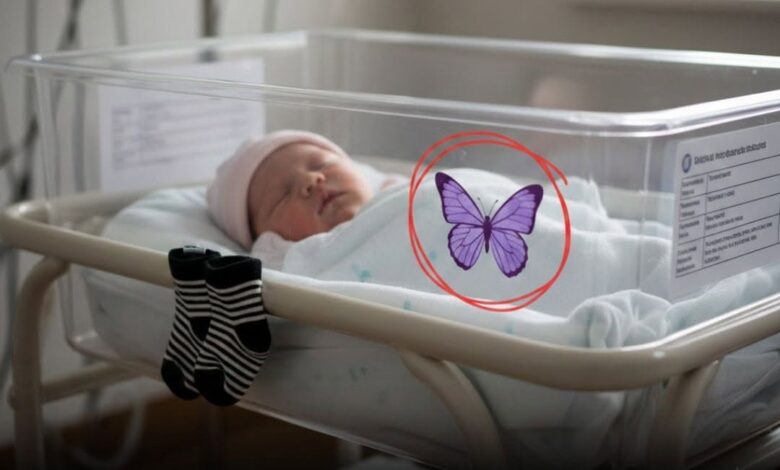
The neonatal intensive care unit is usually a place of quiet, clinical hope, filled with the soft hum of monitors and the cautious optimism of parents watching their little ones grow stronger every day. But in the midst of this sterile sanctuary, a simple, vibrant purple butterfly sticker can be the most devastating signal a parent could ever encounter. It is a symbol that stops you in your tracks, a silent, poignant message that carries a weight no words can fully capture. Behind that small, colorful image lies a story of profound grief, resilience, and a mother’s desperate mission to prevent others from enduring a unique kind of agony.
The story begins with Millie Smith and her partner, Lewis Cann, who were overjoyed when they learned they were expecting identical twin girls. But their excitement quickly curdled into terror when a routine scan revealed that one of their babies had anencephaly, a severe and fatal birth abnormality. Doctors delivered the crushing news: one of their daughters would likely not survive more than a few minutes after birth. Despite the agonizing prognosis, Millie and Lewis chose to carry their daughters to term, determined to love them for every second they had. When the twins were finally born on April 30, they named them Skye and Callie. To their shock and immense relief, Skye lived for three precious hours—a gift of time that allowed the parents to cuddle their daughter before she passed away.
While Callie, the survivor, remained in the NICU to recover from being born prematurely, Millie found herself living a double reality. She was a mother to a living daughter fighting for her life and a grieving mother whose child had just flown away. The NICU was filled with other parents, many of whom had healthy twins. In the emotional exhaustion of the ward, it was impossible for everyone to know every patient’s history. Then, the inevitable happened: a well-meaning mother of healthy twins turned to Millie and, with a cheerful smile, remarked that she was “so lucky” not to have the chaos and stress of caring for two newborns.
That single, innocent comment felt like a physical blow. Millie was shattered, unable to explain that she had once carried two babies but was now leaving the hospital with only one. She fled the room in tears, the pain of her loss compounding in the silence of her isolation. It was a moment of profound miscommunication, but it sparked a realization: there had to be a way to signal the loss of a baby without forcing a bereaved parent to relive their trauma repeatedly in front of strangers. Millie knew that she could not change her tragedy, but she could ensure that no other parent was forced to endure the same soul-crushing sting.
She approached the hospital staff with a simple, compassionate idea. She designed a small, purple butterfly sticker to be placed on the incubators of babies who had been part of a multiple birth but had lost one or more siblings. The purple color was chosen for its neutrality, suitable for both boys and girls, and the butterfly represented the babies who had “flown away” too soon. It was a subtle, respectful code for medical staff and visitors, a visual shorthand that invited sensitivity and kindness rather than thoughtless, if well-intentioned, remarks.
The initiative, eventually becoming the heart of the Skye High Foundation, spread with incredible speed. What started as a local project in one hospital quickly grew into an international movement. Today, the purple butterfly sticker is recognized in neonatal units across the globe. It serves as a gentle guardrail for grieving parents, allowing them to focus on the child they are holding without the constant fear of being blindsided by questions about the “other” twin. It reminds the world that grief is not always visible and that empathy should be our default setting when we walk through the doors of a hospital.
For Millie, this was never about seeking recognition; it was about ensuring that Skye’s short life left a lasting, healing mark on the world. Skye may have lived for only three hours, but her legacy has touched the lives of thousands of families who have had to walk the same unbearable path. It has turned a symbol of loss into a beacon of support, creating a community of understanding where bereaved parents know they are not alone.
Callie, who is now seven years old, serves as a living, joyful testament to her parents’ courage. She is full of energy, a thriving child who reminds Millie every day of the beauty that can coexist with profound sadness. The foundation continues to distribute resources, support cards, and programs designed to help families navigate the complex journey of infant loss. They advocate for better bereavement care, ensuring that parents are treated with dignity during their darkest hours.
The purple butterfly has become more than just a sticker; it is a promise. It promises that every life, no matter how brief, holds immense meaning. It promises that parents who have lost a child will be seen and treated with the compassion they deserve. It validates the existence of the babies who never came home, acknowledging that they are still a part of the family, still loved, and still remembered.
Millie Smith’s transformation of her personal nightmare into a universal tool for kindness stands as a reminder of the power of the human spirit. When we are faced with the unthinkable, we can either let the darkness consume us or we can use our pain to light the way for others. By choosing to share her story and creating the purple butterfly initiative, Millie has softened the sharp edges of grief for countless others. If you ever walk into a NICU and see that tiny, purple butterfly resting on an incubator, remember the story behind it. Recognize the love, the loss, and the enduring strength of the parents who have walked through fire and emerged with a mission to heal the world. It is a small mark with a massive impact, a testament to the fact that love, once given, never truly fades—it only changes form, taking flight like a butterfly, leaving a legacy of grace in its wake.