The Heartbreaking Inside Story Of The Legendary 80s Action Star Who Lost His Face And Mind In A Catastrophic Harley Davidson Crash
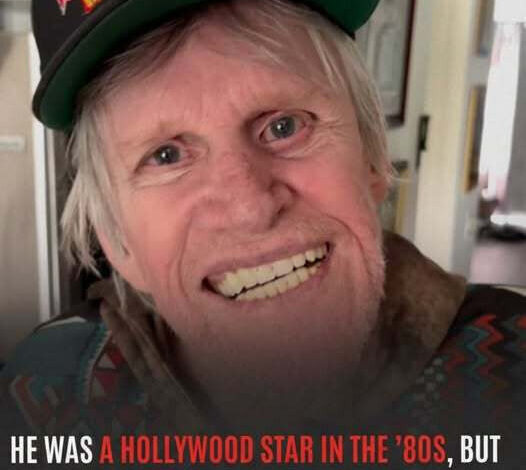
The chaotic, high stakes landscape of Hollywood cinema has produced countless tales of meteoric rises, sudden downfalls, and volatile personalities who burned brightly before fading into obscurity. Yet, even within the wild history of industry survival stories, absolutely no one has traveled a path quite as bizarre, tragic, and resilient as the legendary character actor Gary Busey. Celebrated throughout the late 1970s and 1980s for his raw acting talent, volcanic screen presence, and intense physicality, he seemed destined for a lifetime of elite cinematic prestige. However, a series of terrifying medical catastrophes, destructive substance addictions, and a brutal near-death road accident permanently altered the trajectory of his mind, body, and career. Today, looking back at the high-mileage Hollywood veteran, the public is confronted with a completely transformed man who literally had to rebuild his speech, his identity, and his entire face from scratch.
Long before he became a permanent fixture in classic, high-octane action films, the Texas native actually launched his creative journey within the music industry, showcasing his rhythmic talents as a professional drummer for the iconic singer-songwriter Leon Russell. This musical foundation ultimately paved the way for his monumental cinematic breakthrough in the 1978 masterpiece The Buddy Holly Story. Delivering a powerhouse, transformative performance where he performed all of his own vocal tracks and complex guitar work live, he perfectly captured the eccentric spirit and tragic depth of the rock and roll pioneer. This tour de force performance completely captivated global film critics, earning him a highly prestigious Academy Award nomination for Best Actor and instantly establishing him as one of the most promising, dynamic leading men of his generation.
Yet, as his professional stock rapidly climbed in Hollywood, his personal life began to splinter under the weight of an unconventional, high-velocity lifestyle and a severe, underlying addiction to cocaine. His domestic world included two volatile marriages, starting with his first wife, actress Judy Helkenberg, with whom he welcomed a son, Jake Busey, before divorcing in 1990. A subsequent marriage to actress Tiani Warden in 1996 followed a similar tumultuous path, culminating in a bitter divorce by 2001. But the absolute watershed moment that permanently divided his life into two completely distinct eras occurred on a sunny afternoon in December of 1988, when the actor made the fateful, catastrophic decision to ride his beloved Harley-Davidson motorcycle without a protective helmet.
The resulting crash was absolutely horrific. The actor was thrown violently from the bike, flying headfirst into a solid concrete curb, splitting his skull wide open, and suffering a severe subdural hematoma. Rushed to the Cedars-Sinai Medical Center in a state of advanced trauma, he underwent an emergency, hours-long neurosurgery during which his vital signs completely flatlined. The actor would later claim with absolute conviction that during this period of clinical death, he crossed over into a surreal spiritual realm populated by blinding colored lights and angelic entities, where he was presented with a cosmic choice to either enter the afterlife or return to his broken physical frame to fulfill a unique destiny. When he finally woke up in the intensive care unit, his brain had been fundamentally rewired, giving birth to his famous Buseyisms, which are spontaneous, highly abstract acronyms and philosophical insights that he felt compelled to record without conscious thought.
The road to physical recovery was an absolute nightmare for his young family, placing an immense, traumatic burden on his seventeen-year-old son, Jake. The young man, alongside his mother, had to endure the agonizing reality of watching a formerly robust Hollywood action star reduced to a vegetative state, confined to a wheelchair and staring blankly at the wall. At a tender age when most teenagers are focusing on high school, Jake had to meticulously teach his own father how to speak, how to swallow food, how to write, and how to take his very first steps all over again. Though the actor eccentric laugh became permanently altered and free as a result of the trauma, he fiercely rejected the label of brain damage, colorfully insisting that his mind had merely been disordered in a better direction by the universe.
Regrettably, the profound wake-up call of the motorcycle crash did not immediately cure the deep psychological demons of substance abuse. The actor briefly slid right back into his old, destructive patterns of chasing the ultimate high, culminating in a near-fatal drug overdose on May 3, 1990. Waking up in a hospital bed after what he described as dancing with the devil, he finally realized that his relentless cocaine usage was a literal chase to the death, prompting him to completely break free from the shackles of addiction once and for all. Yet, just as he successfully secured his sobriety, a fresh and terrifying medical crisis materialized while he was filming on location in the tropical paradise of Hawaii. Out of nowhere, the actor began suffering from spontaneous, explosive nosebleeds that erupted with the shocking intensity of a pressurized fire hose.
A subsequent examination by a medical specialist exposed a malignant polyp nestled deep within his sinus cavity, leading to a grueling seven-hour surgery in 1997 to completely excise the localized cancer. To guarantee that no microscopic cancer cells survived, the actor underwent intense, localized radiation therapy, a fateful medical decision that would ultimately ravage his physical appearance. The aggressive radiation severely distorted the underlying muscles and tissue of his face, permanently pulling one eye downward and shifting his nose upward. For a man who made his living exclusively as an elite actor on film and television, this facial disfigurement was an absolute professional death sentence. He subsequently underwent extensive reconstructive facial surgery to restore his features, describing the painful process as a deeply sacred rebirth of his true identity.
The combination of shifting physical features, erratic behavior from his past brain trauma, and a lack of traditional leading roles rapidly derailed his mainstream Hollywood career. By the turn of the century, the star who had once stood toe-to-toe with the industry’s biggest names in blockbusters like Lethal Weapon, Point Break, and Under Siege was largely locked out of major studio budgets. Instead, his legacy became overshadowed by his highly eccentric, self-parodying guest appearances on HBO’s Entourage, reality television stints, and minor cameos in low-budget B-movies like the Sharknado franchise. Compounding this professional displacement was a catastrophic financial collapse in 2012, when the aging icon filed for Chapter 7 bankruptcy protection in California, exposing over half a million dollars in debt to creditors ranging from the IRS to local medical centers, contrasted against less than fifty thousand dollars in remaining assets.
Ultimately, through decades defined by absolute chaos, physical destruction, and artistic exile, the now eighty-one-year-old survivor has miraculously managed to anchor his turbulent life into a harbor of genuine stability and domestic peace. This vital, late-life salvation is due entirely to his partnership with actress and stand-up comedian Steffanie Sampson, whom he officially wed in 2019 following a multi-decade relationship. Despite navigating a notable twenty-five-year age gap and playfully describing themselves as complete opposites, her fierce honesty and unwavering focus have single-handedly saved the actor from institutionalized care. Together in their quiet sanctuary, the couple is actively raising their teenage son, Luke Busey, a bright, platinum-blonde youth who proudly carries his father’s unmistakable signature smile, serving as a beautiful living reminder that even the most broken, unpredictable journeys can eventually conclude in a space of profound resilience, love, and ultimate survival.