STOP ATTACHING RIBBONS TO YOUR LUGGAGE: The Airport Insider Secret That Is Getting Your Bags Lost!
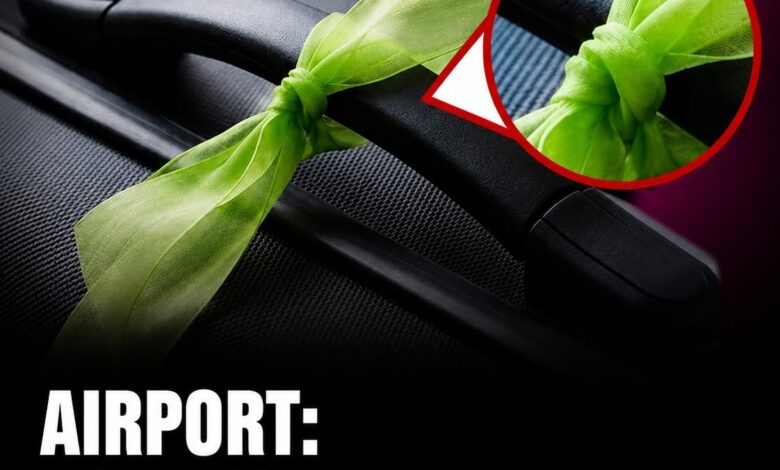
You think you are being smart by tying that bright, colorful ribbon to the handle of your suitcase, but you are actually setting yourself up for a travel disaster! Thousands of unsuspecting passengers unknowingly sabotage their own journeys every single day with this common “hack.” Airport insiders are now warning that this simple, decorative choice is the leading cause of massive luggage delays, mechanical malfunctions on automated sorting belts, and—most terrifying of all—your bag ending up in a completely different country. If you want to ensure your belongings actually arrive at your destination, you need to stop this habit immediately.
For years, we have been told that adding a personal touch to our luggage is the ultimate way to spot our bags at baggage claim. It makes sense on the surface; in a sea of identical black suitcases, a neon-colored scarf or a long, flowing ribbon seems like a beacon of identification. However, the reality of modern air travel is dictated by high-speed, invisible infrastructure that you never see. Airports rely on sophisticated, automated scanning systems to sort, route, and deliver luggage to the correct aircraft with ruthless efficiency. When you add a loose, dangling accessory to your bag, you aren’t just adding a decoration—you are creating a potential hazard for an unforgiving machine.
The primary issue lies in how these automated systems process your items. Luggage tags, typically attached to the handle, are embedded with barcodes that communicate your flight details to high-speed scanners. These scanners operate in a fraction of a second, moving your bag through a complex labyrinth of conveyor belts and diverters. When you add a large, bulky ribbon, a trailing scarf, or decorative straps, you risk obstructing these critical sensors. If a ribbon flips over your barcode or creates a shadow that obscures the data, the scanner will fail to read your information. At that point, the system is forced to treat your luggage as an “exception,” ejecting it from the automated flow to be processed manually by human staff.
This manual intervention is the primary culprit for missing luggage. When your bag is pulled off the automated belt because of an obstruction, it loses its place in the sequence. It might be left in a holding area, moved to the wrong section of the facility, or delayed until a worker has time to manually input your data—which often isn’t until after your flight has already departed. In the worst-case scenarios, the bag is delayed so long that it misses your connection, forcing you to spend the first days of your vacation without your clothes, toiletries, or essential gear.
Beyond the scanning interference, there is a physical risk that many travelers ignore: snagging. Airports process thousands of suitcases every single hour. The conveyor belts are powerful machines designed to move massive weight, and they are packed tightly with luggage. If a loose piece of fabric or a long ribbon gets caught in a gap between belts, a roller, or a piece of sorting equipment, it can cause a mechanical jam. This doesn’t just put your bag at risk of being crushed or ripped open; it can cause a system-wide halt that delays hundreds of other passengers. Airport staff frequently emphasize that luggage should be as streamlined as possible to survive the journey through the “backstage” of an airport.
To make matters worse, the “ribbon hack” has become so popular that it has lost its utility. If fifty other people on your flight have also attached a bright pink ribbon to their black suitcase, you haven’t actually made your bag unique—you have simply joined a large, confusing club of similar-looking luggage. This leads to the all-too-common occurrence at baggage claim where a passenger accidentally walks off with the wrong bag, leading to hours of stress, police reports, and airport security disputes.
So, how can you differentiate your luggage without turning it into a liability for the ground crew? The experts suggest shifting your focus from “dangly” identifiers to “integrated” ones. The most effective way to protect your belongings is to choose a suitcase that is inherently distinct. Opt for a hard-shell bag in a bold, non-standard color like deep forest green, bright orange, or a unique pattern. If you already own a standard black bag, consider using a high-quality, snug-fitting luggage cover. These covers protect your suitcase from scuffs and dirt while providing a vast, customizable canvas that makes your bag impossible to miss from fifty feet away.
Furthermore, consider using durable, personalized accessories that stay flat against the bag. High-visibility luggage straps that wrap tightly around the entire suitcase are a fantastic alternative. They serve the dual purpose of keeping your bag closed even if the zipper fails, and because they are tight against the fabric, they won’t snag on conveyor equipment. You can also use unique, high-quality vinyl stickers, but ensure they are applied firmly and do not cover the crucial barcode area on your tags.
Finally, the most overlooked step in luggage safety is the “cleaning” of your suitcase. Before you even head to the airport, take five minutes to rip off every single old airline tag, barcode sticker, and boarding pass remnant from your previous trips. These legacy tags are one of the most common reasons for routing errors; if a scanner misreads an old tag instead of your current one, your bag could be sent back to a destination you visited three years ago.
By keeping your luggage streamlined, secure, and free of unnecessary dangling accessories, you significantly increase the chances that your belongings will meet you at the carousel. Travel is stressful enough without the added panic of a lost suitcase. By respecting the technology that powers the airport, you ensure that your bags travel just as efficiently as you do. Next time you pack, skip the ribbon—and give yourself the peace of mind that your gear is going to arrive exactly where it is supposed to be.