Scaling to Chaos: The Terrifying Truth Behind the Empire State Building Stunt
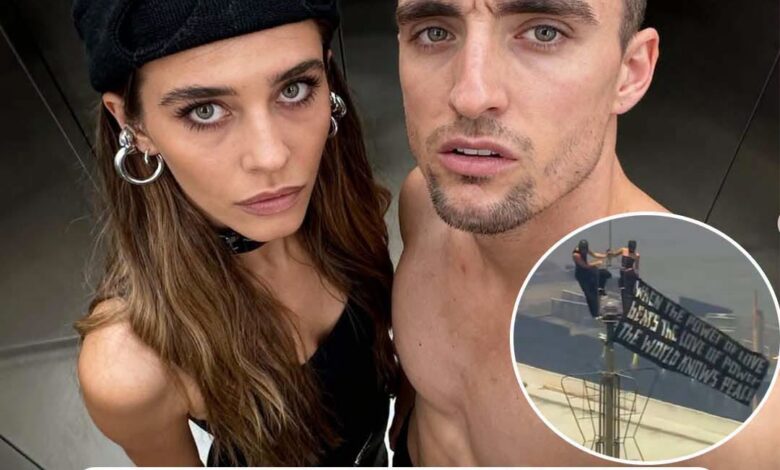
High above the bustling heart of Manhattan, two daredevils clung to the frigid steel of the Empire State Building’s antenna, their fingers dancing with death for the sake of a viral frame. While they unfurled a banner preaching the promise of peace, the chaos they triggered on the ground was anything but tranquil. In a heart-stopping moment, they turned one of the world’s most iconic landmarks into their own private stage, paralyzing the city and forcing an emergency response that put thousands at risk. Was this a genuine act of fearless love, or a calculated, life-threatening performance for the algorithm?
The ascent of Angela Nikolau and Ivan Kuznetsov was not merely a display of human endurance; it was a high-stakes collision between personal ambition and public safety. As they scaled the dizzying heights of the Empire State Building, they weren’t just risking their own lives—they were actively dismantling the experiences of thousands of tourists who had traveled from around the globe to witness a piece of history. For those visitors, the morning was supposed to be a serene climb to the top of the world. Instead, it became a locked-down nightmare, as emergency responders rushed to the scene and the landmark was shuttered, turning long-planned vacations into collateral damage for a single, meticulously curated social media clip.
The digital response was instantaneous and, predictably, polarizing. Almost as soon as the images began circulating, the initial gasps of admiration for their sheer audacity were swiftly drowned out by a deafening chorus of condemnation. Social media platforms, the very arenas where these climbers thrive, became the primary battlegrounds for public outrage. Critics did not see a breathtaking romantic gesture or a sincere plea for global harmony. Instead, they saw pure, unadulterated narcissism—a cynical attempt to manufacture a “viral moment” that looked suspiciously like a high-octane sequel to their previous Netflix documentary. The accusations were sharp: this wasn’t a proposal born of genuine affection, they argued, but a branding exercise designed to extract maximum engagement from an increasingly desensitized audience.
Yet, as we dissect their motives and condemn their recklessness, there is a deeply uncomfortable mirror that we must hold up to ourselves. We were not mere bystanders; we were participants in the very ecosystem that rewards this kind of extremity. We watched. We clicked. We commented. We shared the footage, fueling the fire of their notoriety and proving, once again, that in the modern digital age, attention is the only currency that truly matters. By consuming their content, we essentially validated their choice to place themselves—and the public—in mortal danger. If their climb was a performance, then we, the audience, were the ones demanding the encore.
This brings us to a harrowing and necessary question: where, exactly, does the line between genuine human devotion and dangerous performance art for the algorithm begin to blur? In an industry where “authenticity” is often just another filter applied to a pre-planned stunt, it is becoming increasingly difficult to distinguish the real from the staged. When a couple turns a world-famous building into a climbing gym, they are betting on our collective hunger for spectacle. They understand, perhaps better than anyone, that society has been conditioned to equate danger with importance. If you are willing to risk a fall from a thousand feet, you are automatically perceived as more interesting than the person standing safely on the observation deck.
The Empire State Building is not just a building; it is a symbol of American resilience, architecture, and history. By co-opting it for a stunt, Nikolau and Kuznetsov bypassed the established rules of society to secure a fleeting moment of global attention. This is the hallmark of the “influencer” era: the belief that the rules don’t apply if you have enough followers to back you up. But what happens when the next pair of thrill-seekers decides that the Empire State Building isn’t high enough, or that a simple proposal isn’t dramatic enough? The escalation of these stunts is a dangerous game of one-upmanship, where the bar for what is “viral” is constantly being raised, often at the expense of common sense and human life.
Beyond the danger, there is the issue of the logistical fallout. Emergency services are not a infinite resource. When a landmark is shut down due to a stunt, it diverts police, fire, and medical teams away from the actual emergencies that occur every minute in a city like New York. The ripple effect of their climb was a measurable drain on public infrastructure, a hidden cost that is rarely accounted for when we share their posts. When we look at these clips, we are rarely thinking about the paramedics who had to rush to the antenna or the security staff who had to manage the fallout. We are focused on the aesthetic, the thrill, and the high-definition adrenaline.
Perhaps it is time to reassess what we consider “admiration.” For years, we have celebrated the “extreme traveler” and the “daredevil” as paragons of bravery. But there is a fundamental difference between an athlete who pushes the limits of their discipline and an influencer who treats the physical world as a backdrop for a digital brand. One requires dedication, humility, and respect for the environment; the other requires only a camera, a lack of fear, and a total disregard for the people around them.
The climb of Nikolau and Kuznetsov will eventually fade from the front page, eclipsed by the next big stunt that promises more danger and more drama. But the questions they raised will persist. How much of our own lives are we willing to trade for the validation of strangers? At what point does the digital hunt for engagement stop being a hobby and start being a moral hazard? We are all complicit in this performance, provided we continue to offer our eyes and our clicks to those who are willing to play with death. Until we stop rewarding the stunt and start valuing the substance, we will continue to see our landmarks turned into playgrounds and our shared public spaces used as bait for the algorithm. Their climb was a spectacle, but the real story is our own obsession with watching it unfold.