I BOUGHT A CHEAP VINTAGE COUCH AT A GARAGE SALE BUT AN INTRUDER BROKE IN THREE DAYS LATER SEARCHING FOR ITS DARK SECRET
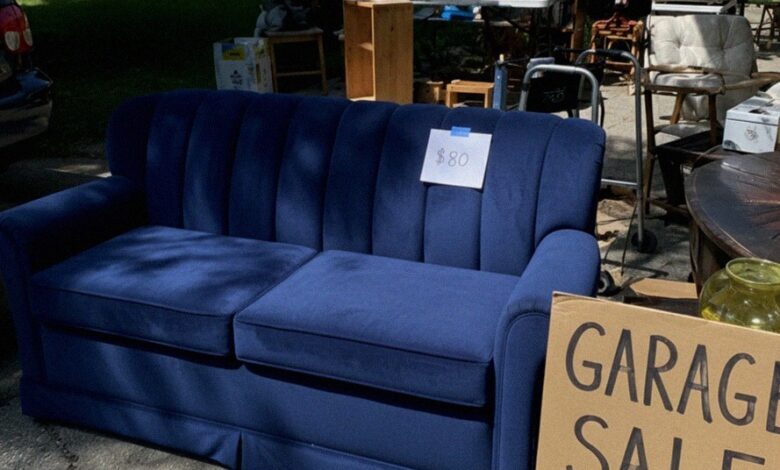
I was twenty six years old, standing in the center of an apartment that felt more like a hollow shell than a home. It was the kind of place where every sound was magnified to an uncomfortable degree—my own footsteps, the rustle of a grocery bag, even the shallow rhythm of my breathing. I owned two folding chairs, a mattress that lived permanently on the floor, and a warped coffee table I had found on the curb. That was the entirety of my living room. After exhausting my savings on the security deposit and the first month of rent, I was existing on a diet of instant noodles and sheer willpower. Furnishing the place seemed like a cruel joke, yet there was a deep, gnawing loneliness in that silence that I desperately wanted to fill.
One Saturday morning, my best friend Mia called me while I was nursing a cup of lukewarm coffee. She listened to me list my grievances for the tenth time that week before bluntly telling me to get out of the house. She insisted that rich neighborhoods often discarded perfectly functional furniture, and she dared me to go find something rather than continuing to wallow. I muttered a sarcastic agreement, joking that if I ended up murdered because I bought a haunted couch, she would be the one responsible for my eulogy. I didn’t know at the time how dangerously close I would come to that reality.
I wandered into a neighborhood a few blocks away, where the garage sales were largely disappointing piles of broken lamps and cracked ceramics. Then, I saw it. It sat beneath a faded blue tarp at the very edge of a driveway, looking like an artifact from a different era. It was a dark green velvet couch with curved wooden legs and intricate antique stitching along the arms. It was undeniably elegant, possessing a weight and presence that felt entirely out of place among the discarded clutter of a driveway. When I saw the price tag—forty dollars—I nearly stopped breathing. I approached it with a mixture of excitement and caution, running my hand over the velvet, which felt surprisingly soft despite the wear.
“That one catches people’s attention,” a voice rasped from the shadows. I jumped, startled by the presence of an old man sitting in a folding chair near the garage. He was impossibly thin, dressed in a long brown coat that seemed entirely too warm for the weather, with eyes that were sharp, observant, and deeply unsettling. He didn’t just look at me; he looked through me, as if he were scanning my soul for some hidden defect. When I asked if he was truly selling the piece for forty dollars, he gave a faint, chilling smile and remarked that valuable things are often overlooked by the greedy. His tone made my stomach tighten, yet I ignored the instinct to walk away, convinced I had simply stumbled upon a stroke of luck.
As we loaded the heavy furniture into the pickup truck I had borrowed from a neighbor, the old man, whose name was Walter, began to mutter in a series of cryptic, disjointed riddles about greed, family feuds, and the rarity of a good heart. Just as I was about to drive off, he grabbed my wrist with a surprising, painful strength. He leaned in, his breath cold against my ear, and whispered that the couch was not an ordinary object. When I demanded to know what he meant, he simply told me I would understand soon enough and let me go. I drove home in a state of profound agitation, the couch sitting in the middle of my living room like a silent, judgmental guest.
The trouble started on the second day. I noticed a small, hard lump beneath the upholstery on the left side. Thinking it was just a misaligned spring, I knelt down to inspect it and discovered that the lining on the underside had been hand-stitched with a thick, uneven black thread. It was deliberate, secretive, and entirely unnecessary for a piece of furniture of its age. That night, I couldn’t sleep. The apartment felt charged with a static electricity, and I was plagued by the irrational feeling that something was watching me from the dark corner of the room. Around 1:30 a.m., I was jolted awake by the sharp, metallic clink of someone attempting to pry open my living room window.
My heart hammered against my ribs as I saw a shadow slip through the frame. It wasn’t a grown man, but a boy, perhaps fourteen, drenched from the rain and trembling with an intensity that signaled pure terror. When he saw me, he didn’t attack; he froze, his eyes darting immediately toward the velvet couch. He didn’t look at me as a threat; he looked at the furniture as if it were a life raft. He whispered the exact phrase Walter had used at the garage sale: “Sometimes a little thing becomes great wealth.” My blood turned to ice. I managed to choke out the second half of the phrase, and the boy’s entire demeanor shifted from desperation to shock.
The boy, whose name was Ethan, explained that the couch had belonged to his late grandmother. She had hidden a box of family savings bonds, heirlooms, and a letter inside the frame before she died, only for the family to fracture in a vicious, greedy war over her estate. His grandfather, Walter, had sold the couch specifically because he despised the greed of his own children and wanted to ensure the inheritance went to someone who wasn’t driven by malice. We spent the next hour with a pair of scissors, carefully undoing the hand-stitched lining until a small, heavy metal box slid out onto the floor. Inside were the bonds, the jewelry, and a note written by his grandmother, declaring that true wealth belongs to the kind, not the greedy.
I didn’t think twice. I pushed the box toward Ethan, watching as his face crumbled with relief. He wasn’t a thief; he was a grandson trying to preserve the last piece of integrity his family had possessed. The next day, Walter knocked on my door, his eyes filled with a rare, softened warmth. He didn’t ask for the money back; he simply thanked me for proving his theory that there were still people in this world who prioritized honesty over personal gain. He insisted on leaving me with an envelope of cash as a gesture of his late wife’s gratitude.
In the following weeks, my apartment stopped feeling haunted and started feeling like a home. I still think about that night and the heavy, velvet-clad secret that had almost ruined my peace. Walter was right: a little thing had become great wealth, but it wasn’t the bonds or the jewelry that mattered. It was the realization that in a world governed by greed, an act of honesty is the most valuable currency of all. I often wonder if I had kept that box, would the memory have haunted me forever? I suspect it would have. The couch is still in my living room, but the shadows are gone, replaced by the quiet, peaceful knowledge that some things are meant to be found, and even more importantly, some things are meant to be given away.