How Many Eggs Are in This Pan?
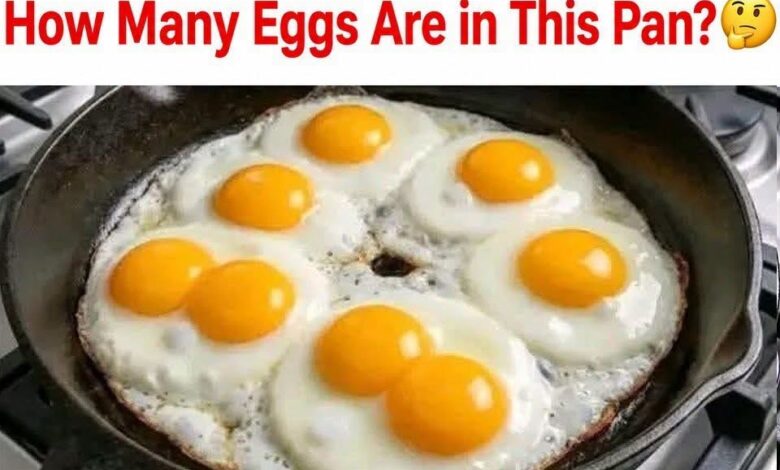
A picture of eggs frying in a pan looks like one of the simplest counting puzzles imaginable. At first glance, the task appears to be nothing more than counting the visible yolks. Yet the longer people study the image, the more answers begin to appear. Some count six eggs, others insist there are seven or eight, and each group can usually explain why its number seems reasonable.
The most direct method is to count every visible yolk as one egg. This works when the puzzle assumes each egg contains a single yolk and every egg in the pan can be seen clearly. If six yolks are visible, the immediate answer is six. Most people stop there because everyday experience teaches us that one yolk normally corresponds to one cracked egg.
That assumption is useful, but it is not guaranteed. Double-yolk eggs exist, meaning two visible yolks may have come from a single shell. If the image shows two yolks sharing one continuous egg white, a viewer might reasonably count them as one egg. The problem is that whites spread and overlap in a hot pan, so a photograph may not reveal where one egg ends and another begins.
The opposite problem is also possible. A broken yolk may be hidden beneath another egg, covered by cooked white, or positioned outside the visible frame. If the question asks how many eggs were cracked into the pan rather than how many yolks can be seen, the image may not contain enough information for a certain answer. A person can count what is visible without knowing the complete cooking history.
Wording makes a major difference. “How many eggs are in the pan?” is not necessarily identical to “How many yolks can you see?” The first question asks about whole eggs used in preparing the food, while the second asks about visible objects. Puzzle creators often rely on that gap, allowing the viewer’s mind to replace an ambiguous question with a clearer one.
Some versions add another trick by showing eggs in different states. One may be cracked, one fried, and several still inside shells nearby. If the question refers only to the pan, eggs on the counter should not be included. If it asks how many eggs appear in the picture, every visible egg-related object may count. A small change in language can produce a completely different total.
The puzzle also reveals how quickly people form assumptions. The brain prefers a clean answer and often fills missing information without announcing that it has done so. We see a yolk, label it an egg, and move on. That shortcut is efficient in ordinary life, but it can create disagreement when an image has been designed to make the boundaries uncertain.
People sometimes defend their answer more strongly after seeing alternatives. Instead of asking what assumption produced another number, they treat the puzzle as a test with only one acceptable solution. A more useful response is to state both the answer and the reasoning: “I count six visible yolks, so I would say six eggs, assuming each yolk came from a separate egg.” That explanation makes the hidden assumption clear.
This is why visual riddles spread so easily online. The arithmetic is not difficult, but the ambiguity invites conversation. Friends compare answers, zoom into the image, trace the edges of the whites, and search for a detail others missed. The puzzle becomes less about eggs and more about observation, language, and the different stories people build from the same limited evidence.
The honest answer may therefore depend on what can actually be confirmed. Viewers can count visible yolks, but they may not be able to prove the number of shells used. If the image clearly separates every egg, a specific total is reasonable. If the whites overlap or multiple yolks share one area, more than one interpretation may remain possible. The smartest solution is not always the quickest number; sometimes it is recognizing exactly where the evidence ends.