FORBIDDEN MCDONALDS ARCHES Why One Secret Arizona Location Swapped Gold For Turquoise
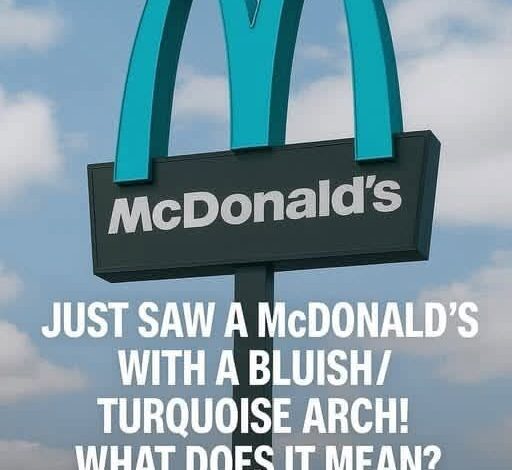
Deep within the high desert of the American Southwest, nestled among the towering crimson spires and mystical energy vortexes of Sedona, Arizona, lies a global anomaly that defies decades of corporate branding. For the average traveler, the sight of a McDonald’s is a predictable comfort—a beacon of bright yellow steel against an asphalt horizon. But in this specific corner of the world, the rules of the Golden Arches simply do not apply. Here, the world’s most recognizable letter “M” is rendered in a cool, striking shade of turquoise, making it the only location on the entire planet to abandon its signature color scheme in favor of a desert hue. This architectural curiosity is not a mistake or a faded relic; it is the result of a high-stakes standoff between a multi-billion dollar corporation and a small town determined to protect its soul.
To understand why this turquoise landmark exists, one must first understand the spirit of Sedona itself. Known worldwide for its mesmerizing red rock formations and its reputation as a spiritual mecca, Sedona is a city that guards its aesthetic beauty with a ferocity rarely seen in modern municipalities. The residents and city planners view their environment not just as real estate, but as a sacred landscape. When McDonald’s first proposed opening a franchise in the area in 1993, the community did not react with the usual excitement of a town gaining a major employer. Instead, the proposal was met with deep skepticism. The concern was not necessarily about the food or the traffic, but about the visual pollution that the garish, neon-yellow arches would bring to their pristine horizon.
In the early 1990s, Sedona had already established some of the strictest building and signage codes in the United States. These laws were designed to ensure that the man-made environment would never compete with the natural majesty of the surrounding canyons. City officials argued that the classic golden arches, while iconic in New York City or Tokyo, would clash violently with the deep ochres and burnt sienna of the Sedona rocks. They feared that the bright yellow would act as a visual scar on the desert landscape, diminishing the very beauty that drew millions of tourists to the region every year. The city council made its position clear: if McDonald’s wanted to sell burgers in Sedona, they would have to find a way to disappear into the scenery.
The ensuing negotiations were a masterclass in corporate compromise. Typically, a brand like McDonald’s is incredibly protective of its visual identity, maintaining strict standards for everything from the exact Pantone shade of its mustard to the curvature of its signage. However, the Sedona city council held its ground, insisting that the restaurant adhere to the city’s “Land Use and Development Code.” This code mandated that all commercial structures use earthy, muted tones that complemented the environment. After months of discussion, a radical idea was proposed. Instead of the disruptive yellow, the arches would be painted a soft, Southwestern turquoise. This color was chosen because it mirrored the clear Arizona sky and traditional Native American jewelry, offering a respectful nod to the local culture while significantly reducing the visual impact of the sign.
When the restaurant finally opened its doors with the turquoise arches, the reaction was immediate and unexpected. What was intended as a way to hide the brand actually turned into one of its most powerful marketing tools. While the arches were designed to be “muted,” their sheer uniqueness made them a magnet for curiosity. Almost overnight, the Sedona McDonald’s transitioned from a local fast-food joint to a legitimate tourist attraction. Travelers who had spent the day hiking through the Devil’s Bridge or exploring the Chapel of the Holy Cross began adding a stop at the “Turquoise McDonald’s” to their itineraries. It became a badge of honor for road-trippers to snap a photo in front of the one-of-a-kind sign, proving they had visited the most unconventional franchise in the world.
Decades later, the turquoise arches have taken on a life of their own. In the age of social media, the location has become an “Instagrammable” destination, featured in thousands of travel vlogs and photography blogs. The restaurant has inadvertently created a new type of brand loyalty—one based on the novelty of being different. Ironically, by agreeing to blend in, this McDonald’s has managed to stand out more than any other location in North America. It serves as a living testament to the idea that a global corporation can coexist with local values without losing its essence. The Sedona location hasn’t lost its identity as a McDonald’s; it has simply enhanced it by adopting the personality of its host city.
This architectural compromise offers a profound lesson in the power of adaptation. In a world where corporate footprints often steamroll over local traditions and aesthetics, the turquoise arches represent a rare victory for community-led design. It proves that even the most rigid global entities are capable of flexibility when faced with a community that knows its worth. The Sedona McDonald’s demonstrates that respecting the “spirit of place” is not just good for the environment—it is good for business. By refusing to be another cookie-cutter building, this franchise secured a permanent spot in the hearts of locals and the cameras of tourists.
Beyond the aesthetics, the turquoise arches have become a symbol of Sedona’s commitment to self-preservation. In an era where many cities are beginning to look identical, Sedona’s insistence on its unique color palette has helped it maintain its status as a premier global destination. The arches remind us that the visual harmony of our world is worth fighting for. They prove that we do not have to accept a world of uniform concrete and neon; we can demand that progress respects the landscape it inhabits. The cool blue “M” sitting against the backdrop of the fiery red rocks is a sight that remains etched in the memory of everyone who sees it, providing a rare moment of whimsy in the often-monotonous world of commercial architecture.
Today, the Sedona McDonald’s continues to thrive, serving thousands of visitors who come for the novelty and stay for the familiar menu. It remains the only place on Earth where you can experience this specific blend of corporate Americana and Southwestern desert vibes. The turquoise arches are more than just a sign; they are a bridge between two worlds. They represent a successful negotiation between the demands of modern commerce and the ancient beauty of the natural world. As the sun sets over the red rocks, casting long shadows across the desert floor, the turquoise arches glow with a soft, respectful light—a reminder that sometimes, the best way to be seen is to simply try to fit in. For those who make the pilgrimage to this desert oasis, the turquoise “M” is a symbol of a town that refused to change for a giant, and in doing so, created something far more memorable than gold.