Dr Pimple Popper Star Reveals The Terrifying Stroke That Almost Ended Her Life
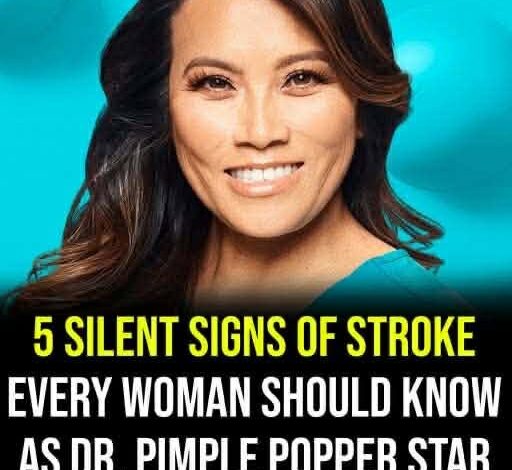
The world knows Dr. Sandra Lee as the cool, collected expert who calmly tackles the most gruesome dermatological nightmares on television, but behind the scenes, she was hiding a secret that could have cost her everything. In a chilling moment of pure vulnerability, the beloved star of Dr. Pimple Popper has come forward to reveal that she suffered a major ischemic stroke while filming her hit series. This is not just a story about a medical crisis; it is a harrowing wake-up call for every woman who dismisses their own health warning signs as mere stress or the inevitable fatigue of a busy life.
The ordeal began in November 2025 during a routine day at her dermatology clinic in Upland, California. While attending to patients, Dr. Lee felt a strange, sudden surge of heat—what she immediately identified as a classic hot flash. Given her age and the natural progression of menopause, she did exactly what millions of other women do every single day: she brushed it off. She convinced herself that her sweating and her off-balance feeling were just a mundane side effect of her biology. That single, split-second decision to ignore her body’s frantic signal almost led to the permanent silencing of a brilliant medical mind.
Once the cameras stopped rolling and she returned to the relative privacy of her parents’ home, the symptoms escalated from annoying to catastrophic. The vague discomfort transformed into a terrifying physical instability. She began to experience sharp, shooting pains in her leg, and as the evening wore on, she found that navigating the simple task of walking down a flight of stairs had become a monumental, near-impossible challenge. By the following morning, the reality was impossible to deny. She attempted to hold her hand out, only to watch it collapse in a slow, frightening surrender to weakness. Her speech, usually her most professional tool, became slurred and difficult to articulate.
Faced with the undeniable, she finally confronted the reality: she was having a stroke. Her father, who possessed his own decades of dermatological expertise, didn’t hesitate for a moment, urging her to get to the emergency room immediately. An MRI confirmed the terrifying diagnosis—an ischemic stroke, a life-threatening event where blood flow to a portion of the brain is obstructed, causing brain cells to die due to a lack of oxygen and vital nutrients. For a physician who had dedicated her life to diagnosing others, the irony of being the patient was a psychic shock that she struggled to process even as the medical team rushed to save her.
The recovery was a grueling, uphill battle that forced her to step away from the fame, the cameras, and the public persona that had defined her career for years. She had to undergo intensive physical therapy to rebuild her strength and re-learn the coordination she had taken for granted. Nearly a year and a half after the event, the impact remains a visible, daily reality. She admits that she is still deeply self-conscious about her speech, noting that the way she articulates words has changed permanently. The embarrassment of her lingering symptoms is a heavy emotional burden for someone who spent her professional life speaking to millions of viewers on camera.
Looking back with the clarity of hindsight, Dr. Lee recognizes the environmental and personal factors that paved the way for her crisis. She had allowed her blood pressure and cholesterol levels to remain dangerously unmonitored while drowning in the immense, unrelenting stress of managing a high-profile practice and the demanding production schedule of a hit television show. She now speaks about the stroke as a painful but vital blessing in disguise—a brutal reminder that we cannot treat our bodies like machines that are guaranteed to run forever. It is a cautionary tale that underscores the reality that health is not a passive state, but an active commitment we must maintain.
The American Heart Association reports that stroke remains one of the most lethal and debilitating conditions in the United States, and the statistics regarding women are particularly alarming. Women account for roughly 60% of all stroke-related deaths, a disparity driven largely by the fact that women frequently suffer from “atypical” symptoms that defy the standard, easily recognizable medical textbook examples. While we are all taught the classic F.A.S.T. acronym—Face drooping, Arm weakness, Speech difficulty, Time to call 911—these symptoms do not always manifest in the dramatic, clear-cut ways we expect. For women, the onset can be far more deceptive.
Medical professionals are now working to educate the public on the “vague” symptoms that often precede a major neurological event. Instead of the stereotypical one-sided paralysis, women frequently report sudden, overwhelming fatigue, intense confusion, general weakness, or bouts of dizziness that are easily mistaken for the flu or professional burnout. Because these symptoms appear mild or manageable, the impulse is almost always to “wait it out” or take a nap. In the world of stroke care, this delay is the ultimate enemy. Time is not just a concept—it is literal brain matter, and even a minor lapse in seeking care can be the difference between a full recovery and permanent neurological disability.
Every woman should have these five specific signs on her immediate radar: sudden, unexplained, and extreme fatigue that feels like being totally physically drained; sudden weakness or numbness, particularly if it is one-sided; sudden confusion or a jarring difficulty in forming thoughts and speaking; unusual, sharp pain that does not resolve; and a sudden, disorienting loss of balance or coordination. These are not signs of being tired; they are not signs of having a busy week; they are signs that your brain is under siege.
Dr. Sandra Lee’s willingness to be so raw about her recovery is a gift to her audience. She has used her platform not to glamorize her career, but to urge her viewers to listen to the whispers of their own bodies before they turn into the screams of a crisis. We all have mothers, sisters, and friends who operate under the dangerous assumption that they are invincible, or that their health can be put on hold until the schedule clears up. We must reject that mentality. If you feel like something is profoundly wrong, do not wait for a second opinion and do not seek the approval of others to be concerned. Trust your instincts, seek professional medical help immediately, and remember that when it comes to your own health, overreacting is infinitely better than underestimating the danger. Your life is not a script, and your health is not something you can edit after the fact.