Barack Obamas brutal reply to Trump after racist video depicting him and Michelle as apes!
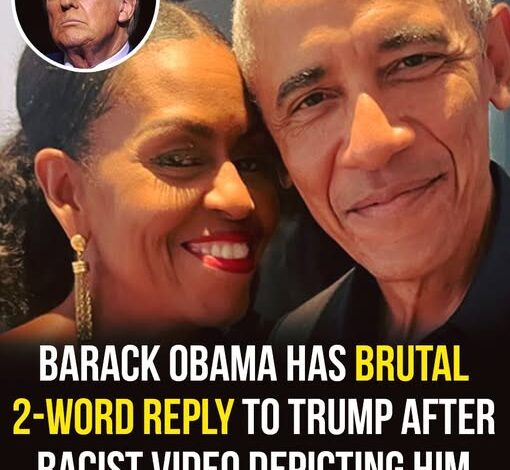
Former President Barack Obama has publicly responded after President Donald Trump shared — and later deleted — a controversial video that depicted Obama and former First Lady Michelle Obama as apes, a portrayal widely condemned as racist. The incident quickly ignited backlash across political and media circles, intensifying tensions between the two longtime political rivals and sparking renewed debate about the tone of modern political discourse.
The video, originally posted on Trump’s social media platform earlier this month, featured animated apes dancing to the song The Lion Sleeps Tonight, with the faces of Barack and Michelle Obama digitally superimposed. Critics from both parties described the imagery as offensive and inflammatory. Although the post was later removed, Trump did not issue a formal apology, and the controversy continued to dominate headlines.
In an interview released on February 14 with political commentator Brian Tyler Cohen, Obama addressed the episode directly. He described the video as “deeply troubling,” arguing that it reflects what he sees as a broader erosion of civility in American politics. Without naming Trump repeatedly, Obama framed the issue as part of a larger pattern rather than an isolated incident.
“It’s important to recognize that the majority of the American people find this behavior deeply troubling,” Obama said during the interview. He suggested that while such posts may capture attention online, they do not reflect the values he encounters when speaking with everyday Americans across the country.
“It is true that it gets attention, that it’s a distraction,” he continued. “But as I’m traveling around the country, you meet people — and they still believe in decency, courtesy, kindness. And there’s this sort of clown show that’s happening in social media and on television.”
Obama’s remarks centered not only on the video itself but also on what he characterized as a broader decline in decorum associated with the presidency. He expressed concern that conduct once considered unacceptable in public office has become normalized in certain political spaces.
“There doesn’t seem to be any shame about this among people who used to feel like you had to have some sort of decorum and a sense of propriety and respect for the office,” Obama said. “That’s been lost.”
The reaction to the original post was swift. Lawmakers, activists, and public figures condemned the imagery as racist. Republican Senator Tim Scott described it as “the most racist thing I’ve seen out of this White House,” reflecting how the controversy crossed party lines. Civil rights advocates also spoke out, highlighting the long and painful history of racist caricatures comparing Black individuals to apes.
White House Press Secretary Karoline Leavitt responded to criticism by downplaying the outrage, telling TMZ that media outlets should “stop the fake outrage and report on something today that actually matters to the American public.” The administration’s messaging suggested that critics were overreacting and framing the video as more significant than intended.
President Trump, 79, later addressed the situation, stating that the video had been posted by a staff member and that he had not fully reviewed it beforehand. “No, I didn’t make a mistake,” he said when asked whether he regretted the post. He characterized the clip as parody tied to broader political messaging, though he did not elaborate further.
The episode underscores the ongoing friction between Trump and Obama, whose political rivalry has remained a defining feature of American politics for over a decade. Trump launched his political career in part by promoting the “birther” conspiracy theory questioning Obama’s citizenship — a claim widely debunked but politically influential at the time. Their exchanges since then have often been sharp, though rarely as overtly controversial as this latest incident.
During the same interview, Obama also broadened his remarks to address policy concerns, particularly regarding immigration enforcement under the Trump administration. He referenced federal operations in the Minneapolis–Saint Paul area, describing certain reported enforcement tactics as “deeply concerning” and “dangerous.”
“It is important for us to recognize the unprecedented nature of what ICE was doing in Minneapolis, St. Paul,” Obama said, citing allegations of aggressive enforcement methods. He framed the issue as part of a larger debate over American values and constitutional norms.
Referring to recent high-profile incidents — including the killing of Alex Pretti in Minneapolis and the death of Renee Good, a 37-year-old woman reportedly killed by an immigration agent — Obama described them as “a wake-up call to every American, regardless of party.” He argued that explanations provided by the administration in those cases lacked sufficient transparency and rigorous investigation.
Obama’s broader message centered on accountability and voter engagement. He emphasized that, in his view, the American public ultimately holds the power to respond to actions they deem unacceptable.
“The American people will ultimately decide how they feel about these actions when they head to the ballot box,” he said. “People still believe in decency, courtesy, kindness. And we’re going to fight back and we’re gonna push back with the truth.”
The controversy highlights the increasingly polarized nature of American political discourse, particularly in the digital age. Social media platforms have become central battlegrounds where political messaging spreads instantly, often amplifying conflict and controversy. The rapid cycle of posting, backlash, deletion, and response has become a familiar pattern in modern politics.
For some observers, the incident reflects deeper challenges facing the country — questions about racial sensitivity, presidential conduct, and the role of online platforms in shaping political narratives. For others, it is viewed as another episode in a long-running rivalry between two high-profile figures whose political philosophies sharply diverge.
Regardless of perspective, the episode has reignited discussion about standards of leadership and the tone set by those in positions of authority. It has also reinforced how quickly digital content can escalate into national controversy, particularly when it touches on race and history.
As the political climate remains charged heading into another election cycle, exchanges between prominent figures are likely to continue drawing intense scrutiny. Obama’s response, focused on values and voter agency, suggests he intends to frame the debate in moral and civic terms rather than personal retaliation.
The incident may fade from headlines in time, but the questions it raises about decorum, accountability, and the boundaries of political expression are likely to persist. In an era defined by rapid communication and deep division, the line between provocation and leadership continues to be tested — and judged — in the public square.