The Graduation Dress Secret: A Stolen Legacy and the Fight for My Sister’s Life
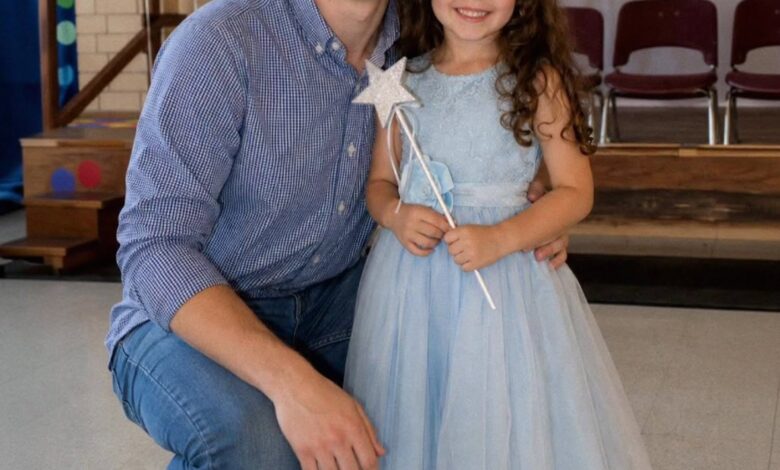
I spent the night sewing a dress, believing it was just for a kindergarten graduation. I was wrong. As the final stitches were tied, a stranger appeared, clutching a sealed envelope from my parents who had been gone for years. The attorney’s words shattered my fragile world, revealing a dark, hidden truth that made me realize my little sister wasn’t just my family—she was a target. With a black sedan stalking our every move and a ruthless relative closing in to claim a secret fortune, I was forced into a desperate battle to save the only person who mattered.
The refrigerator hummed in the pre-dawn stillness, a low, constant vibration that mirrored the anxiety vibrating in my chest. A half-finished pink dress lay draped over the kitchen chair, its hem held in place by a jagged line of pins. I counted the crumpled bills on the counter for the third time, praying that the sum would magically increase. It didn’t. Twenty-three dollars. That was our lifeblood for the next two weeks—rent, electricity, her bus pass, and the textbook I desperately needed for class. I looked out the kitchen window, watching the empty street. For a week, I had felt eyes on us; a black sedan had been lingering near our apartment and the café where I worked. I told myself it was just sleep deprivation, but my gut knew better.
Small, hesitant footsteps broke the silence. Mia appeared in her oversized pajamas, her hair a chaotic halo of tangles, clutching her worn-out rabbit by one ear. “Noah,” she whispered, her voice sleepy and hopeful, “is my dress almost done?”
“Almost, peanut,” I said, forcing a bright tone as I gestured for her to sit. “Come here, let me tackle that bird’s nest.” She climbed onto the chair, a gesture of absolute trust, while I worked a brush through her hair with the slow, patient rhythm our mother had taught me years ago. “Will I look like a real princess?” she asked, her eyes widening. I poured our last bowl of cereal and watched her eat, doing the silent math of survival in my head. “You already are a princess, Mia. The dress is just so everyone else can see what I already know.”
She giggled, kicking her heels against the chair. “Rosa said the sleeve looks professional,” she announced between bites. “She said you’re learning fast for a boy.” I laughed softly. Our elderly neighbor, Rosa, had been a saint, climbing the stairs with her cane to scold me when my stitches were crooked and guide my clumsy fingers across the fabric. Without her, Mia wouldn’t have had anything to wear at all.
After breakfast, I held the dress up. It wasn’t perfect—the seams were a bit wobbly—but the fabric caught the morning light, shimmering with promise. “Try it on,” I said. “I need to check the length.” She spun into the kitchen, the pink fabric flaring around her knees like a dream made real. “You look beautiful,” I choked out, kneeling to fix a ribbon. I promised her everything would be okay, but as I glanced through the window, my heart plummeted. The black sedan was back, parked directly across the street. A man sat behind the wheel, staring upward, perfectly still.
The graduation ceremony was a blur of crayons, floor wax, and proud parents with expensive cameras. Mia stood on stage, radiant in the dress I had poured my heart into. When it ended, she crashed into my legs, beaming. “Did you see me bow?” she squeaked. Before I could answer, a man in a charcoal suit approached us. He didn’t look like a parent; he looked like a predator waiting for a trap to snap shut.
“Noah?” he asked. “I handled papers for your parents.”
I froze. My parents had never mentioned an attorney. The man explained that they had been private, leaving strict instructions that he was only to intervene if I didn’t respond to his mailed notices—notices I had foolishly ignored as junk mail. He handed me a thick envelope, his eyes grave. “This is from your mother. She wanted it in your hands today, not a moment sooner. The trust becomes active after this ceremony, and she feared the wrong person would notice if we acted too early.”
I tore it open, my mother’s familiar handwriting staring back at me. It revealed the secret my parents had died protecting: a trust fund for Mia, controlled by whoever held legal guardianship. Diane, my mother’s estranged sister, had been searching for us for years, not out of love, but out of greed. She wanted the money, and she didn’t care what she had to destroy to get it.
The next few days were a blur of legal papers and mounting terror. Diane appeared at my café, wearing a mask of sweetness, begging for just one visit with Mia. Her words were honeyed, but her eyes were cold. I refused, but the legal battle was already underway. She filed first, painting me as an unstable, broke guardian to bias the court. I spent every waking hour gathering evidence—pay stubs, school reports, medicine charts, and photos of every meal I had ever packed. Rosa helped me practice my testimony, reminding me that love is only evidence if it is organized.
The courtroom was freezing. Diane looked polished and wealthy, a sharp contrast to my borrowed suit. Her lawyer attacked my lifestyle, my income, and my youth. When it was my turn to speak, I didn’t rely on polished rhetoric. I told the judge about the dress, about the late nights, and about the promises I made to the sister who was my whole world. I submitted proof of Diane’s surveillance, showing she was a predator, not a relative.
When the judge finally ruled that permanent guardianship would remain with me, the relief was so profound I nearly collapsed. Outside, the sun felt warmer than it had in years. As Mia ran toward me, swinging my hand, I knew the road ahead would be hard. We were still poor, and the world was still difficult, but the shadows had retreated. That night, as I tucked her in, I kissed her forehead and looked at the pink dress hanging on the closet door. The future was finally something I could hold.