The $80,000 Battle to Erase a Birthmark: Why One Mother Risked Everything for Her Daughter’s Future
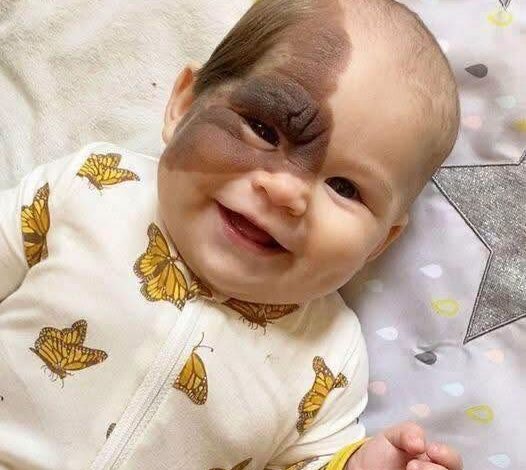
The stares from strangers were like physical blows, each one landing squarely on the heart of a mother who refused to let the world define her child. Vienna Brookshaw was born in April 2021 with a striking, undeniable birthmark centered right between her eyebrows. To the casual observer, it was just a mark of pigment, but to her mother, Celine Casey, it was a ticking clock of emotional trauma. Fearing the relentless cruelty of playground bullies and the soul-crushing weight of future insecurities, Celine embarked on a desperate, high-stakes crusade to erase it—a journey that would demand thousands of dollars, relentless public pleading, and three grueling surgeries.
The medical condition, known as congenital melanocytic nevus (CMN), is a rare occurrence where benign pigment cells cluster together at birth. As a child grows, these cells grow too, often expanding in size and depth. While doctors initially assured Celine that the mark was physically harmless, her intuition as a mother told a different story. She watched the way people lingered on Vienna’s face in public, their gazes shifting from polite curiosity to awkward, lingering stares. She saw her daughter grow uneasy in the presence of strangers, and she began to fear the inevitable day when Vienna would look into a mirror and feel fundamentally different from the other children.
Celine refused to wait for the damage to take root. She was determined to spare Vienna from the internal battle of “not being good enough.” When she approached the National Health Service (NHS) for assistance, however, she hit a wall of clinical indifference. The procedure, they argued, was strictly cosmetic and not medically essential, meaning it was not covered by state funding. To the medical establishment, it was an aesthetic choice; to Celine, it was a vital act of protective parenting.
Undeterred by the rejection, Celine turned to the internet, launching an ambitious crowdfunding campaign. She laid bare her anxieties and her hopes, and the response was nothing short of staggering. In the span of just twenty-four hours, the generosity of strangers surged, raising an incredible $52,000. It was a testament to the power of a mother’s story, but the road ahead was far more expensive than she had anticipated. The global economic ripple effects of the pandemic had caused hospital costs to skyrocket, leaving the family with a daunting $27,000 shortfall.
Instead of folding under the pressure, Celine doubled down. She returned to GoFundMe, sharing regular updates about Vienna and articulating her philosophy on beauty and self-worth. “Everyone has insecurities about their body,” Celine explained to her followers. “Even though the doctors told us it wouldn’t currently damage Vienna’s mental health, we saw it differently. Little ones notice these things because they are perceptive, especially when they start school.” She knew that by the time Vienna turned three, the social landscape would become far more unforgiving. She wanted her daughter to enter that world without the burden of feeling like an outsider.
The journey to the operating room was not for the faint of heart. Over the following months, Vienna underwent a series of three specialized surgeries. Each procedure was a nerve-wracking ordeal, not only because of the inherent risks of anesthesia and surgery for such a young child but because of the sheer exhaustion of managing the post-operative recovery. Celine documented every step of the way, transforming her personal struggle into a public narrative of resilience. She was no longer just a mother looking for a cure; she was a champion for the idea that parents should have the agency to alleviate their children’s future suffering.
Following the surgeries, the family made frequent trips to London, seeking the expertise of top-tier surgeons to ensure the healing process was progressing as perfectly as possible. They were vigilant, constantly monitoring the site for any signs of infection or scarring, and seeking reassurance that the worst was behind them. The sight of her little girl, who had spent so much of her short life in a clinical setting, finally emerging on the other side with only a faint, fading line on her forehead, was the moment Celine had been fighting for.
Today, Vienna is a vibrant, healthy toddler. The birthmark that once dominated the space between her eyebrows is a memory of the past, replaced by a small, nearly invisible scar that tells a story of a mother’s absolute, unyielding devotion. Celine continues to share updates on her daughter’s development, often marveling at the extraordinary beauty of the little girl who was, in her eyes, perfect from the very start—even if she chose to pave a smoother road for her to walk on.
The story of Vienna Brookshaw serves as a profound, if controversial, reflection on the lengths to which modern parents will go to curate their children’s experiences. In a world where our faces are our primary interface with society, Celine Casey chose to take control of that interface before her daughter was old enough to know she needed to. Whether or not one agrees with the necessity of the procedure, it is impossible to deny the raw, visceral force of Celine’s commitment. She looked into the future, saw the potential for pain, and spent every ounce of her energy to shield her child from it. Vienna now stands on the precipice of a future unburdened by the mark of her past, ready to express her own identity, shaped by a mother who believed that no price was too high for her daughter’s peace of mind.