The 45 Bags of Sugar: How My Neighbor’s Heartbreaking Secret Destroyed My Soul
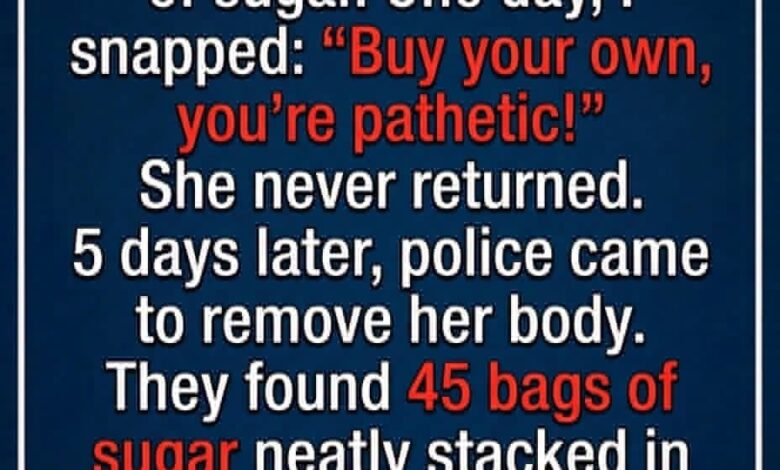
I walked into her house expecting nothing more than a routine task, but what I discovered in the kitchen shattered my reality forever. Stacked against the walls, row after pristine row, were forty-five bags of sugar. They stood in the silence like quiet, white tombstones of a life that had faded away unnoticed. I had lived next door to her for three years, and yet, I knew nothing of the woman who died behind those walls. As I stared at the hoard, an officer handed me a crumpled, ink-stained note. The confession written in her shaky hand would haunt my dreams for eternity.
The air in her home was thick, heavy with the suffocating silence of an ending that had occurred without a single witness. The police officers moved around the kitchen with the brisk, clinical detachment of those who see death every day, but I was frozen. My eyes remained locked on that absurd, terrifying tower of sugar bags. Why so much? Why sugar? When I finally opened the note, my chest tightened until I could barely draw a breath. I hadn’t even finished the first line before the guilt began to crawl up my spine like ice, numbing my senses and forcing me to confront the monstrous nature of my own indifference.
In her fragile, fading handwriting, she hadn’t written a plea for help or a list of demands. She had written a thank-you letter addressed to me. She thanked me for the times I had begrudgingly answered the door when she knocked. She thanked me for the fleeting, impatient conversations we had on the porch, where I was always looking at my watch, eager to return to my own life. She thanked me for making her feel “less alone,” even in those brief moments where my impatience was palpable. To her, my hurried answers hadn’t been an inconvenience; they had been a lifeline.
The note peeled back the layers of a life I had never bothered to investigate. She wrote about Harold, her late husband, and the mornings they spent together, their kitchen filled with the scent of flour and the warmth of a shared existence. She described their old tradition of baking cookies to send to the neighbors, a simple, sweet gesture meant to bridge the gap between their home and the rest of the world. She spoke of a daughter who had stopped calling years ago, a phone that sat silent on the side table, waiting for a ring that never came. The sugar, I realized with a sudden, sickening clarity, was a leftover remnant of those baking days—a desperate, subconscious attempt to cling to the memory of Harold and the life they had shared, even as the world around her grew increasingly cold and quiet.
My doorway, the place where I had stood and checked my phone while she desperately tried to engage, had become her final, fragile thread to the world of the living. She wasn’t just my neighbor; she was a drowning woman reaching out for a hand, and I had consistently offered her only the tips of my fingers before turning away. I had been so preoccupied with the noise of my own schedule, the stress of my own career, and the bubble of my own importance that I had failed to notice the human being wasting away ten feet from my own front door.
I thought about the forty-five bags of sugar. Each one represented a day, a week, or perhaps a month of waiting. She had bought them, stored them, and stared at them, perhaps hoping that one day she would have a reason to bake again. Perhaps she hoped that if she had enough ingredients, someone—anyone—would come over, sit at her table, and share a cookie. But no one came. She was invisible to me, a shadow in the peripheral vision of my life. The sweetness she was trying to preserve had turned into a bitter monument to her isolation.
Standing there in the middle of her kitchen, surrounded by the physical evidence of her slow decay, I finally understood the true nature of indifference. It isn’t just an absence of action; it is a violent act of erasure. By ignoring her, by treating her as a nuisance rather than a person, I had helped to silence her. I had treated her humanity as if it were something optional, something I could afford to ignore because it didn’t fit into my narrative of a successful, busy life.
The weight of her absence began to press down on me, heavier than any physical burden. The police continued their work, their voices muted as if they were speaking underwater, while I stood in the center of a life I had failed to acknowledge. Every bag of sugar felt like an indictment. I had been given the chance to be a neighbor, a friend, a witness to her existence, and I had chosen the path of least resistance. I had chosen to be busy. I had chosen to be “impatient.”
When I finally stepped out of her house and into the harsh, bright sunlight of the afternoon, the world seemed fundamentally altered. People were walking their dogs, laughing on their phones, and rushing to their cars, completely oblivious to the tragedy that had occurred just feet away. I realized then that we are all walking through a landscape filled with hidden stories, unseen heartaches, and neighbors who are starving for nothing more than a moment of genuine acknowledgement.
I looked back at her front door one last time. It was locked, the shades drawn, the life inside permanently extinguished. I couldn’t bring her back. I couldn’t share a cookie, listen to a story about Harold, or make up for the thousands of minutes I had squandered on apathy. But as I walked back to my own home, the silence that had once seemed like a peaceful buffer now sounded like a deafening roar. I had learned the most painful lesson of my life: the difference between a life of meaning and a life of hollow efficiency is often found in the smallest, most ignored places. I had spent my time protecting my convenience, only to realize that I had traded away my humanity in the process. The sweetness she had tried to give to the world had been left to crystallize in the dark, and I was left to carry the bitter, crushing weight of knowing I could have changed the ending, but I simply couldn’t be bothered.