THE WEDDING PRICE TAG: Is Your Invitation Actually a Secret Bill? The Cash-Gift Ultimatum That’s Tearing Families Apart
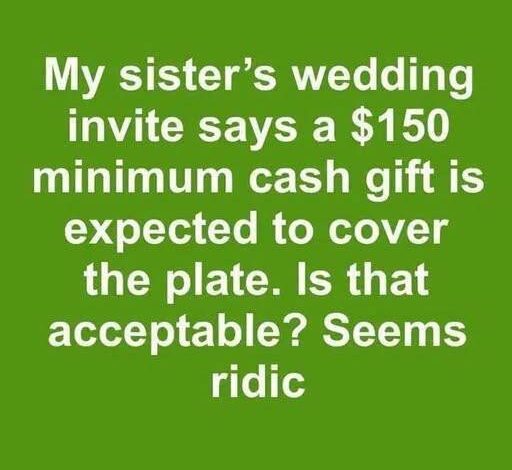
Your wedding invitation arrives in the mail—elegant, gold-foiled, and beautiful. But as you flip the card over, your heart stops. Tucked inside is a cold, calculated instruction: a mandatory “minimum cash gift” requirement to cover your plate. Your stomach turns. Is this a celebration of love, or are you being charged admission to a party you didn’t even want to attend? Across the country, couples are crossing the ultimate etiquette line, turning sacred unions into transactional nightmares. Is demanding cash the new normal, or is it the most offensive trend to ever hit the wedding industry?
The modern wedding has evolved into a high-stakes, hyper-expensive production. With the average cost of nuptials skyrocketing into the stratosphere, couples are feeling the crushing weight of their own expectations. For many, the pressure to host an Instagram-worthy extravaganza is so intense that they’ve decided to outsource the cost of the evening directly to their guest list. They argue that honesty is a virtue—that in an era where couples already live together and possess enough household goods to fill a warehouse, cash is the only logical gift. Why suffer through another pile of duplicate toasters when you can simply ask your grandmother and your college roommate to chip in for the open bar?
To the proponents of this “transparency,” it feels like a practical, modern solution. They view their wedding as a service provided to their inner circle, and in their minds, it is only fair that the beneficiaries of that service help mitigate the expense. They see it as a shift away from the archaic tradition of registry gifts and toward a more pragmatic, direct form of support. By setting a minimum expectation, they believe they are saving guests the guesswork of what to spend, effectively streamlining the process and ensuring that every person in the room contributes their “fair share” to the cost of their own meal, drink, and entertainment.
However, for the vast majority of guests, receiving a mandate for a minimum cash amount feels less like a request and more like an invoice delivered for a luxury item they never ordered. When you place a price tag on an invitation, you fundamentally alter the nature of the relationship. You are no longer inviting a loved one to celebrate your life transition; you are inviting them to participate in a commercial transaction. A guest’s presence, which should be a gift of time, travel, and emotional support, is suddenly reduced to a line item on a budget spreadsheet. The wedding is no longer a community milestone; it is a ticketed event where the host has decided the value of your friendship based on the cost of a slice of dry chicken and a glass of mid-shelf wine.
This trend is particularly insidious because it weaponizes shame. Financial capacity is rarely uniform across a guest list. While one friend might comfortably part with $200 for a wedding gift, another might be struggling with student loans, a mortgage, or a family crisis. By setting a “minimum,” you are effectively telling your guests that their participation is conditional upon their bank account balance. Those who cannot meet the minimum are forced to either stretch themselves beyond their means, potentially risking their own financial stability, or decline the invitation, often leading to a painful sense of social exclusion and inadequacy. The shame inherent in this dynamic is cruel—it forces guests to choose between their personal financial security and the fear of appearing “cheap” or “unsupportive” in the eyes of the couple.
Furthermore, the “minimum gift” mentality ignores the intrinsic value of what a guest brings to the table. A wedding is supposed to be about the gathering of a community, the intersection of families, and the collective support for a new chapter in the lives of the couple. When a couple starts counting heads and multiplying by an arbitrary dollar amount, they lose sight of the fact that guests often spend significant money just to be there. They buy formal attire, pay for travel, arrange for childcare, and sacrifice their weekends. By the time a guest has arrived at your venue, they have already invested in you. To then demand an additional “cover charge” feels like a double-dip that borders on the predatory.
The backlash to this trend is not just about manners; it is about the sanctity of the wedding invitation itself. There is a deep-seated, traditional understanding that an invitation is an honor, not a leverage point. When the transaction becomes the focus of the communication, the spirit of the celebration is suffocated. Couples who prioritize these demands often find that while they may have successfully offset a portion of their venue costs, they have permanently damaged their reputation with their nearest and dearest. The “gift” you receive becomes the last thing you ever get from that person, because the underlying resentment of the transaction often outlasts the marriage itself.
The healthiest and most dignified approach to wedding planning remains, as it always has, the quiet practice of planning within one’s means. If you cannot afford the wedding you are dreaming of, the solution is not to demand a subsidy from your guests; it is to scale back your expectations. True hospitality is about giving, not taking. It is about creating a space where guests feel honored to be present, not pressured to pay for the privilege.
In the end, weddings should be defined by the gratitude of the couple toward their guests, not by the demands of the couple upon their guests’ wallets. When hosts lead with genuine appreciation and guests give according to their ability and desire, the celebration becomes a gift that keeps on giving. A wedding should be a memory that binds people together, not a business deal that tears them apart. By stripping away the transactional pressure and focusing on the shared joy of the occasion, couples can ensure their big day is remembered for the right reasons—the love they celebrate, not the price tag they attached to the front door.