Why Dogs Sniff Our Most Private Areas! Understanding the Science, Instincts, Emotional Intelligence
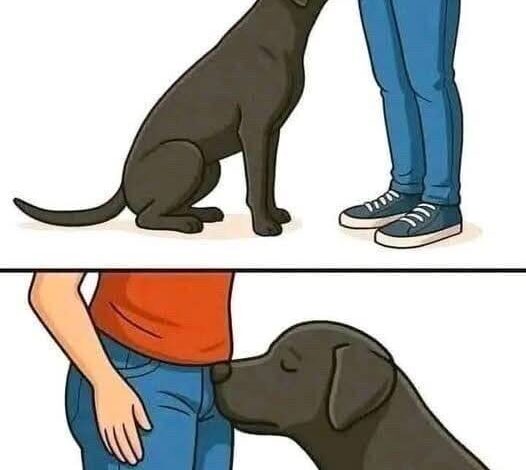
While humans navigate the world through a primary lens of sight and language, the canine experience is defined by an intricate, invisible tapestry of scent. For a dog, a nose is not merely a sensory organ; it is a sophisticated biological interface that gathers data with a precision far beyond human imagination. While people form first impressions based on appearance or a firm handshake, a dog interprets identity, emotional state, and physical health through a complex chemical narrative. This divergence in how we perceive reality often leads to moments of significant human embarrassment—most notably when a dog instinctively sniffs a person’s most private areas. Yet, if we pull back the veil of social awkwardness, we find that this behavior is a remarkable window into the science, instinct, and profound emotional intelligence that defines the bond between species.
The biological catalyst for this behavior lies in the apocrine sweat glands. In humans, these glands are concentrated in the axillary and groin regions, where they release pheromones that communicate a wealth of biological information. To a canine, these pheromones are the equivalent of a detailed digital profile. They provide a quick, authentic introduction that reveals a person’s age, sex, mood, and even recent health developments. When a dog initiates this kind of greeting, they are not being intrusive or disrespectful by their own standards; they are simply engaging in a polite, efficient inquiry into who you are and how you are faring in that exact moment. For the dog, scent is the most honest form of communication—one that cannot be faked or hidden by social masks.
Despite this scientific reality, the behavior often triggers a visceral reaction of surprise or shame in humans. We have spent centuries constructing elaborate social boundaries and associations with bodily privacy that dogs do not share. To a canine, a boundary is a physical or social concept taught through interaction, not an inherent moral code. When a dog’s curiosity clashes with human etiquette, it creates a unique cultural gap. However, this gap can be bridged with patience and clarity. Rather than reacting with frustration, which a dog may interpret as a confusing emotional shift, owners can utilize gentle redirection. Simple cues like “sit” or “leave it” allow a dog to learn the specific expectations of the human social environment without suppressing their natural inquisitive spirit. Recognizing that their motivation is grounded in a desire for connection rather than a breach of privacy helps transform the experience from one of embarrassment to one of mutual understanding.
The same olfactory prowess that leads to awkward social encounters is the very foundation of the dog’s role as “man’s best friend.” This sensitivity allows them to read our internal emotional landscapes with a level of accuracy that borders on the prophetic. Dogs can detect the subtle chemical shifts associated with rising cortisol, changes in heart rate, and fluctuations in body chemistry. They often notice the onset of sadness, fear, or stress long before the human experiencing those emotions has even voiced them. By reading the air for shifts we are blind to, dogs respond with a grounded presence, offering comfort exactly when it is needed most. They are, in a very literal sense, mapping our internal world through their noses.
This extraordinary sensory awareness is the biological engine behind the success of medical alert and service animals. A well-trained service dog can detect the specific chemical markers that precede a seizure, a drop in blood sugar, or an impending panic attack. These life-saving abilities are not magical; they are the professional application of the same basic instincts that drive ordinary sniffing. When a dog senses an internal chemical shift, they adjust their demeanor with localized intelligence—becoming a still anchor of support, a playful distraction, or a protective guardian depending on the specific requirement of the person they serve. Their closeness is a reflection of their capacity to interpret the smallest chemical clues, weaving a thread of trust that is reinforced with every breath they take.
When viewed through this lens of compassionate sensory awareness, even the most uncomfortable moments take on a sense of warmth and depth. For a dog, scent is the primary currency of relationship-building and memory. Your specific scent offers them a sense of reassurance, familiarity, and a deep feeling of belonging. When they lean in toward you, they are expressing a form of recognition that is both ancient and devoted. They are reaffirming a bond and engaging in an unspoken language that shapes the very architecture of your shared life. In their world, to know someone’s scent is to know their soul; it is a way of asking “How are you?” and “Are you still mine?” in a single, silent moment.
Ultimately, a dog’s sniff is a gesture of profound attention and unwavering loyalty. Each inhale serves as a reminder that they notice you in a way no human can, seeing past the clothes, the titles, and the social pretenses to the biological truth of who you are. Their instinctual behavior may feel briefly awkward in a crowded room, but it stems from a lineage of devotion that stretches back tens of thousands of years. In the canine world, scent is truth, and memory is a fragrance that never fully fades. To be sniffed by a dog is to be truly seen—known deeply and accepted without judgment by a creature who finds every detail of your existence endlessly fascinating and worthy of their love.