Why Dogs Sniff Certain Areas! The Surprising Reason Behind This Natural Behavior!
For many dog owners, there is a familiar moment of social awkwardness that occurs when a pet, acting with total confidence, decides to investigate a houseguest or a stranger in a way that feels entirely too personal. While humans often interpret a dog’s focused sniffing of specific bodily areas as a breach of etiquette or a sign of misbehavior, the reality is far more clinical and sophisticated. To a dog, these interactions are not “inappropriate”; they are a high-speed data download. Understanding the biology and intent behind this behavior can transform a moment of embarrassment into a fascinating look at how our canine companions navigate their reality.
The primary reason dogs gravitate toward certain areas—specifically the groin or armpits—is rooted in the presence of apocrine sweat glands. Unlike the eccrine glands found all over human skin that produce watery sweat for cooling, apocrine glands produce pheromones that serve as a biological ID card. These scents carry an immense amount of data, including a person’s age, sex, mood, and even recent health changes or hormonal shifts. Because these glands are most concentrated in the areas dogs often target, they are essentially checking the “profile” of the human they are meeting. While we use our eyes to scan a person’s face for social cues, a dog uses its nose to scan a person’s chemistry.
A dog’s olfactory system is a marvel of biological engineering. They possess up to 300 million olfactory receptors in their noses, compared to about six million in humans. Furthermore, the part of a dog’s brain that is devoted to analyzing smells is, proportionally, 40 times greater than ours. When a dog sniffs you, they aren’t just smelling “scent”; they are perceiving a timeline of where you have been, what you have eaten, and how you are feeling. This is largely facilitated by the Jacobson’s organ, located in the roof of the mouth, which allows dogs to “taste” the chemical signals they inhale.
In the canine social hierarchy, sniffing is a fundamental component of a greeting. It is the equivalent of a firm handshake or an introductory conversation. By gathering this chemical information, a dog reduces the “unknowns” about a new person, which helps them feel secure and confident in the interaction. A dog that is allowed to sniff (within reasonable social boundaries) is often a calmer dog, as they have successfully identified the newcomer and determined they are not a threat.
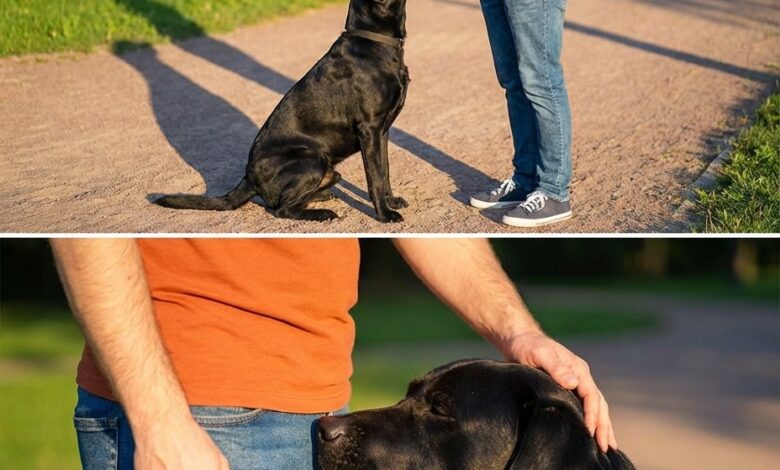
Despite the natural necessity of this behavior, it can undeniably cause discomfort in polite human company. The goal for a responsible owner isn’t to suppress the dog’s instinct—which is impossible and can cause anxiety—but to manage the execution. Implementing “bridge” behaviors can help bridge the gap between canine instinct and human manners. Training a dog to “sit” or “touch” a hand upon meeting a new person redirects their focus, allowing them to gather scent from a more socially acceptable distance, such as a person’s hand or leg, without the intrusive direct contact.
Managing these moments with patience and positive reinforcement strengthens the bond between owner and pet. When we stop viewing a dog’s nose as a source of embarrassment and start seeing it as their most vital sensory tool, we can better advocate for them in social settings. Recognizing that your dog is simply a curious biologist trying to understand their environment allows you to guide them with confidence. By balancing their natural drive to sniff with consistent training, you create a harmonious space where the dog feels informed and the humans feel respected.