SOTD – The Stop That Changed Everything!
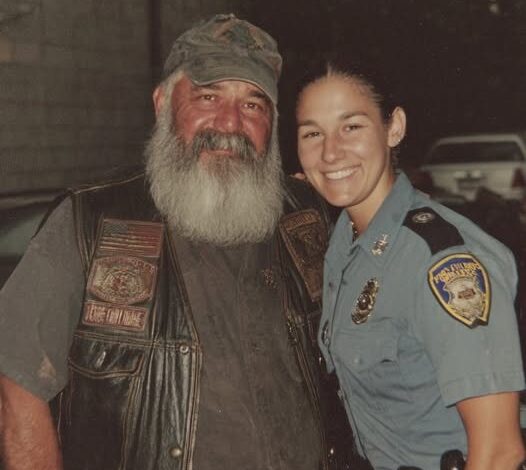
The asphalt of Highway 49 shimmered under the bruised purple and amber of a dying sun. It was the kind of evening that felt heavy with the weight of things unsaid, stretching out over the long, lonely miles that Robert McAllister had traveled for more than half his life. The rhythmic vibration of his motorcycle was a familiar pulse against his thighs—a mechanical heartbeat that had sustained him when his own felt hollow. For decades, the road had been his only true companion, a way to stay half a step ahead of a past that never quite stopped chasing him.
The interruption came in the form of a sharp, staccato flicker in his rearview mirror. Red and blue. Rhythmic and cold.
Robert let out a long, ragged breath and eased the bike onto the gravel shoulder. He killed the engine, and the sudden silence of the open plains rushed in to fill the void. He already knew the culprit: a flickering taillight he’d promised himself he would fix three towns ago. Procrastination was a side effect of a life lived in the margins, where time was measured in tankfuls of gas rather than birthdays or anniversaries.
He remained seated, his gloved hands resting loosely on the handlebars, listening to the measured crunch of footsteps on gravel. They were confident, professional steps.
“Good afternoon, sir,” a voice called out. It was steady, youthful, and carried the practiced authority of someone who had worn a uniform long enough to grow comfortable in it. “Do you know why I pulled you over today?”
Robert didn’t turn around immediately. “The taillight, I’d wager,” he said, his voice sounding like dry leaves skittering across pavement. “I keep meaning to get to it.”
“License and registration, please.”
Robert reached into the pocket of his weathered leather jacket. His fingers, gnarled by time and the biting wind of a thousand highways, trembled just slightly as he produced his wallet. He handed the documents over and finally looked up.
The world didn’t just slow down; it stopped. The air seemed to turn to glass, fragile and sharp.
The officer was young, perhaps in her early thirties, her uniform crisp against the fading light. Her badge glinted, catching the last shards of the sunset. It read: Officer Sarah Chen.
Sarah.
The name was a physical blow, a ghost he had chased through every truck stop and Greyhound station from Seattle to the Florida Keys. His lungs felt as though they had suddenly filled with water. He told himself he was an old man suffering from the delusions of the lonely, that a lifetime of regret had finally begun to hallucinate. But his eyes were clearer than they had been in years.
She had her grandmother’s eyes—dark, observant, and framed by a fierce intelligence that only softened at the corners when she blinked. And then, he saw it. Tucked just beneath the lobe of her left ear, a mark so faint most wouldn’t notice it, was a small, dark crescent-moon birthmark.
Thirty-one years.
He had spent three decades looking for that mark in every crowded mall and city street. He had memorized the curve of it while rocking a colicky infant in a dimly lit apartment, whispering promises into the crown of her head. He had promised he would always find her. Then came the night of the empty rooms—the night her mother disappeared with her, leaving behind nothing but a silence that had echoed in Robert’s ears for the rest of his life.
“Robert McAllister,” she read aloud, her voice pulling him back from the precipice of his memories. “Is this address in Montana current?”
“Yes, ma’am,” he replied, his voice a mere whisper. Most people called him ‘Ghost’—a moniker earned by his habit of vanishing before anyone could learn his real name. To hear his full name spoken by her was like hearing a dead language brought back to life.
She didn’t flinch at the name. There was no flicker of recognition, no widening of those familiar eyes. If her mother had hidden her well—given her a new name, a new life, a new history—why would she? To her, he was just another transient on a vintage bike.
But Robert watched her. He saw the way she shifted her weight onto her back foot, a subconscious habit he used to have himself. He saw the way she tucked a stray lock of dark hair behind her ear with a specific, delicate flick of her wrist. He had seen that same gesture in a three-year-old girl who used to sit on the floor of their living room, meticulously organizing her crayons by color.
“Sir,” she said, her tone shifting. The professional politeness remained, but there was a new edge of duty. “I’m going to need you to step off the motorcycle.”
He complied slowly, his joints aching from the cold and the shock. He swung his leg over the seat, feeling as though he were moving through deep water.
“Please place your hands behind your back.”
The cold, biting snap of the handcuffs against his wrists should have been an indignity. Instead, it felt like an anchor.
“You have an outstanding warrant from three years ago regarding an unpaid citation in another county,” she explained, her hands efficient as she double-locked the cuffs. “I have to take you in.”
Robert didn’t care about the warrant. He didn’t care about the jail cell that awaited him. He was staring at the back of her head, at the way her hair caught the light, at the badge that identified his daughter as a stranger.
As she led him toward the patrol car, he stopped.
“Officer Chen,” he said quietly.
She paused, her hand on the door handle. “Yes?”
“Can I ask you something? Before we go?”
She hesitated, her training battling with a sudden, inexplicable flicker of curiosity. She turned to face him fully. “Make it quick.”
“Do you ever wonder where you got that tiny scar on your left eyebrow?” he asked.
The change in her was instantaneous. Her hand tightened on the door frame, and the professional mask she wore began to fracture. “How do you know about that?” she asked, her voice losing its steady rhythm. “That’s… that’s from when I was a baby. My mother said I tripped.”
Robert swallowed the lump in his throat, his eyes never leaving hers. “You were three years old,” he said softly. “You were riding a red tricycle with one squeaky wheel. You took a turn too fast in the driveway and caught the edge of the brick planter. You cried for exactly five minutes, and then you looked at me and demanded a bowl of strawberry ice cream like it was the most important thing in the world.”
The highway was silent now. The wind had died down, and for a moment, the only sound was the clicking of the cooling motorcycle engine.
Sarah’s eyes widened, her pupils dilating as she searched the face of the man in handcuffs. She looked at the lines around his eyes, the shape of his nose, the desperate, hopeful set of his mouth. Doubt, shock, and a terrifying, buried recognition fought for dominance on her face.
“How could you possibly know that?” she whispered, the “Officer” stripped from her voice.
Robert took a small step forward, as far as the cuffs would allow. “Because I was the one who carried you inside,” he said. “And I’m the one who bought you the ice cream.”
In the fading light of a Montana evening, thirty-one years of searching came to an end on the shoulder of Highway 49. The handcuffs were still there, and the law still demanded its due, but for the first time in three decades, the Ghost had finally come home.