The Road Sign Many Drivers Might Be Missing or Misunderstanding!
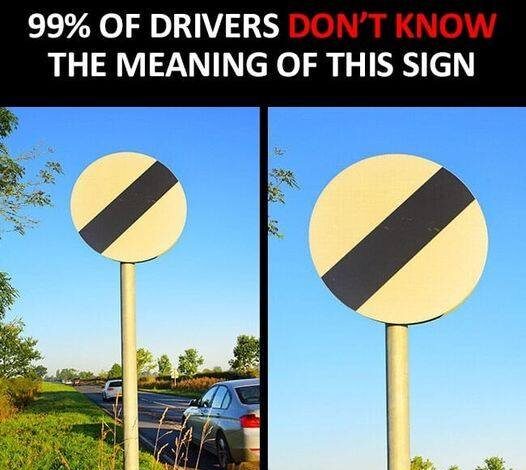
Most drivers think they know every sign on the road—until they’re confronted with the one that exposes how much they’ve forgotten. A simple white circle with a bold black diagonal stripe cuts through the middle, clean and almost too plain to look important. Drivers pass it constantly across the UK, and it shows up on the theory test, yet when faced with it in the wild, many admit they hesitate for a moment. That quick flash of doubt is exactly what sparked a fiery online debate after one motorist boldly claimed that “99% of drivers” misunderstand the sign entirely. And judging by the hundreds of comments that followed, he wasn’t far off.
The discussion revealed something obvious but rarely acknowledged: a lot of people drive on autopilot. They rely on habit, muscle memory, and familiarity with their usual routes instead of actively remembering what every sign means. So when they suddenly see that stark black stripe cutting across white, they guess. They assume. They even joke. One Reddit user called it the “official national drifting zone” sign; another insisted it meant “unlimited speed—floor it.” It was funny, sure, but it also made one thing clear: a sign meant to simplify driving was being misinterpreted by a major chunk of the population.
In reality, the sign marks the beginning of the national speed limit. That’s all. The idea behind its minimalist design is simple: instead of posting specific numbers again and again on rural or high-speed roads, the sign signals that whatever special speed limit you were following no longer applies. From that point forward, you default back to the standard speed for the road type. Clean, minimal, and universal. But simple doesn’t always mean intuitive, and the lack of a number leaves plenty of room for misunderstanding—especially when different vehicles follow different rules.
The RAC stepped in during the online debate to spell it out clearly. For cars, the national speed limit means:
• 60 mph on single-carriageway roads
• 70 mph on dual carriageways and motorways
But that’s only for standard cars. The moment someone climbs behind the wheel of a van, a pickup, a towing vehicle, or anything heavier, the numbers shift. Vans are capped at 50 mph on single carriageways and 60 mph on dual carriageways. Vehicles towing caravans must follow even tighter restrictions. Suddenly, that plain black stripe holds a hefty amount of nuance, especially for people who rarely drive anything other than a normal saloon car. The confusion is understandable. The consequences aren’t.
Road safety experts argue that while the national speed limit sets a legal maximum, it does not guarantee that the limit is safe at all times. On wet roads, narrow bends, foggy mornings, uneven surfaces, or heavily trafficked stretches, the true safe speed may be far lower. Yet countless drivers see the black-stripe sign and treat it like an automatic green light to accelerate—sometimes aggressively—without considering visibility, road width, or the behavior of other vehicles around them. This mismatch between assumption and reality is exactly why the debate took off in the first place.
As the comments piled up, one theme kept reappearing: drivers forget. Not because they’re careless or reckless by default, but because most people never revisit the Highway Code after passing their test. Years pass. Habits form. Memory fades. The rules they once memorized under pressure become vague outlines in the back of their minds. People rely on instinct instead of the knowledge they once had. And road signs—especially the understated ones—end up carrying meanings that get twisted or diluted over time.
The conversation also sparked an uncomfortable truth: driver education shouldn’t end once the license is printed. Many countries require ongoing refreshers or periodic written tests, but the UK doesn’t. Some commenters argued that retesting would make roads safer, while others insisted that drivers would simply memorize answers again without truly absorbing the lessons. But almost everyone agreed on one point: more awareness would save lives.
Even the simplest sign can become dangerous if misunderstood. The national speed limit sign doesn’t hand out permission to speed—it removes the previously posted limit and shifts responsibility back to the driver. It asks them to know the road they’re on, to understand the type of vehicle they’re driving, and to think. Not react. Not guess. Think. A plain sign demands a more engaged driver.
The debate eventually moved beyond the sign itself and into a broader discussion about driving culture. Several people shared stories about witnessing others accelerate instantly when the sign appeared—even when approaching blind bends or narrow bridges. Others admitted they’d assumed the wrong speed limit for years, never realizing they’d been unintentionally breaking the law. A few even confessed they had to pull up the Highway Code during the discussion just to double-check. The sign had been there their entire driving lives, but its meaning had become fuzzy.
That fuzziness becomes a problem when everyone on the road assumes they already know enough. Assumptions create conflict. They create accidents. They create the “I thought you were slowing down” or “I didn’t realize this was a single carriageway” or “I thought the limit changed back there” situations everyone hates dealing with. And most of the time, they’re avoidable.
Driving safely isn’t just about following rules—it’s about continuing to remember them. The national speed limit sign is a quiet reminder that responsibility never disappears just because the signs become familiar. And the online uproar proves people could use that reminder more often than they care to admit.
Knowledge dulls with time. Confidence doesn’t. That’s a dangerous mix.
In the end, the debate wasn’t really about a black stripe on a white circle. It was about how easily drivers forget the details that keep them safe, and how refreshing that knowledge—even briefly—can make a difference. Everyone on the road benefits when people drive with clarity rather than assumption. A little more humility behind the wheel, a little less autopilot thinking, and suddenly that simple sign becomes exactly what it was meant to be: a cue to be aware, not an invitation to race.
Sometimes the signs that look the simplest are the ones that test how much attention we’re really paying.