The original hourglass! The model who changed the standards of beauty and power
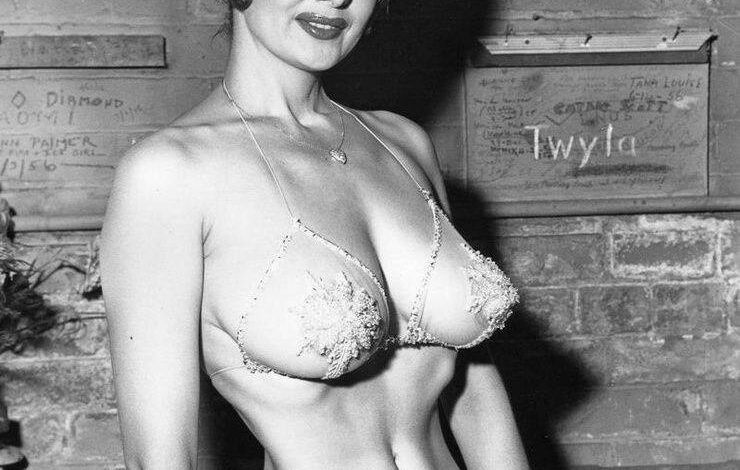
In the pantheon of mid-century icons, few names carry the electric charge of Tempest Storm. With a moniker that seemed to predict a meteorological event, she was a woman for whom fireworks were not just a possibility, but a certainty. Boasting a mane of fiery red hair, eyes that held a commanding, almost hypnotic depth, and an ambition that refused to be dampened by the social constraints of her era, she transformed herself from a desperate small-town runaway into the undisputed queen of burlesque. Long before the term “hourglass figure” became a common marketing cliché, Tempest Storm was its living, breathing architect—a model of beauty and power who redefined what it meant to be a woman in the spotlight.
The woman the world would come to know as Tempest Storm began her journey in a much humbler setting. Born Annie Blanche Banks on Leap Day, 1928, in the rural town of Eastman, Georgia, her early life was a grueling landscape of poverty and systemic abuse. In the deep South of the late 1920s and 30s, her prospects seemed narrow, defined by the red clay and the stifling expectations of a girl from her background. However, Annie possessed a restless spirit that could not be contained by the borders of Georgia. At the tender age of fourteen, she took the ultimate gamble: she ran away, trading the only life she knew for the uncertainty of the road.
Her early years as a runaway were marked by the frantic search for stability. By her mid-teens, she had already navigated two brief, failed marriages—unions born more out of a need for survival than romantic fulfillment. Recognizing that her hometown and its traditional structures held nothing for her, she set her sights on the shimmering, distant promise of Hollywood. She wasn’t just chasing a career; she was chasing a version of herself that didn’t yet exist.
When she arrived in Los Angeles, the transformation began in earnest. Annie Blanche Banks was discarded, and in her place emerged Tempest Storm. She entered the world of burlesque during its golden age, a time when the art form was transitioning from vaudevillian comedy to a high-glamour spectacle. Tempest stood out immediately, not just because of her physical proportions—which were legendary even among her peers—but because of the way she carried herself. She didn’t just perform; she commanded the stage with a regal poise that bordered on the aristocratic.
Her rise was meteoric. By the 1950s, Tempest Storm was a household name, frequently gracing the pages of magazines and headlining the most prestigious clubs in Las Vegas and New York. She became the “Original Hourglass,” a woman whose silhouette challenged the waifish, buttoned-up standards of the early post-war period. She represented a raw, unapologetic femininity that was both a celebration of the female form and a deliberate subversion of the “girl next door” archetype favored by the film studios of the time.
Tempest’s influence, however, extended far beyond the stage of a burlesque theater. She was a master of self-branding before the concept had even been named. She understood that in the world of entertainment, mystery was as valuable as visibility. She famously insured her breasts for a then-staggering sum of $1 million—a publicity masterstroke that solidified her status as a high-value icon. This wasn’t merely a gimmick; it was a declaration of power. She was asserting that her body was her own property, a valuable asset over which she held total control.
Her social life was equally legendary, placing her in the inner circles of the most powerful men in America. She was linked to luminaries like Elvis Presley and Mickey Rooney, and her friendship with John F. Kennedy remains a subject of fascination for historians of the era. These connections weren’t just tabloid fodder; they were a testament to her charisma. In an era where women were often expected to be decorative accessories, Tempest Storm was a protagonist. She navigated the male-dominated worlds of show business and politics with a shrewdness that belied her “runaway” origins.
As the 1960s ushered in a sexual revolution, Tempest remained a relevant and respected figure. Unlike many stars of the 1940s who struggled to adapt to changing tastes, she embraced the evolution of performance. She saw burlesque not as a relic of the past, but as a precursor to the empowerment movements of the future. To Tempest, the act of taking up space, of being seen and admired on one’s own terms, was a political act.
Her legacy is visible today in the revival of “neo-burlesque,” where performers cite her as a foundational influence. She proved that beauty didn’t have to be passive and that power didn’t have to be masculine. She took the trauma of her Georgia upbringing and used it as fuel, building a life that was as expansive and brilliant as the neon lights of the Vegas Strip. Tempest Storm lived her life as if every day were Leap Day—a rare, extra moment of existence that she refused to waste.
When she passed away in 2021 at the age of 93, she left behind more than just a collection of iconic photographs and film clips. She left a blueprint for self-invention. She taught generations of women that you could come from nothing, escape the worst of circumstances, and become a storm that the world couldn’t help but watch. She was the original hourglass, reminding us all that while time eventually runs out, the impact of a truly unstoppable woman is timeless.