The Hammond B3 Finally Goes Silent, Why the Death of This Rock Legend Marks the End of an Era
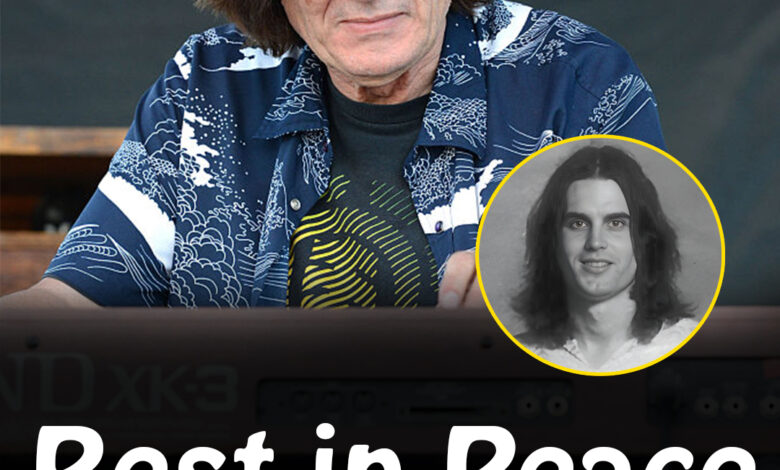
The world of progressive rock has been plunged into a sudden, resonant silence. Christopher North, the founding keyboardist and undisputed sonic architect of the band Ambrosia, has passed away at the age of 75. To the casual listener, he was the man behind the keys, but to those who lived through the golden age of 1970s experimental rock, North was a “keyboard wizard” who didn’t just play music—he commanded the very atmosphere of the room. His death on April 2, 2026, has sent a shockwave through the industry, leaving bandmates devastated and fans worldwide mourning the loss of a man whose Hammond B3 organ was the heartbeat of a generation.
Ambrosia emerged from the fertile creative ground of Southern California in the early 1970s, a time when rock was shedding its simple blues roots and reaching for something more symphonic, complex, and profound. While many bands were content with standard three-chord progressions, Ambrosia sought to blend the technical precision of classical music with the soul of rhythm and blues. At the center of this ambitious sonic experiment stood Christopher North. He was the kind of musician you felt in your chest before his name even crossed your mind. When he sat behind his massive Hammond B3, he wasn’t just a performer; he was an alchemist, turning electricity and air into emotional landscapes that could wrap themselves around a listener and refuse to let go for decades.
North’s contribution to the band’s identity cannot be overstated. While Ambrosia is often remembered for their smooth, yacht-rock-adjacent hits like “How Much I Feel” and “Biggest Part of Me,” it was their early, progressive work that truly showcased North’s virtuosity. On their self-titled debut album and its follow-up, Somewhere I’ve Never Travelled, North’s organ work provided a roaring, weeping, and lifting foundation that set the band apart from their contemporaries. He had a unique ability to make a mechanical instrument sound human. Under his fingers, the Hammond B3 became a character of its own—one that could growl with aggressive intensity during a heavy jam or shimmer with a delicate, ethereal beauty during a ballad.
Beyond the stage lights and the thunderous applause, North was a man who lived with the same intensity he brought to his music. However, that intensity was often directed toward personal battles that the public rarely saw. He was a survivor in the truest sense of the word, having fought and won a grueling battle against throat cancer. This particular struggle was deeply poignant for a musician; throat cancer threatens the very breath and voice that connect a performer to their art. Yet, even as his physical health faced its greatest challenge, North’s spirit remained unyielding. He continued to find solace and strength in the music, proving that while the body may falter, the creative drive is often indestructible.
His bandmates, who spent decades traveling in cramped vans, sharing cheap hotel rooms, and performing on the world’s most prestigious stages, remember him as much more than a virtuoso. To them, he was a friend whose laughter could fill a room and whose dedication to the craft pushed everyone around him to be better. In the collaborative environment of a band like Ambrosia, where complex time signatures and intricate vocal harmonies were the norm, North was the glue. He possessed an intuitive understanding of space and dynamics, knowing exactly when to let the organ roar to the heavens and when to pull back and let a single, haunting note hang in the air.
The legacy of Christopher North is etched into the wax of every record he touched. His influence can be heard in the work of countless keyboardists who followed him, musicians who realized that the keys weren’t just for backing chords, but for creating a narrative. He belonged to a rare breed of instrumentalists who understood that technical skill is secondary to emotional delivery. Whether he was playing in a smoky, dimly lit club in the band’s early days or in a packed theater during their commercial peak, he treated every performance with a sacred reverence. He played as if every note might be his last, a quality that gave his music an enduring, timeless energy.
In the wake of his passing, the music community has rallied to celebrate a life lived in the service of sound. Tributes have poured in from fellow legends of the prog-rock era, all echoing a similar sentiment: North was an original. He didn’t follow trends; he set them. He didn’t just play the Hammond B3; he redefined what the instrument could do in a rock context. Today, as fans listen back to the soaring swells of “Holdin’ on to Yesterday” or the intricate textures of “Nice, Nice, Very Nice,” the loss feels particularly heavy. Those recordings are now more than just songs—they are the final, permanent echoes of a man who gave everything to his art.
The mystery of North’s final years—the quiet dignity with which he handled his recovery and the private nature of his later life—only adds to the aura of the “wizard.” He was never one to chase the hollow fame of the modern era. He was satisfied with the work, the friendship of his peers, and the profound connection he shared with his audience through the speakers. Even as the silence of his passing hits harder than any minor chord, there is a sense of completion in his journey. He survived the storms, he left his mark on the world, and he ensured that the name Christopher North would be synonymous with musical excellence for as long as people still value the sound of a roaring organ.
As we look toward the future of music, the absence of figures like North becomes increasingly apparent. We are losing the pioneers who built the foundation of modern rock, the men and women who experimented with sound when there were no roadmaps. Christopher North was a pioneer in every sense of the word. He explored the emotional depths of the keyboard, finding beauty in the distortion and grace in the volume.
The records will continue to spin, and the memories of his fire onstage will continue to tremble in the hearts of those who saw him live. Somewhere in those soaring organ swells, in the feedback and the sustain, Christopher North is still very much alive. He has transitioned from the physical stage to the eternal one, leaving behind a body of work that will continue to roar, weep, and lift audiences for generations to come. The “keyboard wizard” has laid down his wand, but the magic he created is permanent. The world is a quieter place without him, but it is infinitely richer because he was here.