Silent Signal on the Highway!
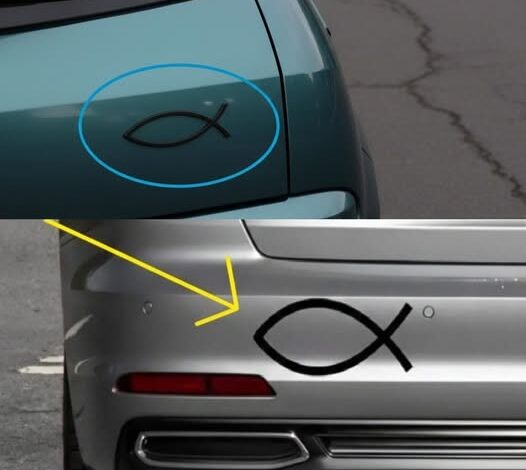
The American highway system is perhaps the last great theater of communal anonymity, a sprawling network of asphalt and concrete where millions of lives intersect at high velocity without ever truly meeting. It is a space defined by the internal combustion engine and the iron cage of the modern automobile—a place where the human being is often reduced to a color, a make, a model, and a driving habit. In this environment, frustration is the default setting. We exist in a state of perpetual low-grade combat, vying for lane dominance and cursing the brake lights of strangers. Yet, amid the heat of the commute and the sterile blur of the interstate, a small, silver icon often clings to the trunk of a sedan or the bumper of a weathered truck: the simple, elegant arc of the ichthys, better known as the “Jesus fish.”
This symbol did not begin as a piece of automotive flair. It began nearly two millennia ago as a whispered signal between strangers in the shadows of an empire that viewed their existence as a threat. It was a subterranean shorthand, a way of saying, “I am trying to be kind, even when it costs me,” without the need for public applause or the risk of immediate persecution. It was an ancient “ping” in a world of analog silence. Over the centuries, that quiet, sacred promise slipped from the walls of catacombs and secret gatherings onto the chrome bumpers and plastic trunks of the 21st century. It migrated from the periphery of history into the chaotic heart of rush hour.
The Psychology of the Rearview Vow
For the individual who chooses to affix this symbol to their vehicle, the act is rarely about vanity; instead, it functions as a self-imposed vow. In the sterile isolation of a car, it is dangerously easy to forget that the person who just cut you off is a human being with a mortgage, a sick child, or a heavy heart. The metal skin of the car acts as a psychological barrier, stripping away empathy and replacing it with territorial aggression. When we are behind the wheel, we are not neighbors; we are obstacles.
The fish, however, acts as a persistent, silent interrogator. It sits there, catching the glare of the morning sun or the neon of a truck stop, flashing in the rearview mirror like a recurring question: Who do you want to be now? It creates a friction between the primal urge toward fury and the spiritual calling toward restraint. In that split second when a hand reaches for the horn in anger or a foot prepares to floor the gas in a fit of “road rage,” the symbol serves as a visual speed bump for the soul.
It is a difficult standard to maintain. To display the symbol is to invite a specific kind of scrutiny. The world is quick to point out the hypocrisy of a driver with a fish on their bumper who fails to use a turn signal or who tailgates in the fast lane. But the power of the symbol lies not in its guarantee of perfection, but in its suggestion of intention. It is a fragile but stubborn choice to remember the humanity of the other car, even when that car is being difficult.
The Highway as a Shared Pilgrimage
When viewed through this lens, the highway shifts its fundamental nature. It ceases to be a battlefield where we compete for arrival times and becomes, instead, a shared, trembling pilgrimage toward home. Every driver is carrying something—grief, ambition, exhaustion, or joy. When a driver observes the “silent signal” on another vehicle, it serves as a reminder that the road is a collective experience.
Consider the “zipper merge” or the simple act of letting someone in during a gridlock. In the grand scheme of a life, these moments are infinitesimal. But in the psychology of the road, they are profound acts of surrender. To yield a car length is to yield a piece of one’s ego. The symbol on the bumper suggests that this surrender is not a sign of weakness, but a manifestation of a higher order of grace. It is a way of acknowledging that we are all moving toward the same destination: a place of rest, a place of safety, a place called home.
The Fragility of the Signal
There is a certain vulnerability in displaying such a sign. It is a public declaration of a private struggle. Sometimes the drivers fail. They lose their tempers; they drive selfishly; they forget the vow they made when they peeled the backing off the adhesive and pressed the silver arcs onto their paint. We are, after all, made of dust and stardust, prone to the failings of the flesh.
But failure does not negate the intention. Every time the driver catches a glimpse of that fish in the garage light or sees a similar one on a passing car, the road shifts—just a little. The anonymity of the highway is pierced by a moment of recognition. It is a signal that says, “I am trying, and I know you are trying, too.” It is a recognition that the person in the lane next to you is not an enemy to be defeated, but a fellow traveler navigating the same hazards, the same potholes, and the same fading light.
The Evolution of the Icon in 2026
As we navigate the complexities of 2026, where digital disconnection often mirrors the physical disconnection of the highway, these analog signals have taken on a renewed importance. In a world of automated driving assists and sensor-laden vehicles, the “human element” is at risk of being coded out of our transit experience. The simple fish remains one of the few ways to inject a sense of personhood back into the machine.
It serves as a reminder that technology can move our bodies, but only intention can move our spirits. The fish doesn’t make the car go faster, nor does it improve the fuel economy. What it does is adjust the internal compass of the navigator. It suggests that the “shortest distance between two points” is not always a straight line, but often a path that involves a bit of patience and a measure of mercy.
Ultimately, the silent signal on the highway is a testament to the enduring power of hope. It is the belief that even in the most impersonal of settings—the high-speed, high-stress corridors of our modern lives—kindness is possible. It is an acknowledgment that while we may be strangers traveling at seventy miles per hour, we are bound by a common need for grace. The fish remains, a small silver stubbornness on the trunk, reminding us that every journey is a chance to be better than we were when we pulled out of the driveway. It reminds us that the road home is one we all travel together, one lane at a time, one signal at a time, until the engine finally stops and the silence of the destination takes over.