Robert Duvall shared these eerie words on Donald Trump before his death!
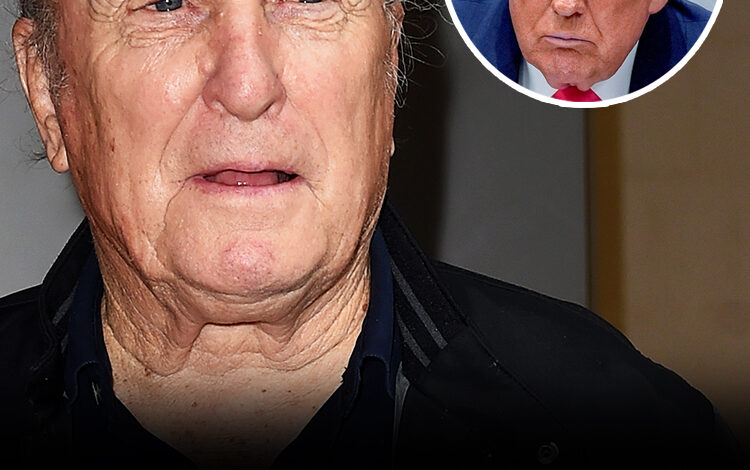
The passing of Robert Duvall at the age of 95 marks the departure of one of the most formidable and quietly dignified titans of American cinema. A seven-time Academy Award nominee and a winner for his unforgettable turn in Tender Mercies, Duvall died this past Sunday at his home in Middleburg, Virginia. Surrounded by the rolling hills of the horse country he loved so dearly, he took his final breath in the company of his family, bringing a close to a career that spanned nearly seven decades and helped define the Golden Age of 1970s Hollywood.
His wife, Luciana Pedraza, shared an emotional tribute that highlighted the man behind the legendary roles. She noted that while the world recognized him as an Oscar-winning actor, director, and master storyteller, to those in his inner circle, he was a soul of immense depth whose passion for life extended far beyond the studio gates. Duvall was a man who found as much joy in the precision of a tango or the tending of his horses as he did in the craft of acting. His approach to life mirrored his approach to film: he sought the “truth of the human spirit” in its simplest, most grounded forms, eschewing the vanity often associated with Hollywood stardom.
In an industry where public figures frequently use their platforms to broadcast rigid political ideologies, Duvall was a notable exception. He was a lifelong conservative, but his politics were characterized by a thoughtful, reflective nuance rather than combative rhetoric. He was often described as a “quiet conservative,” someone who valued historical perspective and individual resilience over partisan tribalism. In a significant 2014 interview, he notably critiqued the fracturing of the major political parties, suggesting that the Republican Party had lost its way and humorously noting that his wife considered herself a “tree-hugging Republican.” He possessed a rare ability to support certain traditionally liberal ideals while remaining a staunch defender of conservative principles, viewing America as a flawed but ultimately magnificent and resilient experiment.
It is within this context of quiet observation that an “eerie” prediction from 2016 has resurfaced following his death. Dan Patrick, who met Duvall during the early months of the 2016 presidential race, recounted a conversation that felt shocking at the time. While the majority of national polling, political analysts, and betting markets were leaning heavily toward a victory for Hillary Clinton, Duvall was reportedly unwavering in his conviction. According to Patrick, Duvall “guaranteed” that Donald Trump would win the presidency. At a time when Trump’s path to the White House was dismissed by the media establishment as a statistical impossibility, Duvall’s instinct—perhaps honed by years of playing men from the American heartland—proved to be remarkably prescient. Whether that moment was a stroke of political insight or a deep understanding of the national mood, it stands as a testament to his connection to the “common man” characters he portrayed so frequently.
Duvall’s career was characterized by a chameleonic ability to disappear into a role. From the calculated, cool-headed Tom Hagen in The Godfather to the surf-obsessed, terrifyingly intense Lieutenant Colonel Bill Kilgore in Apocalypse Now, Duvall’s range was nearly unparalleled. He didn’t just act; he inhabited the skin of his characters. This commitment to craft allowed him to maintain a career into his nineties, long after many of his contemporaries had retired. He belonged to a generation of performers who believed that the work should speak louder than the person, and his lifestyle in Virginia reflected that belief. He lived far from the paparazzi-laden streets of Los Angeles, preferring the quietude of his farm and the company of those who valued him for his humanity rather than his celebrity.
The “prediction” he shared regarding the 2016 election is now being viewed by some as a final piece of a complex puzzle. It suggests that Duvall, despite his private nature, was deeply attuned to the shifts in the American landscape. In an era where celebrity commentary is often dismissed as being out of touch, Duvall’s perspective carried the weight of someone who had spent decades traveling the country and studying its people. He understood the undercurrents of American life because he had made a career out of representing them on screen.
As the industry mourns his loss, there is a collective sense that a specific type of Hollywood figure has vanished. Duvall was an actor who valued discretion over attention and substance over controversy. He was a storyteller who understood that the most powerful narratives are often the ones told in whispers rather than shouts. His death on February 15, 2026, coincided with a time of heightened political tension in the country, yet the tributes pouring in from both sides of the aisle suggest that his talent was a unifying force. Even those who disagreed with his personal views could not deny the immense contributions he made to the American cultural canon.
The image of President Donald Trump taking questions aboard Air Force One in early 2026, just days before Duvall’s passing, serves as a strange visual bookend to the actor’s 2016 guarantee. It highlights a political era that Duvall seemed to anticipate long before it became reality. Yet, for many, the “eerie” words he shared will ultimately be overshadowed by the warmth of his performances. He was a man who could make a viewer feel the weight of a sunrise in a Western or the quiet desperation of a down-on-his-luck country singer.
Robert Duvall leaves behind a legacy that is as vast as the Virginia countryside he called home. He was a master of his craft who managed to remain a mystery to the public, even after decades in the spotlight. In his final years, he found peace in the simple rhythms of life, away from the “noise” of modern discourse. His passing marks the end of an era of understated brilliance. While the political predictions and the headlines may fade, the characters he brought to life—men of honor, men of violence, and men of profound faith—will continue to speak to the truth of the human spirit for generations to come.
Duvall’s life was a masterclass in how to exist as a public figure with integrity. He showed that it was possible to hold strong convictions while treating others with respect, and to reach the pinnacle of a profession without losing one’s soul to the machinery of fame. As his wife Luciana so beautifully stated, to the world he was a legend, but to those who knew him, he was “simply everything.”