Quick wit and unexpected outcommes!
In the intricate dance of human relationships, the most potent weapon is often not a raised voice or a grand gesture, but the razor-sharp application of a quick wit. We live in a world where communication is constant yet frequently ignored, where expectations can become lopsided over decades of marriage, and where social friction is a daily occurrence. In these moments of tension, a well-timed retort does more than just win an argument; it serves as a profound reminder of the power of humor to reset the scales and transform an awkward confrontation into a moment of legendary amusement.
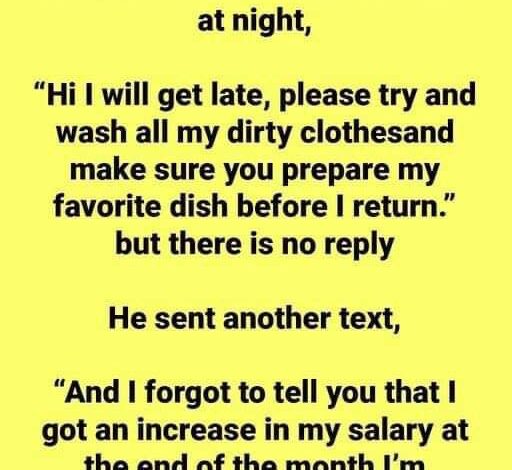
Consider the modern struggle of the digital age: the “unread” message. There is a specific kind of domestic frustration that arises when a request is sent into the void of a spouse’s smartphone, only to be met with a deafening silence. One evening, a husband found himself in this very predicament. Working late and feeling particularly entitled to the comforts of home, he sent a series of directives to his wife. He requested that she wash a specific load of laundry and prepare his favorite, labor-intensive dish so that it would be steaming on the table upon his arrival. He watched the screen, waiting for the bubbles of a reply that never surfaced. He knew she had seen the notification; he simply knew she was choosing the sanctuary of silence.
Rather than calling her or descending into a petty argument about responsiveness, he decided to play a more sophisticated game. He sent a second text, his thumbs flying across the glass with newfound inspiration. “By the way,” he wrote, “I just got word from the office. I’ve been granted a massive salary increase and a year-end bonus. I’m heading to the dealership tomorrow morning to pick out that new SUV you’ve been eyeing. I want it in your favorite color, fully loaded.”
The reaction was instantaneous. Within seconds, the wife replied, her excitement radiating through the screen: “OMG, really? Are you serious? I’m so happy!”
The husband, savoring the victory of his psychological trap, replied with a calm, clinical precision: “No, not really. I just wanted to make sure you actually got my first message about the laundry and the dinner.” It was a masterpiece of domestic maneuvering—a reminder that while a request for service might be easily overlooked, the promise of a luxury vehicle has a way of restoring one’s connectivity to the world.
However, wit is not merely a tool for ensuring the chores are done; it is also a vital defense mechanism in the face of long-term marital fatigue. After ten years of marriage, the routines of life can sometimes make a partner feel as though their contributions are undervalued, leading to moments of dramatic, if slightly misguided, rebellion.
One afternoon, a man returned home from work to find his wife standing in the middle of their bedroom, surrounded by open suitcases. She was packing with a frenetic energy that suggested a permanent departure. Stunned, he asked the obvious question: “Where on earth do you think you’re going?”
His wife didn’t stop folding her clothes as she delivered her ultimatum. “I’m moving to Las Vegas,” she declared, her voice trembling with a mix of defiance and hope. “I’ve done some research, and I’ve discovered that there are men in Nevada willing to pay me $500 cash for exactly what I do for you every single day for free! Why should I stay here when I can be a professional?”
The husband was silent for a moment, processing the logic of her newfound career path. Rather than begging her to stay or expressing outrage, he walked to the closet and pulled out his own suitcase. He began tossing his socks and shirts into the bag with equal fervor.
The wife stopped, her hands hovering over a stack of sweaters. “What do you think you’re doing?” she demanded.
“I’m coming to Las Vegas with you,” he replied calmly, zipping his bag shut. “I’ve got to see how you’re going to manage to live on only $1,000 a year.”
It was a staggering blow of reality delivered through the medium of a joke. In one sentence, he had simultaneously acknowledged the frequency of their intimacy and pointed out the statistical improbability of her new business model. The silence that followed was heavy with the realization that sometimes, the things we take for granted are far more valuable—and frequent—than we care to admit.
Beyond the walls of the home, quick wit also serves as the ultimate equalizer in the public square, especially when navigating the friction between generations. There is perhaps no greater modern frustration than the “parking lot poacher”—the person who swoops into a spot that someone else has been patiently waiting for.
An elderly woman had been idling her car in a crowded shopping center lot for nearly ten minutes, her blinker clicking rhythmically as she waited for a shopper to load their groceries and vacate a prime spot near the entrance. Just as the car began to pull out, a flash of red blurred across her vision. A young man in a brand-new Mercedes-Benz zoomed around her, cut across the lane, and slammed his car into the space she had rightfully earned.
He stepped out of the vehicle, adjusting his expensive sunglasses and smoothing his hair, looking entirely satisfied with his maneuver. The lady rolled down her window, her face flushed with a righteous indignation. “Excuse me!” she called out. “I was clearly waiting for that spot. I’ve been here for ten minutes!”
The young man didn’t even look ashamed. He smirked at her, his attitude dripping with the unearned confidence of the wealthy and the youthful. “Sorry, lady,” he retorted with a dismissive wave. “That’s what you can do when you’re young and bright.”
He began to walk toward the store, but the elderly lady wasn’t finished. She didn’t yell, and she didn’t call the police. Instead, she put her car in gear, floored the accelerator, and slammed her heavy, steel-bumpered sedan directly into the side of his pristine red Mercedes. The sound of crunching metal and shattering glass echoed across the pavement.
The young man spun around, his jaw dropping in horror as he looked at the wreckage of his luxury car. “What are you doing?” he screamed, sprinting back toward the scene. “Are you crazy? You just totaled my car!”
The lady looked at him through her window, a serene and satisfied smile playing on her lips. She didn’t offer her insurance information or an apology. Instead, she echoed his own words back to him with the weight of decades of experience. “Well, dear,” she said calmly, “that’s what you can do when you’re old and rich.”
In each of these stories, the outcome is the same: the person who attempted to use power, silence, or arrogance to gain an advantage was undone by the superior speed of their opponent’s mind. Humor, when used correctly, is the great leveling force of society. It reminds the silent spouse that they are being watched, the rebellious partner of the reality of their situation, and the arrogant youth that those who came before them have both the resources and the audacity to strike back.