Pam Bondi confirms full release of Epstein files as 300 high-profile names are exposed!
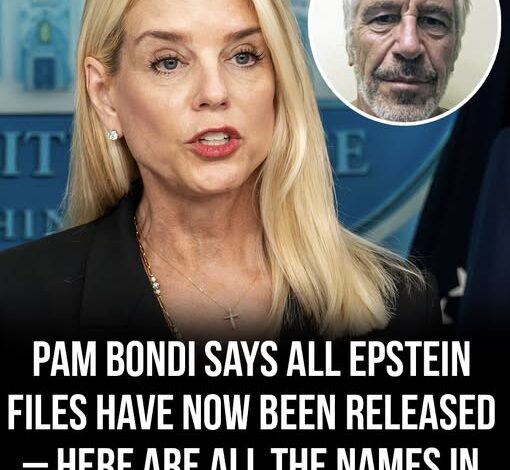
U.S. Attorney General Pam Bondi has confirmed that the Department of Justice has completed the public release of documents related to convicted financier Jeffrey Epstein, marking what officials describe as the final phase of disclosures required under the Epstein Files Transparency Act. The announcement, made in a letter dated February 14, follows months of incremental document releases and extensive internal review of investigative materials.
According to Bondi, the Justice Department has now disclosed all records mandated under Section 3 of the Act. The process involved federal staff reviewing millions of pages of emails, photographs, flight logs, memoranda, and investigative files. The final tranche of documents, officials say, includes references to more than 300 high-profile individuals whose names appear at least once within the records.
Bondi’s letter emphasized that the appearance of a name in the files does not imply criminal involvement or misconduct. She noted that individuals were mentioned in a variety of contexts, ranging from documented communications to passing references in media articles, email chains, or contact lists. “References appear in a wide variety of contexts,” she wrote, adding that inclusion in the documents “does not assume any guilt or wrongdoing” related to Epstein’s crimes.
In addition to the primary records, the department released a separate compilation identifying individuals who are or were government officials or politically exposed persons and whose names appeared in the files. Bondi underscored that the department did not withhold or redact documents on the basis of potential embarrassment, reputational harm, or political sensitivity, including to public officials or foreign dignitaries.
The newly disclosed materials include references to prominent figures from politics, business, entertainment, and royalty. Among those named are Donald Trump, Bill Gates, Barack and Michelle Obama, Benjamin Netanyahu, Princess Diana, Bill and Hillary Clinton, as well as celebrities such as Barbara Streisand, Amy Schumer, Bruce Springsteen, Kim Kardashian, Bill Cosby, and Robert De Niro. The list also includes deceased cultural figures such as Janis Joplin and Elvis Presley.
Deputy Attorney General Todd Blanche joined Bondi in clarifying that the context of each name varies significantly. Some individuals had documented communications with Epstein or his associate Ghislaine Maxwell. Others were mentioned indirectly, such as in news clippings, archived correspondence, or third-party communications that referenced them without direct involvement.
“The only category of records withheld were those records where permitted withholdings under Section 2(c) and privileged materials were not segregable from material responsive under Section 2(a),” the letter stated. The department cited legal privileges including deliberative-process privilege, attorney-client privilege, and work-product protections as the basis for limited redactions.
Despite the Justice Department’s assertion that it has complied fully with the statutory requirements of the Transparency Act, debate continues in Congress over whether the release meets the spirit as well as the letter of the law. Representative Thomas Massie (R-Ky.), who co-authored the Epstein Files Transparency Act alongside Representative Ro Khanna (D-Calif.), argued that the legislation requires disclosure of internal deliberations related to prosecutorial decisions.
“The problem with that is the bill that Ro Khanna and I wrote says that they must release internal memos and notes and emails about their decisions on whether to prosecute or not prosecute, whether to investigate or not investigate,” Massie said during an appearance on ABC’s This Week. He suggested that internal communications could shed light on earlier prosecutorial decisions and plea agreements connected to Epstein’s case.
Representative Khanna echoed concerns about how the release was structured, arguing that listing hundreds of names without detailed context risks misleading the public. He pointed out that figures such as Janis Joplin, who died in 1970 while Epstein was still a teenager, appeared on the same compilation list as convicted offenders. “Release the full files,” Khanna wrote on X. “Stop protecting predators. Redact only the survivor’s names.” His statement reflects a broader push among some lawmakers for deeper transparency into investigative processes and prosecutorial discretion.
Attorneys representing survivors of Epstein’s abuse have also raised concerns regarding privacy protections. They stated that certain materials included email addresses and nude images that could potentially identify victims. The Justice Department acknowledged that some documents were briefly posted in error due to what it described as “technical or human error” and confirmed that those files were removed once the issue was flagged.
Epstein’s case has long drawn public scrutiny due to the scale of his social connections and the leniency of a controversial 2008 plea agreement in Florida that allowed him to avoid federal prosecution at the time. Following his arrest in 2019 on federal sex trafficking charges, Epstein died in jail under circumstances officially ruled a suicide, though his death continues to generate speculation.
The Transparency Act was introduced in response to mounting public pressure for disclosure of government records tied to Epstein’s activities and the decisions surrounding his prosecution. Lawmakers from both parties argued that greater transparency was necessary to restore public trust and address persistent questions about accountability.
In their joint statement, Bondi and Blanche reiterated that the department has complied with the Act’s requirements. “In accordance with the requirements of the Act, the Department released all ‘records, documents, communications and investigative materials in the possession of the Department’ that ‘relate to’ any of nine different categories,” they wrote. Officials maintain that no relevant materials were withheld outside of legally protected privileges.
Nevertheless, some members of Congress and victim advocates contend that full transparency requires disclosure not only of names and communications but also of internal decision-making processes that shaped earlier outcomes. They argue that understanding why certain prosecutorial decisions were made is essential to evaluating systemic accountability.
The public release of the files marks a significant milestone in the long-running effort to make Epstein-related records accessible. Yet the disclosures also underscore the complexity of balancing transparency, privacy, and due process. The presence of high-profile names within the documents has fueled renewed public interest, but officials stress that context remains critical.
As scrutiny continues, lawmakers from both parties have indicated that oversight efforts will persist. Hearings or additional legislative action may follow if members conclude that statutory obligations have not been fully satisfied.
For now, the Justice Department’s announcement signals the formal completion of disclosures under the Epstein Files Transparency Act. Whether the release ultimately resolves public concerns or deepens calls for further investigation remains to be seen.