Old Men On The Bench!
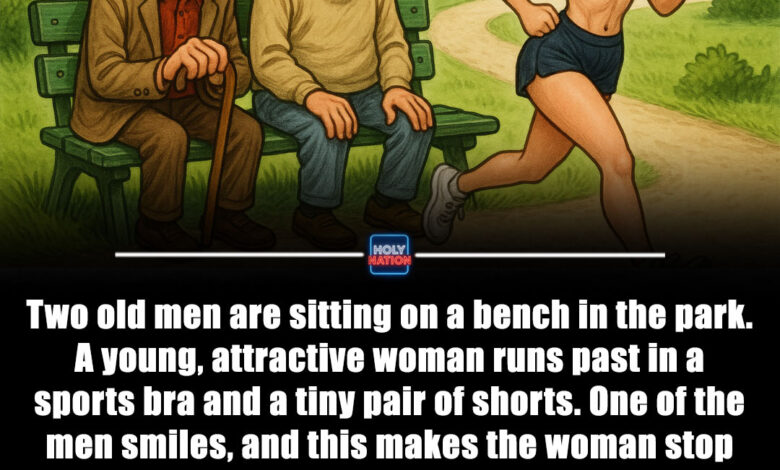
The familiar sensation of being watched—of a lingering gaze that felt less like observation and more like a tactile, unwanted stain—brought the young woman to an abrupt halt. Her morning run, an essential ritual of personal fitness and stress release, was suddenly interrupted. Every muscle in her body tightened as she spun around to confront the source of the discomfort. There, on a sun-drenched park bench, sat two elderly men, one offering a slight, knowing, guilty smile, the other holding his breath in anticipation. The air between them crackled with unspoken tension as she marched back, prepared to unleash a torrent of justified anger and demand that the old man retract his invasive stare. Yet, the moment he opened his mouth, the entire scenario flipped, shifting the emotional dynamic and leading to a startling, unexpected conclusion.
He did not offer the rote, anticipated apology. Instead, he spoke with a gentle, almost theatrical softness, his voice carrying an inflection that seemed deliberately borrowed from a more courtly, bygone era. He delivered a carefully calibrated line about her evident natural beauty serving as a sudden, vital reminder that he was still alive. He claimed that the sheer sight of her energetic run had momentarily pulled him out of the relentless, long gray stretch of his twilight days, a poetic and seemingly harmless reflection on aging and mortality. His words were just sentimental enough, just cracked enough with the sound of genuine age and weary isolation, that her building anger found no purchase. Her shoulders, rigid moments before, visibly dropped; the clench in her jaw released.
A brief, reluctant laugh escaped her. Disarmed by his soft delivery and the pathos of his sentiment, she leaned in quickly and pressed a small, slightly embarrassed kiss to his cheek—a gesture of sudden, unexpected human connection and perhaps misplaced pity. Her impulsive act complete, she trotted away, her ponytail bouncing, resuming her exercise routine and attempting to restore the hard-earned rhythm of her morning.
Silence resettled over the park bench, heavy and undisturbed. The old man, watching her retreating figure, finally exhaled, leaning back into the wood slats. He then slowly turned to his companion, a mischievous, boyish glint—a piece of arrested development—flashing in his eyes that seemed profoundly out of place on such an aged face. “Told you,” he whispered, a smirk playing on his lips. “Three kisses this week.” His friend, who had remained silent throughout the performance, offered a guttural snort—a sound half-admiring of the successful deception, and half-disgusted by the manipulation.
In that single, casual act of scorekeeping, the fragile moment of shared humanity instantly curdled. What had superficially appeared to be a tender, vulnerable human connection—a moment where youth and age briefly transcended the boundaries of time and prejudice—shrank, in that instant, into nothing more than a calculated social engineering trick. It was revealed to be a cynical old man’s sport, a calculated game played brazenly in plain sight. The casual boast exposed the entire interaction as a performance where the unsuspecting young woman served merely as a conquest, a verifiable “score” in a private, unacknowledged contest of social power and manipulation.
The full weight of the revelation lay in the realization that the world, observing such an exchange from a distance, would almost certainly mistake the old man’s predatory technique for genuine elder wisdom or gentle, harmless flattery. This psychological manipulation uses the perceived vulnerability of age to disarm and extract a reward. The incident stands as a potent, though miniature, examination of how gender dynamics and societal perceptions of age can be exploited, transforming moments that appear to be genuine expressions of connection into exercises in vanity and deceit. The true cost of the interaction was not the kiss itself, but the shattering of the young woman’s momentary belief in the simple goodness of an elder’s sentiment, replacing it with the cold, unsettling reality of being a pawn in an unsavory, unspoken game of “getting a rise.” This kind of narrative is highly engaging within relationship psychology discussions and generates strong readership in viral news platforms dedicated to exploring the darker side of human interaction and social boundaries.