My 6 Siblings Refused to Take Care of Our Mother – I Was Never Her Favorite, So What I Said Next Shocked Everyone!
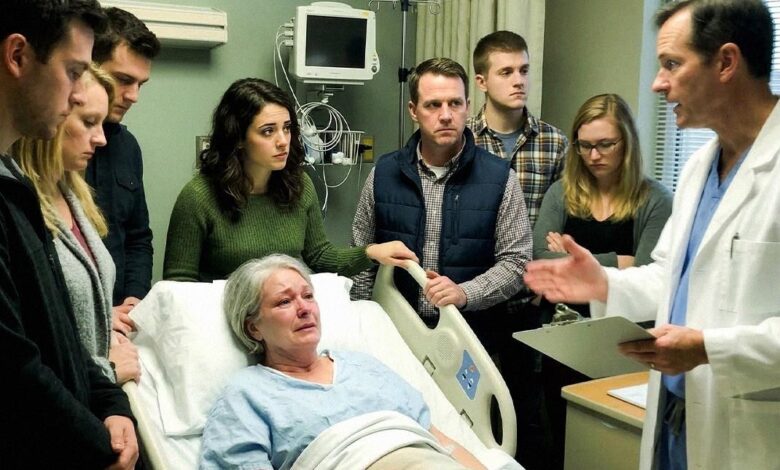
The sterile, fluorescent hum of the hospital room felt like a physical weight as the doctor delivered the verdict we had all been avoiding. Our mother, Margaret, had suffered two serious falls in a single year, and her balance was failing. “Living alone is no longer an option,” he stated flatly. The silence that followed was deafening. My mother sat on the edge of the hospital bed, wearing that fragile, hopeful smile that elderly parents use when they are terrified their children will look away.
I stood there with my six siblings—seven of us in total, all raised by this woman who had worked grueling night shifts at a grocery store after our father walked out. We were the legacy of her sacrifice, yet as the need for action arose, the room became a gallery of excuses. My oldest brother, Jack, was the first to strike a blow, claiming his mortgage left him with nothing to spare. Eliza followed, citing a convenient move to Dallas. Nick, Kirk, Nancy, and Sam fell into line like dominoes, each offering a variation of “I can’t.”
As I watched my mother’s smile slowly dissolve into the realization that she was being treated as a burden, something inside me snapped. I was the youngest, the “unexpected” seventh child whose arrival coincided with our father’s departure. I had grown up on hand-me-downs and the subtle, lingering sense that my mother looked at me and saw the moment her life fell apart. I was never the favorite; I was the complication.
“I’ll take Mom in,” I said, stepping toward the bed.
The room exhaled in collective relief, but I wasn’t finished. I looked at my siblings, whose faces were already beginning to brighten with the prospect of an easy exit. “But only if we sell the house.”
The relief vanished instantly, replaced by a sharp, jagged tension. To my siblings, the family home wasn’t just a building; it was the only real asset they expected to inherit. They weren’t just avoiding the labor of caregiving; they were protecting their future dividends. Jack and Eliza were the loudest in their protest, but my mother silenced them with a single, sharp command. We agreed to meet the following evening at the house to settle the matter.
I arrived two hours early the next day, finding my mother resting in her familiar kitchen chair. In the quiet before the storm, I asked the question that had haunted me for three decades: “Why was I always the one you kept at a distance?”
The truth she offered was heartbreakingly simple. She hadn’t rejected me; she had been protecting herself. My birth was tied to the trauma of abandonment and the crushing weight of poverty. “I thought if I didn’t get too close, it wouldn’t hurt as much when things fell apart,” she whispered. In that moment, I realized I hadn’t been unloved; I had been loved carefully, from a safe distance.
When my siblings arrived, the air was thick with greed and defensiveness. I laid out the reality: the house was unsafe, none of them were willing to act, and the equity in that building was the only way to fund the care Mom deserved. To my shock, for the first time in my life, my mother had my back. “She’s right,” she said firmly.
The siblings began to crumble under the weight of their own negligence. Nancy admitted that Mom had been wandering and confused during a brief stay the year prior—symptoms they had all chosen to ignore or dismiss as “just aging.” We moved forward with the sale, and the house was gone within days. My siblings took their shares of the remaining equity and vanished back into their lives, satisfied with the payout.
But I knew there was more to the story. I took Mom to see a specialist, Dr. Harris, for a second opinion. I suspected that her rapid decline wasn’t just the march of time. After a series of tests and a deep dive into her records, Dr. Harris called a family meeting. My siblings showed up, driven by a lingering curiosity about “their” mother’s health.
“The decline you’ve observed isn’t as advanced as you believed,” Dr. Harris informed the group. Confusion rippled through the room. He explained that many of her symptoms—the confusion, the balance issues, the “odd” phone calls Nancy had complained about—were the result of massive medication mismanagement. She had been taking overlapping doses and incorrect prescriptions for months.
“It wasn’t just the illness,” the doctor said pointedly. “It was how it was being treated.”
The revelation hit like a thunderclap. My siblings looked at their shoes, realizing that their eagerness to write her off had nearly cost her her mind. Under my roof, and with a corrected medical plan, the fog began to lift. My mother became more present, more aware, and more like the woman who had once navigated those night shifts to keep us fed.
Living together was an adjustment, but it became a season of quiet redemption. My siblings, humbled by the medical report and seeing the actual progress, began to trickle back in. Sam brought groceries; Nick fixed the broken cabinets; Eliza called daily. The “burden” had become a person again.
One night, as we sat together after dinner, my mother looked at me with a clarity I hadn’t seen in years. “I didn’t expect it to be you,” she said.
“Yeah,” I replied, drying a plate. “Me neither.”
“I’m sorry, Miranda,” she whispered, her eyes filling with tears. “I wish I’d done things differently.”
“I know,” I said, and for the first time in my life, the word ‘youngest’ didn’t feel like an afterthought. I wasn’t the favorite, and I wasn’t the child she had dreamed of, but I was the one who stayed. In that two-bedroom apartment, we finally found the closeness she had spent thirty years trying to avoid. I wasn’t just a reminder of the bills and the fear anymore; I was the proof that she had survived it.