Museum issues response after mom claims she saw sons skinned body displayed!
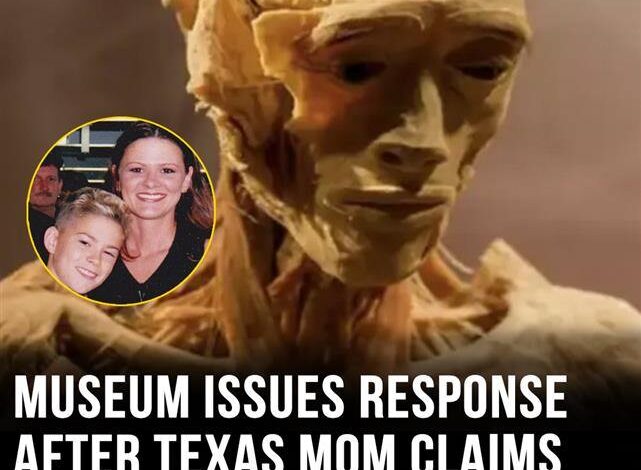
The Las Vegas exhibit was supposed to be educational—quiet, clinical, the kind of place where visitors wander slowly and stare at human anatomy without thinking too much about the lives behind the bodies. But for one Texas mother, the visit turned into something far darker. What most people saw as a museum display, she saw as her son—skinned, posed, and turned into a scientific attraction. And she hasn’t stopped fighting that belief, no matter how many officials insist she’s wrong.
Kim Erick has been living with unanswered questions ever since her 23-year-old son, Chris Todd Erick, died in 2012. Police said he suffered two heart attacks caused by an undiagnosed heart condition. He was found in his grandmother’s home in Midlothian, Texas—alone, slumped, and already gone. His father and grandmother handled the cremation immediately, and Kim received only a necklace containing what she was told were some of his ashes. From the start, it felt too fast, too neat, too closed off. But grief has a way of swallowing your instincts, and she spent months trying to convince herself that the official story was true.
Then she saw the bruises in the police photos. Dark marks on his arms, patterns she didn’t understand, areas she thought looked like restraint. She pushed the police for answers, but the 2014 homicide investigation confirmed the original ruling. No evidence of foul play, no reason to reopen the case. She was left with doubt and the feeling that her son’s story had been sealed shut before anyone really listened.
Her suspicion hardened into something unshakeable when she visited the Real Bodies exhibit in 2018. People walked around calmly, observing muscles and organs preserved through plastination—a process that replaces bodily fluids with polymers to freeze a body in time. But one figure stopped Kim cold: a seated, skinless body called “The Thinker.”
Something about it felt wrong. Familiar.
She studied the skull and saw what she believed was a fracture in the same spot Chris had suffered an injury. She looked at the limbs and became convinced she recognized his proportions. And the detail that hollowed her out: the figure’s upper arm, where her son had a tattoo, appeared to have a patch of skin removed before preservation. The resemblance hit her like a blow to the chest.
She demanded that the exhibit allow DNA testing. They refused instantly. According to the organizers, the body was sourced legally from China, like the rest of the collection, and had been plastinated in 2004—eight years before Chris died. They showed documents. They pointed to archived photographs. From their perspective, the case was closed before it even began.
Kim didn’t believe them. She couldn’t.
Her resolve only deepened when she learned “The Thinker” had been quietly removed from the Las Vegas display later that year. When she tried to track where it had gone next, the trail went cold. No public notice, no updated exhibit map, no explanation. For Kim, the disappearance wasn’t coincidence—it felt like someone trying to hide something.
Her suspicions returned to the surface again in 2023, when hundreds of unidentified cremated remains were found scattered in the Nevada desert. Most had nothing to do with the exhibit, but that didn’t matter. To her, it was another sign that bodies—real people—could fall through cracks without anyone taking responsibility.
Officials continue to stand by their documentation. Investigators reiterate the same conclusion: the plastinated figure cannot be Chris. The timeline makes it impossible. The exhibit’s creation date predates his death by nearly a decade. The museum maintains that all displayed specimens were sourced legally and ethically (as far as Chinese documentation allows anyone to verify).
But Kim’s belief is rooted in something deeper than paperwork. Her conviction is built from grief, fear, and the kind of ache that refuses to fade with time. The official story hasn’t given her peace. Her questions haven’t been answered in a way she can accept. To her, the similarities she saw weren’t coincidences. They were signs. They were warnings. They were the echo of a truth that no one else wants to admit.
And so she keeps searching.
Every so often, her claim resurfaces online—someone reposts the story, someone asks if anything new has come out, someone insists she must be mistaken, while others wonder if maybe, just maybe, something darker happened behind the scenes. The conversations always ignite the same tension: how far can grief stretch your perception before the world stops listening? And how far should institutions go to prove transparency when a grieving parent is convinced they’ve been deceived?
Kim says she won’t stop until she knows exactly what happened to Chris, even if she has to chase down shadows and dead ends for the rest of her life. Her fight isn’t just about a body in an exhibit anymore. It’s about dignity. Truth. Closure. The things she never got.
The museum has facts, documents, and time on its side.
Kim has motherhood.
And sometimes, the two are at war in a way no investigation can neatly resolve.
But one thing is certain: for Kim, the story isn’t over. Not until she says it is.