Mechanic Caught His Mother-in-Law Trying to Kill His Wheelchair-Bound Daughter, Security Cameras Exposed Everything
The wrench slipped from my oil-stained fingers and clattered against the concrete floor of Peterson’s Auto Shop, echoing like a gunshot in the empty bay. I stood slowly, wincing as the familiar ache in my lower back flared up—the tax paid for twenty years spent bending over engine blocks. Through the open garage door, I could see Redwood Glen spreading out in the late afternoon light. It was a picture-postcard town: pine-covered hills rolling toward the horizon and the shimmer of Lake Thornton visible between the trees. It looked peaceful. It looked like a lie.
I wiped my hands on a rag that was more grease than fabric and checked the clock: 4:30 PM. Nancy would be getting home from school soon. The thought of my daughter brought the only genuine smile I’d managed all day, though it faded when my phone buzzed. A text from my wife, Riley: Mom staying for dinner. Please don’t start anything. My jaw tightened. Donna Wells had been “staying for dinner” almost every night for three months, turning our home into a demilitarized zone where the ceasefire felt increasingly fragile.
When I pulled into the driveway, Donna’s pristine silver sedan was parked like a territorial marker. I found Nancy on the ramp I’d built for her wheelchair. She was ringing the small bell on her handlebar—ding, ding, ding—a bright, defiant sound.
“Daddy! Guess what we learned today? The water cycle!” she chirped, though her enthusiasm dimmed as she glanced at the front door. “Grandma said it was boring. She said I should focus on things I’ll actually need.”
The cruelty of it stung. Nancy was seven, and she was already being told by her own grandmother that her mind was as limited as her mobility. Before I could respond, Donna stepped onto the porch, looking down her nose at us.
“Riley’s getting dinner ready,” Donna snapped. “Nancy, come inside. You’re blocking the walkway.”
“She’s fine,” I said, standing tall.
“I wasn’t talking to you.” Donna’s eyes were chips of ice. Once Nancy had rolled past her, Donna turned to me with a sneer. “You spoil her, Roy. That child is a drain on Riley. You have no idea what it’s like for her, dealing with that every day while you’re hiding in your garage.”
“That is my daughter,” I said, my voice dropping an octave. “If you ever speak about her like that again, you aren’t welcome here.”
Donna just laughed, a brittle, snapping sound, and brushed past me. Dinner was a suffocating affair. Riley looked exhausted, refusing to meet my eyes, while Donna made cutting remarks about everything from the salt content of the food to the neighbors’ lawn. Later, when I tried to talk to Riley about her mother’s behavior, she snapped. She claimed Donna was “pragmatic” and was the only reason she wasn’t overwhelmed. The cost of that help, however, was being extracted directly from Nancy’s spirit.
The tension broke into open horror two weeks later during a family hike at the Ridge Trail. The trail ran close to a steep, gravelly drop-off overlooking the lake. I had positioned Nancy near the railing, her brakes locked tight. Riley had stepped away to the restrooms. While I knelt to tie my shoe, I heard Donna’s voice, low and bitter, right behind Nancy’s chair.
“She slows everyone down. Riley could have had a better life.”
I looked up just as Donna’s arms extended in a violent shove. The wheelchair lurched. The locked wheels skidded on the loose gravel, and the chair vanished through a gap in the railing. Nancy’s scream cut through the mountain air.
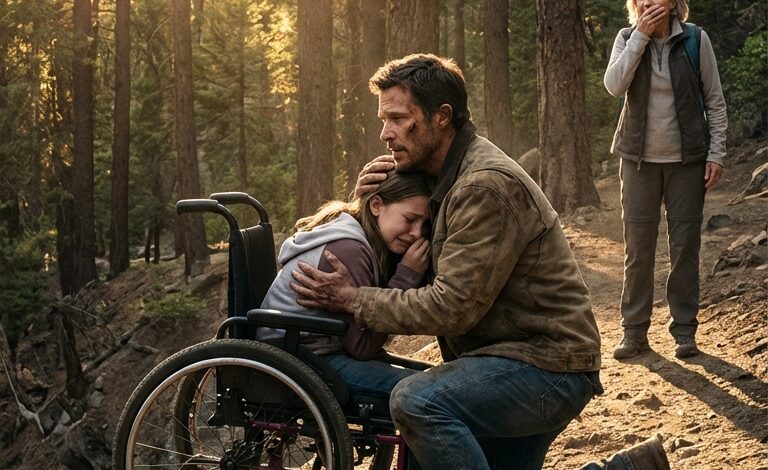
I didn’t think. I lunged, my boots scrambling for purchase as I dove down the embankment. The chair was picking up terrifying momentum, heading straight for a cluster of jagged rocks. I threw my body forward, my fingers hooking around the metal frame at the last possible second. The weight dragged me through the dirt, shredding the skin on my arms, but I dug my heels in until we skidded to a halt inches from a massive pine tree.
When I carried Nancy back up, sobbing and shaking, Donna was already performing. “The brakes! They just failed!” she shrieked.
“You pushed her,” I snarled, but Riley, arriving late to the scene, wavered. She looked at her mother’s “innocent” tears and then at me. “Roy, maybe the brakes were faulty… you know the chair is old.”
That was the moment I realized I was alone in this fight. The following Monday, I called in sick and installed high-definition security cameras throughout the house and yard—one on the porch, one in the living room, and one overlooking the pool. When Riley found the living room camera, she called me paranoid and insane. I didn’t care. I needed an unblinking eye to see what she refused to acknowledge.
The test came on a Friday evening. An emergency transmission repair kept me late at the shop. I checked my phone app at 6:15 PM and felt my blood turn to liquid nitrogen. The backyard camera showed Nancy in her spare wheelchair near the edge of the pool. Riley was nowhere to be seen. Donna was there, leaning over her.
I tapped the audio. “Everyone is tired of you, Nancy,” Donna’s voice hissed through the speaker.
“I’ll be good, Grandma,” Nancy whimpered.
“It’s too late for that.”
I saw Donna look back at the house to ensure the coast was clear, and then she pushed. The splash was deafening in my mind. I floored the gas, screaming as I raced toward home. On the screen, the pool surface rippled. Donna just stood there, watching. She didn’t call out. She didn’t jump in. She simply waited for the bubbles to stop.
I screeched into the driveway and sprinted to the backyard, diving into the water fully clothed. The chlorine stung my eyes, but I saw the glint of chrome at the bottom of the deep end. Nancy was strapped in, her pigtails floating like a halo, her eyes wide. I fumbled with the buckle, bracing my feet against the chair until the fabric tore. I broke the surface with her limp body and hauled her onto the concrete.
“Nancy! Breathe!” I started CPR, my rhythm automatic despite my terror. Finally, she coughed—a ragged, wet sound. She retched and began to wail.
Donna stood over us, her face pale but calculating. “I tried to save her,” she stammered. “She just rolled in…”
I stood up, soaking wet and lethal. “RILEY!”
Riley ran out, dropping a laundry basket in shock. Donna began her routine, but I silenced her by thrusting my waterproof phone into Riley’s face. “Watch it,” I commanded.
Riley watched. She heard the audio: Everyone is tired of you. She saw the deliberate check of the door. She saw the shove. She saw her mother watch her daughter sink. Riley made a sound like a wounded animal. She looked at Donna, who finally let the mask slip. “I did it for you, Riley! You were miserable!”
“Get out,” Riley whispered, then screamed it. “GET OUT!”
The police caught Donna an hour later. The video evidence was insurmountable. During the trial, the audio of her cold, calculated words to a seven-year-old child destroyed any hope of an insanity plea. She was sentenced to fifteen years for attempted murder and child endangerment. As the bailiffs dragged her away, she screamed at Nancy, calling her a “brat” who had ruined her life.
The aftermath was quiet but heavy. I kept the house and the primary custody; Riley moved out, finally realizing she had years of her mother’s psychological programming to undo. One year later, I took Nancy back to the Ridge Trail. She was in a new, bright red sports wheelchair she’d picked out herself. We looked out over Lake Thornton.
“She can’t hurt me anymore,” Nancy said, ringing her bell. Ding, ding, ding.
“No,” I promised. “Never again.”
“I learned about gravity today,” she said, looking at the slope. “It pulls things down. But if you have enough momentum, you can keep moving forward.”
I smiled through the tears. We turned around and headed back down the mountain, leaving the shadows behind us and moving toward a future that, for the first time, felt like the truth.