Iran Launches Widespread Attacks Across Middle East After US and Israel Strike Leadership Sites!
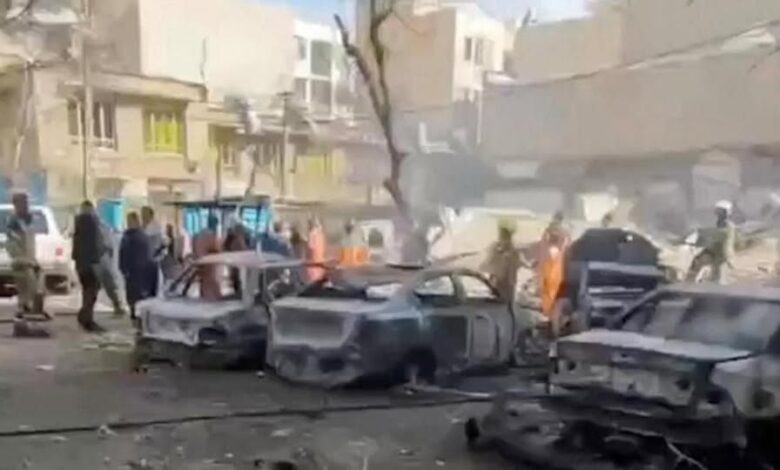
The geopolitical landscape of the Middle East has been thrust into a state of unprecedented volatility following a massive, multi-axis military confrontation that began in the early hours of February 28, 2026. What started as a surgical joint operation by the United States and Israel against Iranian leadership and strategic assets has rapidly devolved into a regional conflagration. As of March 2, 2026, the cycle of strike and counterstrike has expanded far beyond the borders of the primary combatants, engulfing the Persian Gulf, the Levant, and international energy corridors in a shadow of uncertainty.
The Decapitation Strike: February 28
The catalyst for the current crisis was a highly coordinated aerial and cyber campaign executed by U.S. and Israeli forces. Targeting what the Pentagon described as “critical nodes of command and control,” the strikes hit multiple Iranian metropolitan centers simultaneously. Explosions rocked Tehran, Isfahan, Tabriz, and the religious center of Qom. While the official objective was to neutralize Iran’s long-range missile capabilities and nuclear infrastructure, reports quickly surfaced regarding the “decapitation” of high-ranking Iranian officials.
In Tehran, satellite imagery confirmed significant structural damage to government complexes in the city center. However, the human cost of the operation has become a focal point of international scrutiny. Iranian state media reported that civilian infrastructure was caught in the crossfire, most notably in the city of Minab, where a strike allegedly hit a girls’ school. While independent verification of these casualty figures remains difficult due to restricted access, the narrative of civilian suffering has already begun to fuel domestic and regional fury.
The Iranian Response: A Regional Firestorm
Tehran’s retaliation was swift and geographically expansive. Within hours of the initial strikes, the Islamic Revolutionary Guard Corps (IRGC) initiated “Operation Martyr Soleimani II,” launching a massive barrage of ballistic missiles and “kamikaze” drones. The targets were not limited to Israel; instead, Iran utilized a “total theater” approach, striking U.S. military installations and host-nation assets across the Gulf.
Air defense systems in Qatar, Bahrain, Kuwait, and the United Arab Emirates were pushed to their operational limits. While the majority of the incoming projectiles were successfully intercepted by Patriot and THAAD batteries, the sheer volume of the saturation attack allowed for several “leakers.” In the UAE, at least one fatality was confirmed due to falling debris from an intercepted missile, and a major fire broke out at the Fairmont The Palm in Dubai after being struck by fragments. This expansion of the conflict into the UAE and other neutral Gulf states highlights the “miscalculation risk” that analysts have feared for years: a localized conflict becoming a global economic and humanitarian catastrophe.
International Fallout and Diplomatic Gridlock
The global reaction to the escalation has been polarized. Russia and China issued immediate condemnations of the U.S.-Israeli strikes, with Moscow labeling the operation a “flagrant violation of international law” and an “act of unprovoked aggression.” An emergency session of the United Nations Security Council was called, but as is often the case in high-stakes confrontations among permanent members, the session yielded little more than rhetorical posturing.
European capitals have expressed a more nuanced anxiety. While acknowledging Israel’s right to defend itself against nuclear threats, leaders in Paris, Berlin, and London have urged “maximum restraint,” citing the catastrophic potential of a full-scale war on global energy markets. The price of Brent crude surged by nearly 15% in the 48 hours following the Tehran strikes, reflecting fears of a prolonged closure of the Strait of Hormuz—the world’s most critical oil chokepoint.
Life Under the Sirens: The Civilian Experience
For the millions of civilians living in the path of the missiles, the strategic calculations of generals in Washington or Tehran are of little comfort. In Tehran, reports suggest a mass exodus toward rural areas as residents fear a second wave of “decapitation” strikes. In cities like Tel Aviv and Dubai, the sound of air-raid sirens has become a hauntingly regular occurrence, forcing families into reinforced shelters and disrupting the flow of daily life.
The psychological impact of “living under the dome” is profound. In the Gulf states, which have marketed themselves for decades as bastions of stability and luxury, the visual of missile debris falling near five-star hotels has shattered the illusion of immunity. Markets have reacted accordingly: transportation networks are snarled, and airspace closures across Iran and Iraq have forced commercial airlines to reroute flights over Africa or Central Asia, adding hours to international travel and millions to operational costs.
The Fragile Path to De-escalation
Military analysts describe this moment as a “civic stress test” for the entire Middle East. The geographic breadth of the strikes—spanning from the Mediterranean to the Arabian Sea—suggests that the traditional “rules of engagement” have been discarded. Iran’s position remains defiant; state media continues to broadcast warnings that any nation hosting U.S. assets is a legitimate target, effectively turning the entire region into a potential battlefield.
Conversely, the U.S. administration has framed the strikes as a “necessary preventative measure” to stop a nuclear-armed Iran from achieving regional hegemony. President Trump’s characterization of the operation as a “rapid success” suggests that the White House may not see a need for further escalation, provided Iran ceases its retaliatory launches. However, in the logic of Middle Eastern conflict, “silence is seen as weakness,” and both sides are now trapped in a cycle where backing down requires a level of diplomatic cover that currently does not exist.
Conclusion: A Region on the Brink
As of the evening of March 2, the situation remains fluid. The coming days will determine if the Middle East enters a period of “contained hostility” or descends into a multi-state war. History shows that once the initial “shock and awe” of a campaign fades, the grinding reality of attrition begins. The human cost, already climbing in Minab and the UAE, risks being overshadowed by the grand strategy of the powers involved.
Clarity will come in stages, but the immediate necessity is for a “red line” that both sides can respect to prevent the total collapse of regional order. Whether through back-channel negotiations in Muscat or third-party mediation by European powers, a diplomatic off-ramp is desperately needed. Without it, the “Quiet Giant” of the Middle East—the relative peace that has allowed for decades of economic growth—may be gone for good, replaced by a permanent state of high-velocity warfare.