I Bought My Daughter a Teddy Bear, Years After She Died, I Opened It and Heard Her Voice Again
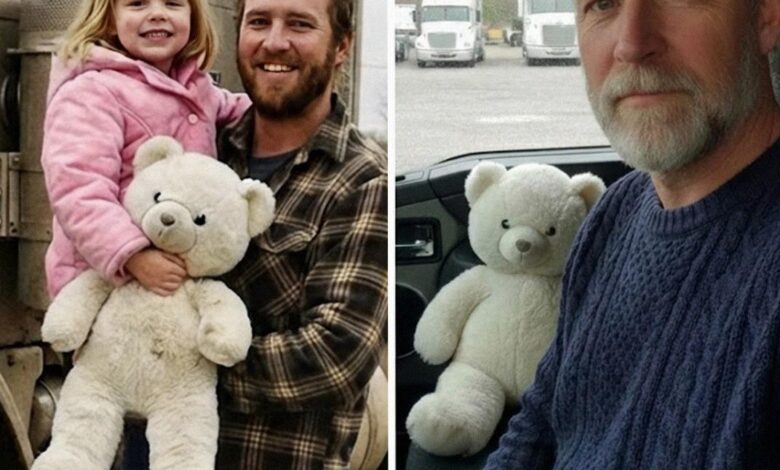
I used to think grief would arrive like a storm.
Loud. Violent. Impossible to ignore.
Sirens, shouting, something breaking just to match what’s breaking inside you.
But that’s not how it happened.
Mine came quietly.
It settled into long highways, empty miles, and the bitter taste of gas station coffee at three in the morning. It lived in silence—the kind that fills a truck cab when there’s no one left to call.
Ten years ago, I was barely holding things together.
New to trucking. Broke more often than not. Trying to figure out how to be a good father while spending most of my life on the road.
My daughter Emily was turning four.
She didn’t want anything complicated.
Just a teddy bear.
“As big as me,” she said.
I found it at a dusty flea market outside Dayton. It was oversized, white, and slightly crooked—one eye stitched just a little higher than the other. The woman selling it, Linda, saw me hesitate when I checked my wallet.
“Ten bucks,” she said with a soft smile. “Dad price.”
I bought it without thinking twice.
Emily wrapped herself around that bear like it was the greatest thing she’d ever been given. She named him Snow before we even got back to the car.
And somehow, Snow became more than just a toy.
He became part of us.
Every time I left for a trip, Emily would drag that giant bear out to the driveway, struggling to carry him but refusing help.
“Buckle him in,” she’d say.
And I did.
Every single time.
Seatbelt across his belly, like he was just another passenger.
At night, when the road stretched endlessly ahead and loneliness crept in, that lopsided bear sat beside me, quiet and steady. It sounds ridiculous, but it helped. It made the silence feel less empty.
When I came home, Emily would run out to the truck, unbuckle him, and smile like she’d just completed a mission.
“See?” she’d say. “He protected you.”
I’d tap Snow’s head. “Good job, partner.”
Even when she got older—too cool, too sarcastic—she never stopped doing it.
She’d roll her eyes, call it stupid, but she always made sure Snow was packed before I left.
It became our thing.
The one constant between two lives that didn’t always line up.
Her mom, Sarah, never liked it.
She said it made me look childish. Like I needed a stuffed animal to feel like a parent.
Maybe she was right.
But the truth was simpler.
I needed something that felt like home.
Sarah and I didn’t fall apart all at once.
We wore down.
Slowly.
Distance, exhaustion, too many conversations about schedules instead of feelings. By the time Emily turned twelve, we signed the papers without much of a fight.
But Emily stayed the same.
Every trip.
Every goodbye.
Snow went in the truck.
No exceptions.
Then everything changed.
It started small.
Bruises that didn’t make sense.
Tiredness that didn’t go away.
Then hospital visits.
Tests.
Words no parent is ever ready to hear.
Cancer.
Emily handled it better than any of us.
She joked with nurses. Named her IV pole “R2-Drip2.” Made us laugh when we didn’t want to.
One night, sitting under harsh hospital lights, she grabbed my hand and looked straight at me.
“Promise me something,” she said.
“Anything,” I told her.
“Keep driving.”
I shook my head. “I’m not going anywhere.”
“Yes, you are,” she said firmly. “Promise, Dad.”
There was no arguing with her.
So I promised.
Two weeks later, she was gone.
And that promise felt like it was carved into me.
After the funeral, I did something I’m not proud of.
I started throwing her things away.
Clothes. Drawings. Toys.
Stuffing everything into black trash bags like I could outrun the memories if I moved fast enough.
Sarah walked in and saw them by the door.
“What are you doing?” she asked.
“Surviving,” I said.
Her face changed instantly.
“You’re throwing her away.”
We argued.
She left.
And after that, we barely spoke.
Except when we had to.
The only thing I couldn’t bring myself to get rid of was Snow.
Maybe because he didn’t carry her scent.
Maybe because he felt like a piece of something I couldn’t explain.
So he went back into the truck.
Buckled in.
Like always.
Years passed.
Or maybe they just blurred together.
I told people I was okay.
I laughed when I needed to.
That was enough for them.
But last week, something shifted.
I was packing for another trip when I realized the passenger seat was empty.
It felt wrong.
Like something important was missing.
I dug through my closet and found Snow buried under blankets, forgotten in a way I didn’t want to admit.
When I picked him up, I heard it.
A small crack.
Something inside.
I froze.
Ran my hands along his back until I found a seam—barely open.
Inside, there was something hard.
I cut the stitches carefully, pulling stuffing aside until I found it.
An envelope.
And a small voice recorder.
The envelope had Sarah’s handwriting.
The recorder had a label in messy letters:
“FOR DAD.”
I sat down, staring at it, my hands shaking.
Then I pressed play.
Static.
Then—
“Hi, Daddy.”
Her voice hit me like I’d been dropped into ice water.
I couldn’t breathe.
She giggled.
“If you’re listening, you found it. Good job.”
I covered my mouth, but the sound that came out wasn’t human.
Then I heard Sarah’s voice in the background.
“Keep going, Em.”
Emily laughed.
“Mom helped me hide this in Snow. Because Dad is bad at surprises.”
Then her voice softened.
“I need you to be okay even if I’m not.”
I broke.
Completely.
She told me there was a box buried in the yard.
By the old maple tree.
“Keep driving,” she said. “Don’t get stuck.”
Then static.
Then, for a second, Sarah’s voice.
“Jake, I’m sorry… I didn’t send it because—”
Silence.
I opened the envelope.
Sarah explained everything.
Emily had planned it months before she died. Made Sarah promise not to tell me. Sarah was going to send it after the funeral—but when she saw the trash bags, she couldn’t risk it being thrown away.
“She was afraid you’d lose it,” she wrote.
I went outside immediately.
No coat.
No hesitation.
The maple tree stood there like it always had.
I dug like I was chasing her voice through the ground.
When I hit the box, my hands were shaking so hard I could barely open it.
Inside were photos.
Polaroids.
Moments I didn’t know existed.
Me asleep on the couch.
Us at a diner.
Snow buckled into my truck.
And one of Emily in the hospital, bald and smiling, holding that same bear.
On the edge of the photo, she’d written:
“Still magic.”
There was a letter.
“Dad,” it started. “If you found this, you’re still here. Good.”
She told me I was a good father.
Even when I didn’t believe it.
Then she wrote something that changed everything.
“Tell Mom you’re not mad. She cries in the car.”
I sat there in the dirt and cried like I hadn’t in years.
Not anger.
Not anymore.
Just regret.
I called Sarah.
When she answered, her voice was careful.
“Hello?”
“It’s Jake,” I said. “I found it.”
Silence.
Then a sharp inhale.
“You found it?”
“She told me to tell you I’m not mad.”
Sarah broke.
And for the first time in years, we talked.
Really talked.
Later, I drove to her house.
Snow buckled in beside me.
When she opened the door, we didn’t say much.
She touched the bear’s ear gently.
“She loved you so much,” she said.
“I’m sorry,” I replied.
“I am too.”
We stood there, two people who had lost the same thing in different ways.
And finally understood it.
Snow is back in the truck now.
The seam is stitched, but you can still see where it opened.
And sometimes, late at night, I play that recording.
“Hi, Daddy.”
And I remember the promise.
Keep driving.
Don’t get stuck.
Because she knew something I didn’t.
That even when everything stops…
You don’t.