I Bought My Daughter a Teddy Bear at a Flea Market – After She Died, I Discovered What She Had Hidden Inside
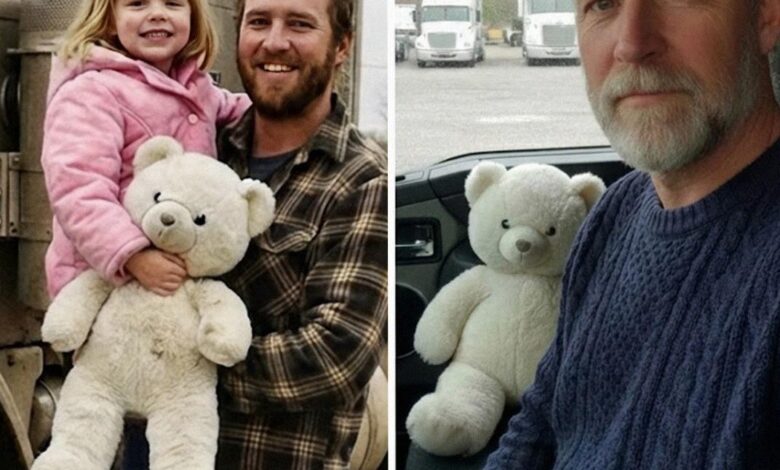
Grief is often portrayed as a loud, shattering event—a cacophony of sirens and the sound of things breaking. But when mine finally arrived, it was quiet, carried on the hum of highway miles and the stale, bitter scent of thermos coffee. I am a truck driver, a man accustomed to the solitude of the open road, yet nothing could have prepared me for the silence that followed the loss of my daughter, Emily.
Ten years ago, I was a novice in the trucking industry, struggling to make ends meet and desperate to be the kind of father who could conjure magic out of thin air. Emily was turning four, and her birthday wish was simple yet monumental: she wanted a teddy bear “as big as me.” At a sun-bleached flea market outside Dayton, I found him. He was a giant, plush white bear with a lopsided face, one plastic eye stitched slightly higher than the other, giving him an expression of permanent, inquisitive concern. The woman selling him noticed my fraying wallet and offered him for ten dollars—the “Dad price.” Emily named him Snow, and from that moment, he was less of a toy and more of a family member.
Snow became the centerpiece of our departing ritual. Every time I prepared for a long haul, Emily would drag that massive bear to the truck, grunting under his weight, and command me to “buckle him in.” I always complied, pulling the heavy nylon seatbelt across his plush belly. He sat in the passenger seat, a silent sentry against the loneliness of the cab. When I returned home, Emily would sprint down the driveway, unbuckle her partner, and declare that he had kept me safe. As she grew older, the ritual persisted, even when she entered that teenage phase where everything her father did was “dumb.” She never forgot to pack him.
My relationship with Emily’s mother, Sarah, didn’t survive the long absences and the exhausting logistics of our lives. We didn’t explode; we simply wore thin, like old tires on a rough road. By the time Emily was twelve, the divorce was final. Sarah hated the bear, viewing it as a childish mascot, but for me, Snow was the only thing that made the truck feel like a home instead of a workplace.
The world shifted on its axis the year Emily turned thirteen. It began with inexplicable bruises and a fatigue that wouldn’t lift. Soon, our lives were measured in hospital ceilings, IV poles, and the sterile hum of oncology wards. Emily, ever the optimist, named her IV stand “R2-Drip2.” She refused pity and used her wit to keep us all afloat. One night, under the buzzing fluorescent lights of the hospital, she squeezed my hand and made me promise to keep driving. Two weeks later, she was gone.
In the raw, jagged aftermath of the funeral, I retreated into a survivalist shell. I began stuffing Emily’s life into black trash bags—drawings, glitter pens, the colorful artifacts of a childhood cut short. When Sarah saw the bags by the door, she accused me of throwing our daughter away. I told her I was just trying to survive. We didn’t speak again for years, bound only by the cold formality of paperwork.
The only thing I couldn’t part with was Snow. I buckled him back into the truck and drove through a blur of years, motel curtains, and endless asphalt. I told everyone I was fine. Last week, however, while packing for a run to Colorado, a sudden panic seized me. The passenger seat was empty. I realized I had buried Snow in the back of a closet months ago, an unconscious attempt to misplace my grief. As I pulled him out from under a pile of blankets, I heard a small, brittle crack.
Tracing the seam along the bear’s back, I felt something hard hidden beneath the synthetic fur. I carefully cut the stitches and pulled out the stuffing until I found a voice recorder and a small envelope. The recorder had a messy label in Emily’s handwriting: “FOR DAD.” My hands shook as I pressed play.
“Hi, Daddy.” Her voice hit me like a physical wave. She giggled, explaining that she and her mom had hidden this “surprise” inside Snow because I was notoriously bad at spotting them. Her tone then softened, becoming impossibly mature for a thirteen-year-old. “I need you to be okay even if I’m not,” she whispered. She told me she had buried a box for me in the backyard, beneath the old maple tree where we used to play baseball. The recording faded into static, ending with her final command: “Keep driving. Don’t get stuck.”
The envelope contained a letter from Sarah. She explained that Emily had orchestrated the recording months before her death, making Sarah swear to keep the secret. Sarah had intended to give it to me after the funeral, but when she saw me throwing Emily’s things into trash bags, she feared I would discard the bear and the message along with everything else. She had waited for a time when I might finally be ready to listen.
I went into the backyard without a coat, the winter air biting at my skin. I dug beneath the bare branches of the maple tree until the shovel hit plastic. Inside the buried box were dozens of Polaroids. There was a photo of me snoring on the couch, one of us sharing milkshakes, and another of Snow buckled into the truck. The most heartbreaking image was Emily in her hospital bed, bald and beaming, holding Snow up like a trophy. On the border, she had written two words: “Still magic.”
Her final letter in the box was a grace note. She told me I was a good father, even when I doubted myself, and she left me one last mission: “Tell Mom you’re not mad. She cries in the car.”
The anger that had fueled my isolation for years evaporated. I felt a profound sense of shame for the silence I had maintained. I called Sarah immediately. When she answered, her voice was a fortress of caution, but it crumbled when I told her I had found the “magic.” We spoke for the first time without barbs or invoices. I told her I wasn’t mad, and the sound she made—a mixture of a sob and a long-held breath—was the sound of a wound finally beginning to close.
I packed Snow back into the truck and drove to Sarah’s house. We stood on her porch, two people who had been broken by the same loss but had forgotten how to lean on one another. I apologized for the trash bags; she apologized for the years of silence. We cried together for the first time since we lost her.
Snow is back in his place now, buckled into the passenger seat of my rig. The seam on his back is stitched shut, though the scar remains visible—a reminder of where the truth was hidden. Every time the road gets long and the loneliness threatens to settle in, I remember the promise I made to a girl who was wiser than her years. I hear her voice through the static, a constant reminder to keep moving forward. I keep driving, but I am no longer stuck. I am just a man heading home, with a partner by my side who reminds me that even when things feel broken, the magic remains.