He Promised to Come Back, 30 Years Later, I Found Him Waiting Under the Same Tree, And the Truth Was Worse Than Death
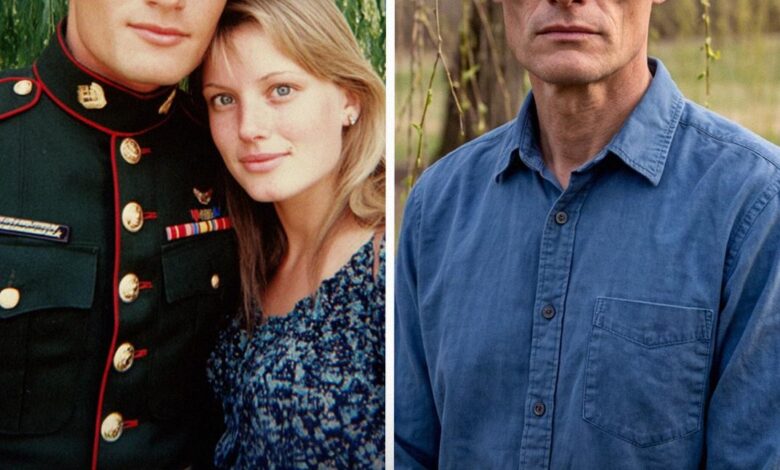
Every year on February 22nd, I followed the same ritual.
No matter how busy life became, no matter how much time passed, I always returned to it. It wasn’t something I questioned anymore. It was simply part of who I was—like breathing, like remembering.
But this year felt different.
I couldn’t explain it, but there was a quiet pressure in my chest, like something unfinished was about to finally surface. Something I had carried for decades without knowing how—or if—it would ever end.
That morning, I opened the cedar chest at the foot of my bed.
Inside, carefully folded, was the only piece of him I still had—Elias’s Marine uniform. I lifted it gently, pressing it against my chest the way you hold something that has become more than an object. It still felt like him. That doesn’t make sense, I know. Fabric doesn’t hold a person for thirty years.
But grief doesn’t follow logic.
I stopped trying to explain that a long time ago.
I sat there for a while, letting the weight of memory settle in, letting the tears come the way they always did. Then, just as carefully, I folded the uniform again, smoothing it the way he used to, and placed it back in its place.
Some things you don’t disturb.
Some things you preserve.
I grabbed my coat, my keys, and drove to the only place where I ever felt close to him.
The willow tree.
We found it when we were seventeen—young, reckless, completely consumed by a love that felt endless. It stood at the bend of a quiet river, its branches hanging low enough to brush the water when the current rose. The first time we stepped beneath it, it felt like we had entered a world that belonged only to us.
And we kept it that way.
We went back every week. No one else knew about it. It was ours—untouched, hidden, sacred.
Years later, that same place became something even more important.
That’s where he proposed.
No ring, just a cheap plastic one he had grabbed on the way. But the way he looked at me made it feel like nothing else mattered. I wore that ring like it was real, like it was forever.
And then came the day everything changed.
He stood under that same willow, wearing his Marine uniform, ready to leave. I fixed his collar even though it didn’t need fixing—just to keep my hands steady.
“I’ll come back,” he told me. “Right here. I promise.”
I believed him.
Before he could walk away, I told him the truth I had been holding inside me.
“I’m pregnant.”
He didn’t hesitate. He smiled—wide, certain, like I had just given him the world.
“When I come back,” he said, “we’ll get married.”
Then he kissed me.
And he left.
I watched him walk away until I couldn’t see him anymore.
That was the last time I saw him.
Weeks later, the telegram arrived.
Lost at sea. Shipwreck. No survivors.
No body.
No goodbye.
Just words printed on paper, cold and final.
I was twenty-three, four months pregnant, and suddenly alone.
Everything stopped that day—not physically, not visibly, but in all the ways that mattered. Life didn’t end. It changed shape. It became quieter, heavier, something I carried instead of lived.
I stayed in the same house.
Raised our daughter, Stacy, there.
She had his eyes—sea-glass green, the kind that never quite settled. Every time she looked at me, I saw him. And I felt both grateful and broken in the same moment.
Years passed.
People told me to move on.
I didn’t.
Because some promises don’t disappear.
They wait.
Stacy grew up strong. At twenty-two, she told me she was joining the Navy.
“I need to honor him,” she said.
I wanted to beg her not to go.
But I didn’t.
“Just come home,” I told her.
And I meant it more than she could ever understand.
Then came this February.
I parked at the edge of the field and walked toward the willow, the grass damp beneath my feet, the river louder than usual after the rain.
I saw it from a distance.
And I stopped.
Because someone was already there.
A man stood beneath the branches, facing the water. Still. Silent. Like he had been waiting.
Something in me shifted.
When he turned, my mind refused to accept what I was seeing.
He was older. Thinner. Worn by time.
But his eyes…
They were the same.
Exactly the same.
“Elias?” I whispered.
The name came out before I could stop it.
His face broke.
Tears filled his eyes as he took a step toward me.
“They told you I was gone,” he said.
I couldn’t move.
Couldn’t think.
Couldn’t understand how a man I had buried in my heart for thirty years was standing in front of me, breathing.
He didn’t rush me.
He waited.
And then he told me everything.
He had survived the shipwreck.
Rescued.
Hospitalized.
Alive.
But when he woke up, his parents had already told him I had moved on. That I had lost the baby. That I was gone.
And he believed them.
Not completely.
But enough.
Enough to stay away.
Enough to let time pass.
Enough to let thirty years slip by.
I listened in silence, the weight of everything pressing down on me.
“And now?” I asked.
“What changed?”
He looked at me, steady and certain.
“I saw her,” he said.
Our daughter.
He had met Stacy by accident. Recognized her instantly. Her eyes. My face. Everything we had created together standing right in front of him.
And when she told him I never left—that I still came here every year—he knew where to find me.
So he came.
And he waited.
All morning.
“I waited thirty years,” he said softly. “A few more hours didn’t matter.”
That broke me.
I walked toward him, slowly at first, then faster, until there was no distance left between us.
I touched his face.
Real.
Solid.
Alive.
“I never left,” I cried. “I stayed. I waited.”
He pulled me into his arms, and for the first time in decades, something inside me finally let go.
Not of him.
But of the waiting.
A month has passed since that day.
We’re getting married in the spring.
Under the willow.
Stacy will walk me down the aisle.
And this time, when he makes a promise—
I know he’ll keep it.
Because some promises don’t disappear.
They just take time to find their way back.