GOLD NEEDLE MYSTERY Doctors Shaken By Secret Objects Hidden Inside Womans Knee XRay For Decades
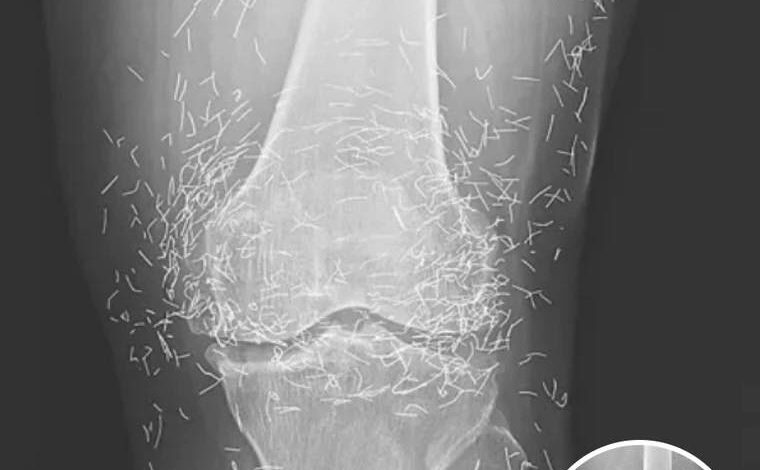
When a 65-year-old woman walked into a medical clinic in South Korea complaining of chronic, debilitating joint pain, the physicians expected to see the standard markers of a long-term degenerative condition. They anticipated the narrowing of joint spaces, the telltale bone spurs, and the loss of cartilage that defines a life lived with osteoarthritis. However, the moment the X-ray film was developed, the medical team was met with a sight that defied conventional clinical experience. Staring back at them from the glowing screen were hundreds of tiny, hair-thin gold needles, meticulously embedded deep within the soft tissue and muscle surrounding her knees. This was not a sudden injury or a freak accident; it was the physical map of a years-long battle against pain that had pushed a patient to seek an extreme form of alternative relief.
The patient’s journey began with a diagnosis that millions of people around the globe face every day. Osteoarthritis is a relentless mechanical disease that systematically breaks down the protective cartilage that cushions the ends of the bones. As the cartilage wears away, the bones begin to rub directly against one another, triggering a cascade of inflammation, swelling, and a stiffness that can turn the simple act of walking into an agonizing chore. For this woman, the standard path of modern medicine had reached a frustrating dead end. She had dutifully tried the prescribed regimen of painkillers and anti-inflammatory medications, but the temporary relief they offered came at a high cost. The drugs began to wreak havoc on her digestive system, causing chronic stomach issues that eventually became as burdensome as the joint pain itself.
Desperate for a solution that didn’t involve a chemical trade-off, she turned to the deep-rooted traditions of her culture. In many parts of Asia, particularly South Korea, acupuncture is not just a secondary option; it is a primary pillar of the healthcare system. However, the specific procedure she underwent went far beyond the typical temporary insertion of needles. In a practice known as gold thread or needle implantation, practitioners intentionally leave the needles inside the body. The theory behind this controversial method is that the gold provides continuous, long-term stimulation to the acupuncture points, theoretically offering a permanent blockade against the pain signals caused by arthritis. To the patient, it was a promise of a life without pills; to the doctors who saw the X-ray decades later, it was a potential medical time bomb.
The medical community is increasingly vocal about the hidden dangers associated with leaving foreign objects inside the human body. Dr. Ali Guermazi, a renowned professor of radiology at Boston University, has studied the body’s reaction to invasive materials and offers a stark warning. The human immune system is designed to be a vigilant sentry; it does not take kindly to intruders, even those made of noble metals like gold. The moment a foreign object is detected, the body initiates a defense mechanism known as a foreign body reaction. This starts with chronic inflammation and eventually leads to the formation of dense, fibrous scar tissue as the body attempts to wall off the intruder. In some cases, these “forgotten” needles can become the focal point for infections or the development of painful abscesses that require surgical intervention to resolve.
Beyond the biological risks, these hidden needles pose a significant challenge to modern diagnostic technology. In the field of radiology, metal is a notorious disruptor. These hundreds of gold fragments create “artifacts” on imaging, appearing as bright white streaks that can obscure the very anatomy doctors need to see. This makes it incredibly difficult to track the progression of the patient’s arthritis or to screen for other underlying issues like bone tumors or fractures. The presence of metal also creates a dangerous barrier to one of the most powerful tools in medicine: the MRI. Because an MRI uses incredibly strong magnets, any metallic object inside the body can be subjected to intense force. If a patient with gold needles were to accidentally undergo an MRI, the magnetic pull could cause those needles to migrate through the tissue, potentially puncturing nerves, slicing through tendons, or tearing open major blood vessels, leading to life-threatening internal bleeding.
Despite these documented risks, the allure of “natural” and “permanent” pain relief continues to drive the popularity of extreme acupuncture techniques. In countries where these traditions are passed down through generations, the cultural trust in the procedure often outweighs the scientific skepticism of the West. While advocates of gold needle implantation claim the metal provides a unique bio-electric benefit that supports joint health, the broader scientific community remains unconvinced. Rigorous, large-scale studies proving that permanent needle implants are more effective than standard, temporary acupuncture—or even placebo treatments—are virtually non-existent.
The curiosity surrounding acupuncture is not limited to Asia. In the United States, the practice has seen a massive surge in popularity as patients look for ways to manage chronic pain without relying on opioids or invasive surgeries. According to data from the National Institutes of Health, millions of Americans now integrate acupuncture into their wellness routines. However, the version of acupuncture practiced in reputable U.S. clinics is strictly temporary; needles are inserted for a short duration and then carefully removed and accounted for. The case of the South Korean woman serves as a critical boundary marker for the American public, illustrating the point where a helpful alternative therapy can transition into a dangerous medical complication when taken to an unregulated extreme.
The woman’s case, which was eventually documented in the prestigious New England Journal of Medicine, has become a landmark cautionary tale for healthcare providers and patients alike. It highlights the profound disconnect that can sometimes exist between traditional beliefs and modern safety standards. While the woman may have felt an initial sense of relief from the “continuous stimulation” of the gold, she was ultimately left with a knee joint that was a literal minefield of metal. The X-rays serve as a haunting visual reminder that our bodies are not meant to be permanent containers for external materials, no matter how precious the metal may be.
As the medical world continues to evolve, the lesson from this stunning X-ray is clear: transparency and evidence must be at the heart of every treatment plan. Patients suffering from the grueling effects of osteoarthritis must be empowered to explore every available avenue for relief, but they must also be fully informed of the long-term consequences. What may seem like a harmless, drug-free alternative in the short term can lead to a lifetime of hidden complications that no doctor can easily undo. The human body is a masterpiece of biological engineering, and when we introduce foreign elements into its delicate machinery, we must be prepared for the body to fight back. Before stepping into the world of unconventional medicine, it is vital to remember that the goal of treatment is not just to silence the pain, but to preserve the integrity of the body for the long haul. The South Korean woman’s knees tell a story of a search for comfort, but they also serve as a permanent warning to the rest of the world that some “cures” can be just as dangerous as the disease itself.