Dubais Famous Fairmont Hotel Engulfed in Flames After Iranian Air Strike Amid Middle East Escalation
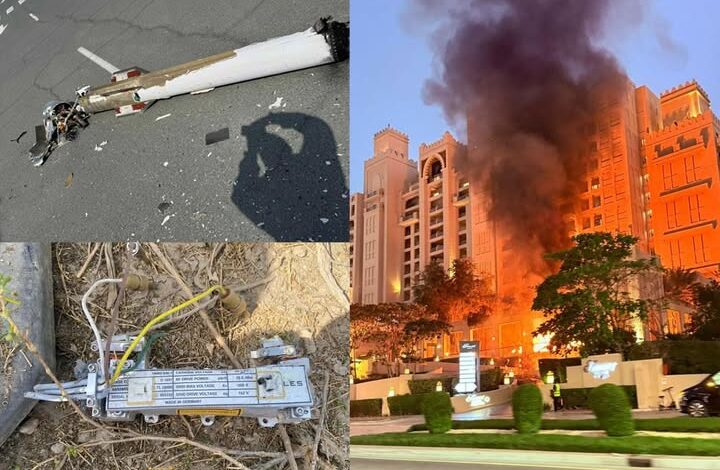
The night sky over Dubai, typically defined by the shimmering architectural silhouettes of the Burj Al Arab and the Burj Khalifa, was transformed into a theater of kinetic warfare on the evening of February 28, 2026. In a harrowing escalation of the conflict currently engulfing the Middle East, the iconic Fairmont The Palm became the site of a major conflagration. The luxury hotel, a cornerstone of the Palm Jumeirah’s tourism economy, was engulfed in flames after what UAE defense authorities describe as “falling debris” from intercepted Iranian projectiles struck the island’s perimeter. This incident marks a significant expansion of the regional crisis, bringing the direct consequences of the U.S.-Israeli-Iranian confrontation to the doorstep of one of the world’s most glamorous travel destinations.
The Strike: Interception and Impact
The sequence of events began shortly after 9:00 PM local time, as air defense sirens—a sound rarely heard in the stable metropolis of Dubai—began to wail across the coast. According to the UAE Ministry of Defense, national air defense batteries successfully engaged several incoming “hostile targets” over Gulf airspace. These targets are believed to be part of the broader Iranian retaliatory wave following the reported decapitation of Tehran’s leadership earlier that morning.
While the interceptions were technically successful, the physics of modern missile defense means that “neutralized” targets do not simply vanish. In this instance, the shattered remnants of an intercepted ballistic missile or long-range drone plummeted toward the Palm Jumeirah. Eyewitnesses reported hearing a series of thunderous atmospheric “claps”—the sound of kinetic interceptors meeting their targets—followed by a high-velocity impact near the Fairmont’s main structure.
Images and videos rapidly circulating on encrypted messaging apps and social media showed a terrifying sight: thick, oily black smoke billowing from the upper tiers of the Fairmont The Palm. The fire, fueled by structural materials and the desert wind, spread quickly across the hotel’s exterior. Dubai Civil Defence, renowned for its rapid response capabilities, arrived on the scene within minutes, deploying specialized high-rise firefighting units to contain the blaze.
The Human Toll and Emergency Response
In the immediate aftermath of the impact, the lobby and surrounding beach clubs of the Fairmont were scenes of controlled chaos. Guests, many of whom were international tourists oblivious to the day’s geopolitical shifts, were evacuated onto the sands of the Palm. Dubai health officials have since confirmed that four individuals sustained injuries during the event. These victims were stabilized on-site by paramedics before being transported to nearby trauma centers; fortunately, no fatalities have been reported at the hotel.
The response from the Dubai Civil Defence has been hailed as a masterpiece of emergency management. By utilizing advanced drone-assisted firefighting and high-pressure water cannons, crews were able to bring the primary fire under control in under three hours. However, the psychological impact on the city’s residents and visitors is far more difficult to contain. The Palm Jumeirah is not just a residential area; it is a global symbol of prosperity and safety. To see it “engulfed in flames” is a visceral shock to the narrative of Dubai as a safe haven in a volatile region.
Broader Geopolitical Context: The Gulf Under Fire
The fire at the Fairmont is a single, vivid data point in a much larger regional “firestorm.” Since the joint U.S.-Israeli strikes on Tehran, the entire Gulf region has become a “hot zone.” Air defense engagements have been reported in Bahrain, Kuwait, and Jordan as Iran’s “Integrated Fire” strategy attempts to saturate the defensive capabilities of Western allies and their regional partners.
The UAE government has issued a sharp condemnation of the attacks, labeling the missile activity a “flagrant violation of national sovereignty.” While the UAE has maintained a delicate diplomatic balance for years, the strike near the Fairmont—even if unintentional or a result of interception—forces the nation into a more assertive defensive posture. Military analysts suggest that the “proximity of debris” to such high-profile civilian infrastructure indicates a deliberate attempt by Tehran to disrupt the economic stability of the Gulf states, signaling that no “neutral” ground remains in this conflict.
Economic and Tourism Repercussions
The long-term impact on Dubai’s tourism sector is currently being evaluated by the Department of Economy and Tourism. The Palm Jumeirah hosts dozens of the world’s most prestigious hospitality brands and thousands of high-net-worth residents. An event of this magnitude inevitably triggers a wave of cancellations and a reassessment of risk by international travel agencies.
However, Dubai’s leadership has historically shown remarkable resilience in the face of crises. Officials have emphasized that the city’s emergency systems functioned exactly as intended. The interception prevented a direct hit that could have resulted in hundreds of casualties, and the rapid suppression of the fire saved the core structural integrity of the Fairmont. The message from the authorities is clear: while the region is in turmoil, Dubai remains prepared to defend its skies and its citizens.
The Fog of War and the Search for Clarity
As of March 2, 2026, investigations are ongoing to determine the precise origin of the debris. Forensic teams are analyzing fragments recovered from the hotel’s perimeter to identify the specific missile or drone system used. This technical attribution is vital for the UAE’s diplomatic response in the United Nations and its coordination with the U.S. Central Command (CENTCOM).
In an era defined by “hyper-connectivity,” the spread of unverified information remains a secondary threat. Authorities have urged the public to rely exclusively on official state media for updates, as rumors of “direct strikes” and “multiple hotel fires” have caused unnecessary panic in the residential districts of Dubai Marina and Jumeirah Beach Residence.
Conclusion: A City on High Alert
The Fairmont The Palm fire serves as a sobering reminder that in 2026, the boundaries between “front lines” and “vacation spots” are increasingly porous. The residents of Dubai, who have spent decades building a global hub of commerce and luxury, are now finding themselves in the crosshairs of a generational conflict.
While the fires have been extinguished and the smoke has cleared, the underlying tension remains. The immediate focus is on the medical recovery of the injured and the structural assessment of the Fairmont, but the broader eyes of the city are fixed firmly on the horizon. The events of February 28 have rewritten the security manual for the Gulf, proving that even the most “famous” and “protected” locations are susceptible to the unpredictable debris of a region in transition.