Donald Trump Gives White House Reporter a Controversial Nickname, Hints at Legal Action!
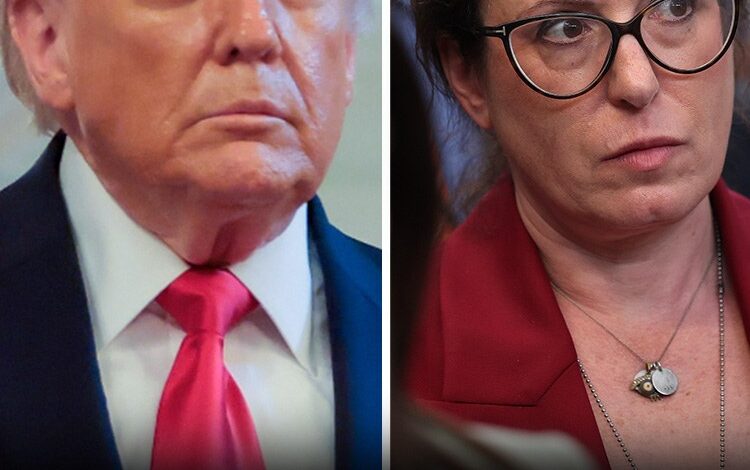
The relationship between Donald Trump and the American press has long been defined by a volatile, percussive energy that transcends traditional political friction. On March 6, 2026, this dynamic was once again illuminated when Trump utilized his Truth Social platform to launch a sharply worded critique against Maggie Haberman, a Pulitzer Prize-winning White House correspondent for The New York Times. While the use of derogatory nicknames and the hint of legal retribution have become familiar hallmarks of Trump’s rhetorical style, this latest exchange underscores a deepening structural tension between political authority and investigative journalism in the digital age.
What made this specific instance noteworthy was the lack of an immediate, identifiable trigger. Unlike many public disputes that stem from a specific headline or a televised segment, Trump did not cite a particular article that prompted his remarks. Instead, the criticism appeared to be a broad-spectrum response to Haberman’s body of work—a career built on meticulous investigative reporting, extensive insider sourcing, and the publication of the 2022 biography Confidence Man: The Making of Donald Trump and the Breaking of America. This absence of a concrete dispute suggests that for Trump, the target is often the institution of the press itself, rather than the specific facts of a given story.
Haberman has consistently occupied a central role in the media environment that Trump labels as hostile. Her reporting frequently explores the internal mechanics of his political strategy, the shifting loyalties within his advisory circles, and the long-term policy trajectories of his movement. Within Trump’s communication framework, figures like Haberman are positioned not merely as reporters, but as active participants in a narrative of opposition. By framing veteran journalists from outlets like The New York Times, CNN, and The Washington Post as biased actors, Trump reinforces a direct line of communication with his base, allowing him to bypass traditional media filters and shape public perception through the lens of institutional conflict.
This pattern of confrontational interaction is not isolated to Haberman. In recent months, other prominent journalists, including Kaitlan Collins of CNN and Natalie Allison of The Washington Post, have faced similar public pushback. These incidents reflect a consistent strategy: when journalistic inquiry challenges an official narrative or pursues an uncomfortable investigative angle, the response is often a blend of personal critique and the threat of litigation. Media analysts suggest these interactions serve a dual purpose. They act as a loyalty test for his supporters, strengthening their commitment by identifying a shared “adversary,” while simultaneously intensifying the polarization of the broader media landscape.
Legal experts, however, point out that the frequent mentions of “legal action” carry significant procedural hurdles that rarely manifest in courtroom victories. In the United States, defamation claims involving public figures must meet the “actual malice” standard, a high bar of proof that requires demonstrating a reckless disregard for the truth. While Trump has initiated numerous lawsuits against media organizations over the years, many have faced dismissal or failed to result in precedent-setting outcomes. Consequently, these public references to lawsuits are often interpreted as tactical communication—a way to project strength and signal disapproval—rather than a precursor to a concrete legal trajectory.
The recurring friction between the former president and the press highlights a fundamental shift in how political communication is conducted in the twenty-first century. Traditionally, the relationship between public figures and the Fourth Estate was one of managed tension, played out in briefing rooms and through official statements. Today, that relationship is more personal, more public, and inextricably linked to social media platforms that amplify the reach of both the message and the reaction. The speed of these platforms ensures that a single post can instantly become the dominant headline, forcing journalists to defend their professional standards in real-time while continuing the grueling work of verification and sourcing.
For journalists like Haberman, this environment presents a dual challenge. It requires a commitment to the foundational principles of investigative journalism—documenting power, providing context, and uncovering truths that are not visible through official channels—while operating under a level of personal scrutiny that was previously unheard of for reporters. Her work contributes to a broader historical record that extends beyond the immediate news cycle, providing a narrative of political activity that will eventually serve as a primary source for future analysis of this era.
Ultimately, the significance of Trump’s latest remarks lies less in the specific language used and more in the institutional friction they represent. We are witnessing a clash between two entities with fundamentally different objectives. One seeks to maintain influence and control the national narrative through direct, unfiltered engagement with an audience. The other seeks to investigate, interpret, and inform, operating on the principle that the role of the press is to hold power accountable, regardless of the personal or professional cost.
This dynamic introduces an added layer of complexity for the public. As reporting and political messaging become increasingly intertwined, audiences are tasked with navigating a landscape where facts are often contested and the credibility of the messenger is constantly under fire. It requires a higher degree of media literacy to distinguish between an evidence-based report and a strategically crafted rebuttal.
The exchange on Truth Social on March 6 is another chapter in a long-standing saga of institutional friction. It reinforces the boundaries of a relationship that has redefined the American political landscape over the last decade. As the 2026 political cycle continues to unfold, these tensions are likely to intensify, serving as a constant reminder of the delicate and often combative balance between political authority and a free press. The work of investigative journalists remains a critical component of that balance, providing the necessary friction that keeps the wheels of a democratic society turning, even when that friction results in explosive and very public sparks.