Bad Bunnys Unity Message Highlighted at Super Bowl Halftime Show, What It Said
The 2026 Super Bowl halftime show will be remembered as a watershed moment in the intersection of sports, global pop culture, and social commentary. When the NFL announced that Benito Antonio Martínez Ocasio—known globally as Bad Bunny—would headline the spectacle, it signaled a definitive shift in the league’s approach to its most-watched musical slot. The choice was not without its controversies; in the weeks leading up to the game, certain segments of the audience and various media groups voiced their opposition, even going so far as to promote alternative programming for viewers who preferred a more traditional or English-centric performance. However, when the lights dimmed at the stadium, those debates were eclipsed by a production that was as intellectually provocative as it was visually stunning.
Bad Bunny did not just perform; he curated an experience that centered on his Puerto Rican heritage while simultaneously speaking to a broader, global identity. From the moment he ascended to the stage, the energy in the stadium shifted into a vibrant, high-octane celebration of Latin trap and reggaeton. The stage design was a masterpiece of contemporary art, utilizing immersive LED technology and pyrotechnics that echoed the neon-soaked aesthetics of San Juan. Despite the pressure of the world stage, the artist remained unapologetically himself, performing almost entirely in Spanish—a bold move that underscored the reality of the United States as the second-largest Spanish-speaking country in the world. This linguistic choice was not a barrier but a bridge, as the infectious rhythms and melodic hooks resonated with the live crowd and the millions watching via broadcast.
The choreography was a seamless blend of street dance and high-concept performance art, featuring a diverse troupe of dancers whose movements mirrored the complexity of the music. As the set progressed, surprise guest appearances from iconic Latin music legends and rising stars added layers of depth to the show, turning the solo headlining act into a communal showcase of talent. Each transition was fluid, moving from the heavy bass of his club anthems to more introspective, melodic tracks that highlighted his range as a vocalist. Throughout the first half of the set, the atmosphere was one of pure, unadulterated joy—a massive party that seemed to momentarily suspend the tensions of the outside world.
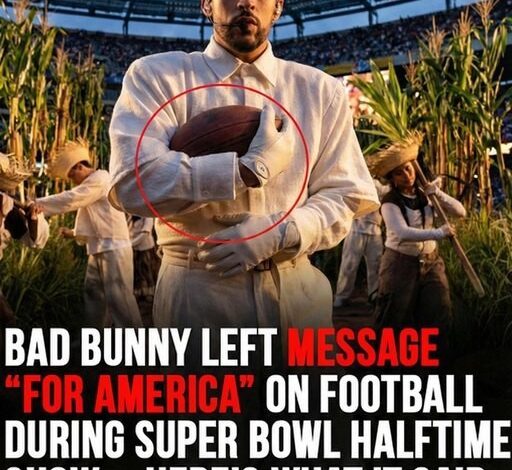
However, the performance took a turn toward the profound during its climax. Bad Bunny, who has often used his platform to address social and political issues, chose a specific moment to introduce a powerful visual symbol. As he moved toward the center of the stage, he was surrounded by a sea of dancers carrying flags from dozens of nations across the globe. The visual was a literal representation of a borderless world united by rhythm. In his hand, he carried a standard American football—a quintessential symbol of the sport and the country’s cultural fabric. As the music reached a crescendo, he held the ball aloft for the cameras to catch a hand-written message scrawled across the leather: “Together We Are America.”
This was not a fleeting gesture. Behind him, the massive stadium screens transitioned from abstract visuals to a clear, bold message of unity, inclusivity, and shared humanity. The phrase served as a poignant double entendre. On one hand, it was a nod to the inclusive nature of the United States as a melting pot of cultures. On the other, it was a reminder of the broader definition of “America” as a continent—a region encompassing North, Central, and South America, all of which have contributed to the cultural and musical landscape that Bad Bunny now dominates. It was an invitation to re-examine the boundaries of identity and to celebrate the diversity that defines the modern era.
The immediate aftermath of the performance saw a digital explosion. Within seconds of the finale, social media platforms were flooded with clips of the “Together We Are America” moment. The discourse was, as expected, polarized. Some commentators and public figures took to the airwaves to criticize the performance, arguing over the appropriateness of the message or the artist’s style. Critics often cited the linguistic shift or the overtly political nature of the props as points of contention. Yet, for a vast majority of the viewing public, the sentiment was one of overwhelming praise. Many praised the artist for his bravery in using such a high-stakes platform to deliver a message of hope rather than one of division.
The cultural impact of the 2026 halftime show extends far beyond the statistics of viewership or social media engagement. It served as a mirror to a society in flux, reflecting the complexities of modern identity. For many young fans, particularly those from the Latinx community, seeing an artist reach the pinnacle of American entertainment while remaining true to his roots was a moment of profound validation. It proved that one does not need to dilute their culture to achieve universal appeal. Instead, the performance suggested that authenticity is the most powerful tool for connection.
As the discussions continued in the days following the Super Bowl, the narrative centered on the idea of the “shared cultural moment.” In an increasingly fragmented media landscape, events like the halftime show are among the few instances where a significant portion of the population watches the same thing at the same time. Bad Bunny utilized that rare collective attention to spark a conversation about what it means to belong. The image of the football, inscribed with a message of unity and surrounded by the flags of the world, became the defining photograph of the year—a symbol of how sports and music can intersect to challenge perceptions and inspire a more inclusive worldview.
Ultimately, the 2026 performance proved that the halftime show has evolved into something much larger than a mere intermission. It is now a site of cultural negotiation, a place where the values of the present are performed and debated in real-time. Bad Bunny’s contribution to this legacy was a reminder that while the game of football is won through competition, the spirit of the event is best captured through the lens of togetherness. He left the stage not just as a global superstar, but as a cultural diplomat who used the world’s biggest stage to remind everyone that, despite our differences, the music remains a universal language that can, if we allow it, bring us all home.