The Blood Debt In The Attic How My Uncles Death Exposed The Chilling Secret Behind The Crash That Left Me In A Wheelchair
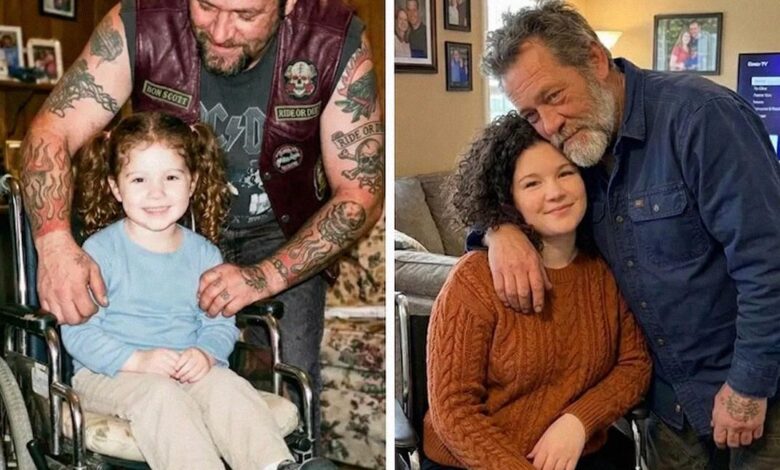
For twenty-two years, my life was divided into two distinct chapters: the blurry, vibrant “before” and the clinical, seated “after.” I was twenty-six years old, and my world was as wide as the plywood ramp my Uncle Ray had built over our front door and as narrow as the four walls of my bedroom. I didn’t remember the crash that claimed my parents’ lives and paralyzed my spine when I was only four; I only knew the story that had been fed to me like medicine since the day I woke up in a hospital bed. The narrative was simple: an accident happened, they were gone, and I was the miracle survivor left to navigate the world from a wheelchair.
When the state began looking for “appropriate placements” for a disabled toddler, Uncle Ray had been the one to slam his fist on the table. He was a man built of concrete and bad weather, a rough-hewn lineman who knew more about power cables than pigtails. He didn’t have a partner, a clue, or a drop of gentleness in his external demeanor, yet he refused to let me go to strangers. He brought me home to a house that smelled of coffee and motor oil, and he transformed himself into a nurse, a mother, and a bodyguard. He learned to roll me to prevent pressure sores, he fought insurance companies until they folded, and he brushed my hair with trembling hands, whispering that I was never “less” than anyone else.
For two decades, Ray was my entire universe. He was the man who sat through the awkwardness of my puberty, the man who welded a tablet stand so I could see the world from my bed, and the man who spent his nights retching from the secret cancer that was hollowing him out, only to show up at my bedside at dawn with perfectly cooked eggs. When he finally succumbed to stage four illness, I felt as though the very earth had been pulled out from under my wheels. But it was only after the funeral, when our neighbor Mrs. Patel handed me a letter in Ray’s blunt, heavy handwriting, that I realized the earth had never been solid to begin with.
The letter began with a sentence that felt like a physical blow: “Hannah, I’ve been lying to you your whole life.” As I read on, the air in my lungs turned to ash. The story of the crash was not an act of fate, but an act of fury. Ray revealed that on the night of the accident, my parents had come to him with a packed bag. They were “messes,” struggling with addiction and instability, and they had told Ray they were moving away for a fresh start—and they weren’t taking me. They believed I was better off with him.
Ray had exploded in a prideful rage. He called my father a coward and my mother selfish. He saw that my father had been drinking, he saw the bottle in the car, and he had the power to stop them. He could have taken the keys, called a cab, or forced them to sleep it off on his couch. Instead, his temper won. He let them drive away into the dark because he wanted the satisfaction of having the last word in an argument. Twenty minutes later, the car wrapped around a pole. They were killed instantly. I was the only one left, pinned in the wreckage of his anger.
The letter was a visceral confession of a man who had lived twenty-two years in a self-imposed prison of penance. Ray admitted that in the beginning, every time he looked at me in that hospital bed, he saw his own punishment. He didn’t just take me in out of love; he took me in to pay a debt he knew was unpayable. Every ramp he built, every insurance call he made, and every night he spent checking my breathing was an attempt to balance the scales for the night he let his pride overrule his humanity. He had hidden the truth because he couldn’t bear the thought of me looking at him and seeing the man who helped put me in that chair.
But the revelations didn’t stop there. Ray had been hoarding more than just secrets; he had been hoarding a future for me. While I thought we were scraping by on his meager wages, he had been working double shifts and storm calls for years, funneling every cent into a trust. He had kept my parents’ life insurance money in his name so the state couldn’t touch it, and he had sold our house before he died. The “janky” life we led was a facade; in reality, he had amassed enough wealth to provide me with the best rehabilitation, equipment, and medical care available. He wanted my life to be bigger than the room he had built for me.
The last lines of the letter were a plea for a forgiveness he didn’t believe he deserved. “If you can’t forgive me, I understand,” he wrote. “I will love you either way. I always have. Even when I failed.”
I sat in the silence of that empty house for hours, clutching the papers to my chest and sobbing for the girl I was and the woman I might have been. Part of me wanted to scream at his ghost, to hate him for the silence and the pride that had cost me my legs and my parents. But as the sun began to set, I looked around at the house—at the ramps, the specialized sinks, and the herbs he had planted in the window just so I could have something green to look at. I realized that while Ray had been part of what ruined my life, he was the only one who had spent every waking second trying to save it.
He couldn’t undo the crash, but he had spent twenty-two years walking into the fire of his own guilt to carry me through it. He had punished himself more severely than any court ever could. A month later, using the trust he had left behind, I checked into a high-intensity neurological rehab center. When the therapists strapped me into a harness over a treadmill, my muscles screamed and my heart hammered against my ribs. It was a brutal, agonizing process, but every time I felt like giving up, I heard Ray’s voice in my head: “You’re gonna live, kiddo. You hear me?”
Last week, for the first time since I was four years old, I stood with the majority of my weight on my own legs. I was shaking, I was crying, and it wasn’t a miracle—it was the result of a man who worked himself to death to give me a door. Do I forgive him? Some days, the weight of the lie is too heavy. But most days, I remember his rough hands pouring water over my hair in the sink and his fierce “you’re not less” speeches. I realize I’ve been forgiving him in pieces for my entire life, one act of care at a time. He carried me as far as his broken heart could take him, and now, the rest of the walk is mine.