After 53 Years of Marriage, I Found a Note in His Pocket, What Waited at That Address Rewrote My Entire Life
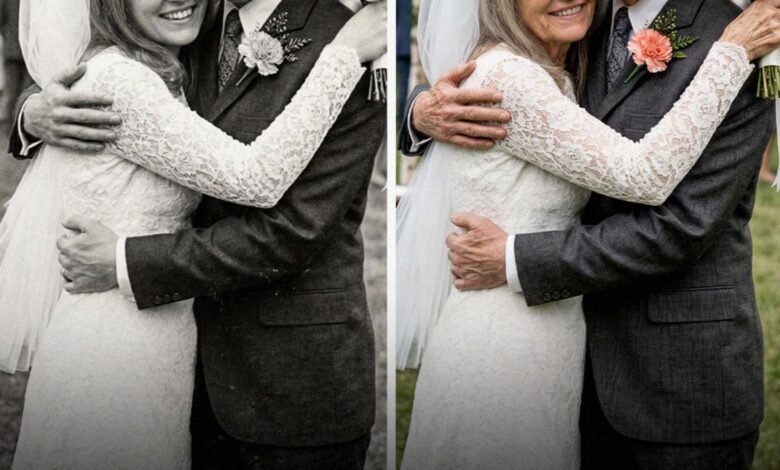
I thought I knew everything about my husband.
After fifty-three years of marriage, you believe there are no secrets left. You believe that whatever life had to reveal, it had already done so—through shared routines, quiet habits, inside jokes, and the kind of understanding that only comes from decades together.
Arthur was my whole world.
He was the man who warmed my side of the bed before I climbed in. The one who filled my gas tank without being asked. The one who held my hand in church, even when there were no words left to say. We weren’t loud about our love, but it was steady, dependable—something others admired because it seemed simple.
I believed in that simplicity.
I believed in him.
And then, three days ago, I buried him.
Grief has a strange way of slowing time. Every movement feels heavier. Every decision feels like it carries more weight than it should. When I insisted on dressing him myself for his burial, it didn’t feel unusual. It felt right.
It was something I had always done—pressing his jackets, smoothing out wrinkles, making sure he looked “put together,” as he liked to say.
Even at the end, I wanted to do that for him.
The funeral director stood quietly as I adjusted his navy tie, the one with silver stripes he wore on Sundays. I smoothed his lapel, brushed away lint that wasn’t there, and tried not to think about the finality of the moment.
Then my hand slipped into his jacket pocket.
At first, I thought it was nothing.
Arthur always carried little things—receipts, mints, folded church bulletins. But this felt different. The paper was smooth, slightly stiff.
I pulled it out.
It was wax paper, folded neatly.
On the outside, there was an address.
Inside, in his handwriting—steady, familiar—just two words:
“I’m sorry.”
My hands started shaking before I could stop them.
Fifty-three years together, and this was what he left me with?
No explanation.
No context.
Just an apology and a place.
I stepped outside, the morning air colder than it should have been. The funeral director asked if I needed help. I told him I just needed air.
That wasn’t the truth.
The truth was, I needed answers.
I got in my car and drove.
The address was across town. As I made my way through streets I had traveled countless times, everything felt unfamiliar. My mind ran through every possibility I could think of.
Another woman.
A hidden life.
A secret he had carried for years.
Each thought felt heavier than the last.
“Arthur, what did you do?” I whispered.
Memories flooded in as I drove—his laugh in the kitchen, the way he sang off-key in the car, the way he held our granddaughter’s hand like it was something fragile and precious.
I missed him.
Even as I questioned him.
When I arrived, I almost turned around.
The place didn’t match any of my fears.
It was a bakery.
Small. Warm. Inviting.
The sign read “Grace’s Place.”
For a moment, I stood outside, unsure of what I was about to walk into. Then I felt the note in my purse, and that was enough.
I pushed the door open.
The smell hit me first—cinnamon, butter, something soft and comforting. It felt like stepping into a memory I didn’t recognize.
A woman stood behind the counter, dusting flour from her hands.
She looked up.
And froze.
For a second, we just stared at each other.
Then she smiled.
Not politely.
Not like a stranger.
But like someone who had been waiting.
“Evelyn?” she asked softly.
My name felt different coming from her.
“I found this address,” I said, holding onto the words like they might slip away. “My husband… Arthur… he passed away. He left me this.”
Her expression changed.
Not shock.
Something else.
“Then he finally did it,” she said quietly.
A chill ran through me.
“Did what?”
She came around the counter slowly, her movements careful, almost cautious.
“Please,” she said. “Sit down before I explain.”
I didn’t want to sit.
I wanted to leave.
But I sat anyway.
She took the note from my hand and smoothed it out, as if it mattered more than just the words on it.
“He told me if you ever came here alone,” she said, “it meant he ran out of time.”
The room felt smaller.
“Who are you?” I asked.
She hesitated.
Then spoke.
“My name is Grace,” she said.
The name hit something inside me.
Something buried.
Something I hadn’t allowed myself to think about in years.
“My parents told me you were gone,” she continued. “But that wasn’t true.”
I stopped breathing.
She looked at me, her eyes filled with something I couldn’t name.
“I’m your daughter.”
The world shifted.
Not suddenly.
Slowly.
Like everything I had known was being pulled apart piece by piece.
She told me everything.
How she had been given away the day after she was born. How my parents had made that decision, not me. How I had been told to move on, to forget, to accept something I never truly understood.
And Arthur…
Arthur had known.
For over thirty years.
He had found her.
Read the letters I had written—letters I never sent, words meant for a child I believed I had lost forever. He had tracked her down, stayed in her life quietly, carefully, without telling me.
“He didn’t want to hurt you,” she said.
But the truth was harder than that.
He had chosen silence.
And that silence had cost me everything.
“He let me mourn a child who was still alive,” I said, my voice breaking.
Grace didn’t argue.
She just held my hand.
And in that moment, there were no years between us.
Just loss.
And something else.
Connection.
We talked for hours.
About her life.
Her bakery.
Her son.
My grandson.
A child I didn’t know existed.
A life I had been separated from without ever understanding why.
By the time I left, everything felt different.
Not fixed.
Not resolved.
But changed.
The next morning, I returned to the funeral home.
Grace came with me.
She hesitated at the door, unsure if she belonged there.
“You do,” I told her. “You always did.”
Inside, the room filled with familiar faces.
Family.
Friends.
People who believed they knew our story.
I stood beside Arthur’s casket, looking at the man I had loved for more than half my life.
Then I turned.
“This is my daughter,” I said, my voice steady despite everything.
The room went silent.
Shock spread quickly, questions forming before anyone could ask them.
But I didn’t stop.
“Arthur knew,” I continued. “And whatever else is said today, that truth won’t be buried with him.”
For the first time in years, I didn’t feel small.
I didn’t feel like I was carrying someone else’s decisions.
I felt clear.
I looked at Grace, her hand in mine.
“I won’t lose another day,” I said.
And I meant it.
Because some stories don’t end with loss.
Some begin the moment the truth finally comes to light.
And for the first time in fifty-three years, I was ready to live mine differently.