One rule never before used could see Donald Trump removed from office!
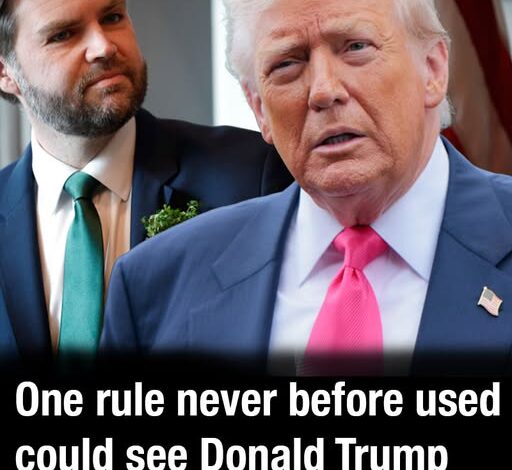
The corridors of American power have long been familiar with the tremors of political dissent, but the current climate in 2026 has introduced a frequency of instability that feels distinctly modern and dangerously high-stakes. Since his return to the White House, President Donald Trump has navigated a landscape of global volatility that has tested the traditional boundaries of executive authority and diplomatic strategy. Central to this turbulence is a deepening and bloody conflict in the Middle East, characterized by coordinated airstrikes with Israel against Iranian targets—an escalation that has fractured international opinion and left a staggering human toll in its wake. With casualty reports exceeding 3,000 individuals, including over 1,000 civilians, the moral and tactical implications of the administration’s foreign policy have moved from the realm of debate into a state of urgent, national crisis.
In this atmosphere of escalating violence and intelligence disputes, a startling voice has emerged from within the conservative establishment itself. Scott McConnell, a respected intellectual and the co-founder of The American Conservative, has broken ranks to propose a solution once relegated to the pages of political thrillers: the invocation of the Twenty-Fifth Amendment. This constitutional mechanism, designed to handle instances where a president is “unable to discharge the powers and duties of his office,” has never been used for the involuntary removal of a sitting commander-in-chief. Yet, McConnell argues that the current trajectory of the presidency, particularly concerning the administration’s handling of the Iran conflict, necessitates this extraordinary intervention.
McConnell’s call to action is directed specifically at Vice President JD Vance. Through a series of pointed public statements, McConnell has outlined a hypothetical yet rigorous path for a transition of power. He has urged Vance to announce immediate support for a Twenty-Fifth Amendment transition, framing it not as a coup, but as a stabilizing necessity for a nation on the brink. To ensure the legitimacy of such a move, McConnell suggested that Vance should pair this transition with a pledge of bipartisanship and self-sacrifice. Specifically, he advised the Vice President to appoint a figure such as Democratic Senator Chris Murphy as his new second-in-command—praising Murphy as an anti-war strategist who is “smart and not super woke”—and to publicly renounce any intention of running for the presidency in 2028. This “unity government” approach is designed to strip the transition of partisan ambition and focus entirely on de-escalation.
The impetus for this radical proposal appears rooted in a profound distrust of the intelligence used to justify recent military actions. McConnell has been unsparing in his critique of the relationship between the White House and international allies, particularly Israeli Prime Minister Benjamin Netanyahu. He suggested that the administration was fed “BS intelligence” regarding Iranian capabilities and intentions—intelligence that President Trump allegedly embraced while ignoring the warnings of his own domestic agencies. The fallout from these decisions has led McConnell to express a grim concern that the United States is being steered toward a conflict that could result in “genocide in our name.” The disconnect between the administration’s claims and the reality on the ground has created a credibility gap that many believe is no longer sustainable.
President Trump, for his part, has maintained a characteristically defiant posture. He recently asserted that “strong” and productive talks were ongoing with Iranian officials regarding a potential ceasefire, an announcement that was intended to signal a pivot toward diplomacy. However, the optimism was short-lived. Iranian officials quickly and publicly rejected those claims, stating that no such meaningful negotiations were taking place. This public contradiction has only added fuel to the argument that the executive branch is operating in a state of dangerous isolation, disconnected from the diplomatic realities of the region and the tactical assessments of the global community.
McConnell’s proposal also suggests a role for other high-ranking Republicans who might be wary of the current direction. He floated the idea that Senator Marco Rubio could join the effort to negotiate a ceasefire, suggesting that Rubio could maintain his standing and potentially become the GOP frontrunner by acting as a pragmatic peacemaker. This highlights a growing sentiment among certain conservative circles that the current administration’s approach to the Middle East is not just a humanitarian concern, but a strategic liability that could alienate the Republican base and jeopardize the country’s long-term security interests.
The Twenty-Fifth Amendment is a heavy tool, a “nuclear option” of the American Constitution that requires the Vice President and a majority of the Cabinet to agree that the President is unfit for office. It is a process fraught with legal complexity and political peril. For a conservative commentator like McConnell to advocate for its use marks a significant shift in the internal dynamics of the right. It suggests that for some, the risks of a Trump presidency during a time of active war have eclipsed the risks of an unprecedented constitutional transition. The debate is no longer just about policy or personality; it is about the fundamental stability of the executive office and the moral direction of American foreign intervention.
As the death toll continues to rise and the flicker of a ceasefire remains elusive, the pressure on JD Vance and the Cabinet continues to mount. The eyes of the world are not just on the battlefields of the Middle East, but on the silent corridors of the White House, where the true test of constitutional resilience is unfolding. Whether McConnell’s call for a “Twenty-Fifth Amendment transition” remains the lonely cry of a disillusioned intellectual or becomes the blueprint for a historical shift in power depends on the events of the coming weeks. In 2026, the traditional rules of political survival are being rewritten in real-time, and the boundary between the unthinkable and the inevitable has never been thinner.
The American public remains caught in the middle of this high-level tug-of-war, watching as their leaders grapple with the definitions of loyalty, duty, and national interest. The conflict with Iran has become a crucible for the administration, exposing deep-seated tensions within the GOP and raising fundamental questions about the nature of Presidential accountability. In this season of crisis, the “one rule never before used” has moved from a constitutional footnote to the center of a national conversation about the future of the Republic.