If You See A Purple Butterfly Sticker Near A Newborn, Here is What It Means!
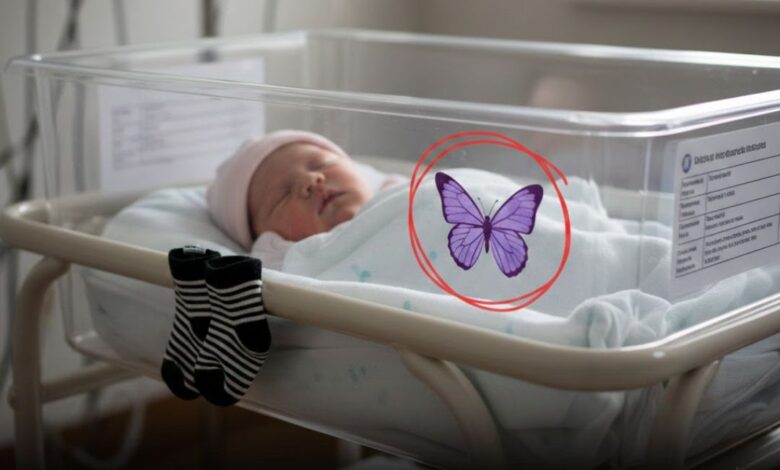
Millie Smith had always felt, deep down, that her first pregnancy would not be ordinary. It wasn’t something she could explain logically—just a quiet certainty that settled in her chest long before any doctor confirmed it. Twins ran in her family, and from the moment she found out she was expecting, she carried that instinct with her.
When the scan finally revealed two tiny heartbeats, she wasn’t surprised. She was thrilled. She and her partner, Lewis Cann, began imagining a life filled with double laughter, double milestones, and double love. But that excitement didn’t last long.
Less than two weeks later, everything changed.
During a routine scan, the room grew too quiet. The technician’s expression shifted in a way that no parent ever forgets. She kept looking at the screen, saying nothing. Millie and Lewis exchanged a glance—they both understood immediately that something was wrong.
The diagnosis came soon after. One of their babies had anencephaly, a rare and severe condition that prevents the brain from developing properly. Doctors explained it gently but clearly: almost all babies born with this condition die shortly after birth.
In a single moment, the future they had imagined split into two paths—one filled with life, the other with inevitable loss.
They had a choice to make, but for Millie, it didn’t feel like one. Both of those babies were hers. Both deserved to be carried, to be loved, to be welcomed into the world no matter how brief that moment might be.
They decided to continue the pregnancy.
From that point on, Millie lived with a strange duality—joy and grief existing side by side. She felt both babies move. She spoke to them. She imagined their faces. And at the same time, she carried the knowledge that one of them would not stay.
They chose names early. It mattered to her that the baby they would lose would still have an identity, a place in their family, even if her time would be short.
They named her Skye.
The name wasn’t random. It meant something. It gave them somewhere to look, somewhere to place their love after she was gone. The sky would always be there—constant, open, and impossible to forget.
Months passed, each day heavy with anticipation and quiet dread. Then, at just 30 weeks, Millie went into labor unexpectedly. There was no more time to prepare.
The delivery had to be immediate.
When the girls were born, something unexpected happened.
They both cried.
It was a small sound, but it carried enormous weight. The doctors had warned them that Skye might not move or make any sound at all. Yet there she was, alive, making her presence known in the only way she could.
For a moment, just a moment, everything felt whole.
Millie and Lewis held both of their daughters. They memorized every detail—their tiny features, their warmth, the fragile rhythm of their breathing. They didn’t think about what was coming next. They just stayed there, suspended in that rare, fleeting space where both of their children were alive together.
Skye lived for three hours.
Three hours that felt both impossibly short and endlessly significant.
When she passed away, Millie was holding her. There was no dramatic moment, no warning—just a quiet slipping away. One second she was there, the next she wasn’t.
The kind of heartbreak that follows something like that doesn’t come in waves. It settles deep and stays.
At the same time, Callie—her twin—needed care. She was premature, fragile, and placed in the neonatal intensive care unit alongside other babies fighting their own battles.
Millie moved between grief and responsibility without pause.
In the NICU, life continued in a strange, suspended rhythm. Machines beeped steadily. Nurses moved efficiently. Parents hovered near incubators, watching, waiting, hoping. It was a place filled with both fear and determination.
At first, the staff knew about Skye. They treated Millie with a quiet understanding, a softness that acknowledged what she had lost. But as days turned into weeks, something changed.
People stopped mentioning her.
New parents arrived. Conversations shifted. The space moved forward, as it always does, and slowly, Skye became invisible to everyone except her parents.
Then one day, a comment broke everything open again.
Another mother, exhausted and overwhelmed, looked at Millie and said casually, “You’re so lucky you didn’t have twins.”
It wasn’t cruel. It wasn’t meant to hurt. It was just an offhand remark, spoken without knowledge of the truth.
But it landed hard.
Millie felt the words hit her like something physical. For a second, she couldn’t respond. Then she stood up and left the room, tears already forming before she even reached the door.
That woman didn’t know. None of them did. And Millie couldn’t bring herself to explain it—not in that moment, not with that kind of pain sitting so close to the surface.
But as she stood there, trying to steady herself, something became clear.
This kind of misunderstanding didn’t have to happen.
There needed to be a way for parents like her to be seen without having to speak, to be understood without having to relive their loss every time someone said the wrong thing.
That idea stayed with her.
And from it, something simple—but powerful—was created.
A purple butterfly.
Millie chose the symbol carefully. Butterflies represented something that had been here, even briefly, and then gone. Something delicate, something real, something that mattered. The color purple was intentional too—neutral, fitting for any baby, whether boy or girl.
The meaning behind it was straightforward: if a purple butterfly was placed on a baby’s incubator, it meant that the child was part of a multiple birth, but one or more of the siblings had passed away.
No explanations needed. No painful conversations forced.
Just quiet understanding.
The idea spread.
What started as a small gesture in one hospital began reaching others. Staff adopted it. Parents recognized it. It became a silent language—one that carried compassion without requiring words.
Millie and Lewis later created the Skye High Foundation to support the initiative and help expand it further. What began as a response to a single painful moment turned into something that has helped countless families feel seen in their grief.
Years passed. Callie grew up—full of energy, laughter, and life. She carried her sister’s story with her, even if she didn’t fully understand it at first. Skye was always part of their family, always present in the way they spoke, remembered, and looked up at the sky.
Grief didn’t disappear. It never does. But it changed shape.
And through that change, something meaningful remained.
A small purple butterfly, placed gently on an incubator, now speaks for parents who don’t have the strength to explain. It tells others to be careful, to be kind, to recognize that not every story is visible.
It ensures that babies like Skye are never forgotten.
And it gives families, in their hardest moments, something they desperately need—understanding without having to ask for it.