Grab a tissue before you read about Little Parkers miracle story!
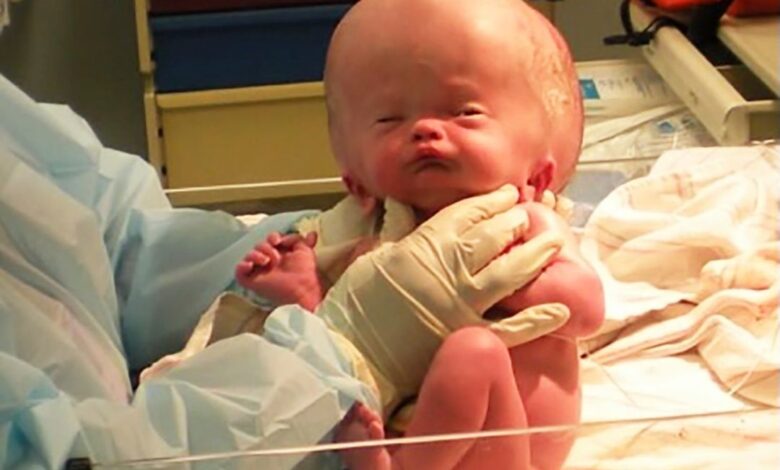
When Crysie and Ryan Grelecki learned they were expecting a child in 2008, their hearts were filled with the universal aspirations of parenthood: a healthy delivery, a nursery filled with sunlight, and the promise of a lifetime of ordinary milestones. However, the trajectory of their lives was irrevocably altered during a routine 20-week ultrasound. The atmosphere in the examination room shifted from excitement to palpable concern as the technician focused on a startling anomaly—the baby’s head was significantly larger than expected for that stage of development. Following a battery of scans and consultations, the diagnosis was delivered with clinical gravity: Parker had hydrocephalus.
Hydrocephalus is a condition characterized by an accumulation of cerebrospinal fluid within the brain’s ventricles. In Parker’s specific case, a blockage between the third and fourth ventricles prevented fluid from draining naturally, causing it to collect within the skull and exert immense pressure on the developing brain tissue. For many, such a diagnosis would signal a period of despair, but for the Greleckis, it became the catalyst for a journey defined by unconditional love and an unwavering refusal to accept the limitations of a medical prognosis. Crysie later recalled that while fear was a constant companion during the remainder of her pregnancy, she anchored herself in the belief that a path would be made where none seemed to exist.
Parker was born in September 2008 via C-section at 39 weeks, and the medical data accompanying his arrival was staggering. While a typical newborn’s skull is comprised of roughly 90% to 95% brain matter, Parker’s anatomy was a dramatic inversion of the norm. His skull contained over 98% fluid, leaving only a thin, eight-millimeter ribbon of brain tissue pressed against the bone. The prognosis was exceptionally grim; doctors cautioned the family to prepare for the possibility that Parker might not survive the neonatal period, and if he did, the quality of his life remained a distressing unknown.
Yet, from his first breath, Parker was surrounded by a fierce, protective devotion. Ryan spent his early days at the hospital bedside, speaking to his son, praying over him, and establishing a physical connection that transcended the sterile environment of the NICU. At just two days old, Parker underwent the first of many life-saving interventions at Children’s Healthcare of Atlanta. Surgeons worked to drain the excess fluid, relieving the crushing intracranial pressure and finally giving his brain the physical space required to develop.
This initial procedure was merely the prologue to an arduous medical odyssey. Parker endured a series of complex craniofacial surgeries designed to expand his skull and separate bones that had fused prematurely. The objective of the medical team was not merely survival, but the creation of an environment where neurological growth was possible. Against every clinical expectation, Parker proved to be a resilient fighter. He was discharged to go home just two weeks after his first major surgery, and by the age of four weeks, he was already enrolled in intensive physical therapy.
The road to development was measured in millimeters and minor victories. Progress was initially slow; Parker struggled to find the strength to hold up his head or sit unassisted. However, his family and the staff at Children’s Healthcare of Atlanta—whom the Greleckis came to view as an extension of their own family—remained steadfast. Then, in a defiance of typical developmental stages that would become characteristic of his life, Parker skipped the crawling phase entirely and proceeded straight to walking.
As Parker grew, his rehabilitation was integrated into a life full of activity and joy. He took swimming lessons and played tennis, bolstered by the constant support of his siblings, Chase and Emily. Growing up alongside Parker provided them with a unique perspective on empathy and resilience, turning them into lifelong advocates for those with diverse needs. The thin ribbon of brain tissue that doctors once doubted could sustain basic function began to flourish, absorbing information and developing a distinct, vibrant personality.
Today, Parker Grelecki is a young man who defies almost every early prediction made about his future. With his glasses, blond hair, and infectious charisma, he has become a fixture in his community. He is not defined by his medical history, but by his quick wit, his talkative nature, and his deep engagement with the world around him. Perhaps the most remarkable aspect of his development is his profound passion for sports. The brain that was once compressed to a fraction of its normal size now houses a staggering encyclopedic knowledge of athletic statistics and strategy.
Parker has channeled this passion into a burgeoning talent for sports commentary. He has already had the opportunity to announce local high school football games, where his energy and professional presence have left a lasting impression on listeners. To hear him speak behind a microphone is to witness a miracle of neurological plasticity and human willpower. While he continues to navigate challenges related to the initial damage caused by his condition, his life serves as a living testament to the fact that a medical prognosis is a starting point, not a destiny.
The Grelecki family remains profoundly grateful for every milestone, viewing Parker’s life as a journey of faith and a celebration of modern medicine. His story is more than a medical anomaly; it is a narrative about the power of a family that chose hope over despair and doctors who saw potential where others saw only a crisis. Parker entered the world under the shadow of the darkest predictions, yet year after year, he has carved out a life of light and purpose.
His journey reminds us that human strength, when nurtured by unconditional love and professional dedication, can reach places that were once deemed unreachable. Parker Grelecki did not just survive; he found his voice, his passion, and his place in the world. He stands as a reminder to every family facing a difficult diagnosis that there is always room for a miracle, and that the future is rarely as narrow as fear would lead us to believe. Parker’s story is a profound legacy of what happens when we refuse to let the final word be spoken by a scan or a statistic, choosing instead to believe in the limitless capacity of the human spirit to grow, adapt, and shine.