Trump destroys Bad Bunnys halftime Super Bowl performance with 5 ruthless words!
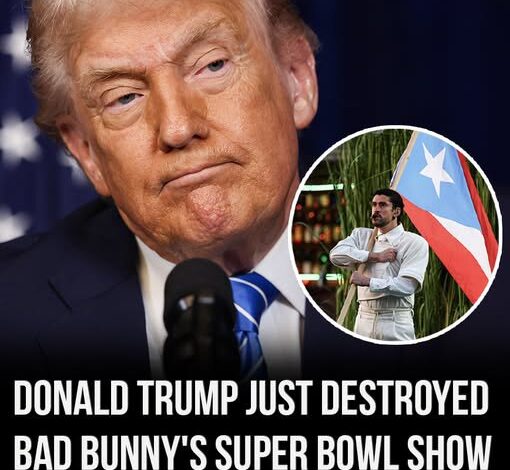
The sporting world witnessed a clinical masterclass on the evening of February 8, 2026, as the Seattle Seahawks deployed a suffocating, relentless defensive scheme to dismantle the New England Patriots in Super Bowl LX. Yet, as the final whistle blew at Levi’s Stadium in Santa Clara, the conversation quickly drifted from gridiron strategy to a polarized cultural debate. While the Seahawks secured their place in history, the true focal point of the night became the Apple Music Halftime Show and the subsequent digital firestorm ignited by Donald Trump. The performance, headlined by global megastar Bad Bunny, was a vibrant, high-concept celebration of Latin heritage that successfully transformed the stadium into a Caribbean dreamscape, only to find itself at the center of a national political tug-of-war.
Bad Bunny, born Benito Antonio Martínez Ocasio, utilized the world’s most-watched stage to deliver a set that was as visually ambitious as it was musically groundbreaking. The production was a sprawling homage to Puerto Rican history and culture, featuring the artist performing amidst a meticulously crafted field of sugarcane—a symbolic nod to the island’s agricultural and colonial past. Throughout the set, the six-time Grammy winner commanded the stage with a magnetism that bridged the gap between his reggaeton roots and the mainstream American audience. The spectacle was further elevated by high-profile guest appearances; the legendary Ricky Martin brought a sense of heritage and nostalgic energy, while Lady Gaga provided a shock of avant-garde pop brilliance. For the fans gathered in Santa Clara and millions more watching at home, it was a high-octane display of creativity and cultural pride.
However, the very elements that earned the show critical acclaim—the Spanish-language lyrics and the specific cultural motifs—became the primary targets of an aggressive critique. As the performance concluded, Donald Trump took to Truth Social to deliver a blistering, multi-paragraph rebuke that signaled his total rejection of the NFL’s creative direction. Trump, who notably declined to attend the game in person, citing that the trip to California was “too far,” did not let the distance mute his displeasure. His rhetoric was sharp and unfiltered, labeling the production “absolutely terrible” and “one of the worst ever.” In a series of ruthless assertions, he characterized the show as an “affront to the greatness of America,” specifically arguing that it failed to meet his prescribed standards of “Success, Creativity, or Excellence.”
A significant portion of the critique focused on the linguistic and aesthetic choices of the performance. Trump argued that “nobody understands a word” being said, a sentiment echoed by a subset of viewers who felt the lack of English lyrics made the show inaccessible. He further disparaged the choreography, describing the dancing as “disgusting” and inappropriate for children. Beyond the artistic critique, Trump leveraged the moment to pivot toward his familiar economic and political narratives. He framed the halftime show as a “slap in the face” to a country he claimed was setting records in the stock market and retirement savings, contrasting the “mess” on the screen with the perceived “Real World” prosperity of his supporters. The rant even veered back to the sport itself, with an added demand that the NFL replace its controversial new kickoff rules, punctuated by his signature “Make America Great Again” call to action.
The animosity toward the halftime lineup had been brewing long before the first notes were played. Earlier in the week, Trump had signaled his frustration to the New York Post, specifically targeting the inclusion of the band Green Day, whose members have been vocal critics of his policies and the MAGA movement. At the time, he claimed to have “never heard” of Bad Bunny, dismissing the selection of performers as a “terrible choice” that served only to “sow hatred.” This preemptive strike set the stage for a clash of ideologies that transcended music. The NFL, by choosing artists with strong political identities and global appeal, had effectively drawn a line in the sand, and the halftime show was the inevitable explosion.
The performance seemed to anticipate this backlash, embedding messages of unity and resistance directly into the staging. As the final pyrotechnics faded, the stadium’s massive digital billboards displayed a single, defiant sentence: “the only thing more powerful than hate is love.” The closing tableau featured Bad Bunny holding a football, flanked by an diverse ensemble of Latin American performers, with the ball itself bearing the inscription, “Together we are America.” For supporters, this was a poignant affirmation of a modern, multicultural United States; for detractors, it was a provocative political statement that had no place in a sporting event.
This collision of celebrity and politics highlights the deepening fracture in American cultural consumption. In the 2020s, the Super Bowl halftime show has evolved from a simple musical interlude into a battleground for national identity. By centering a Spanish-language performance and Puerto Rican imagery, the NFL made a definitive statement about the shifting demographics of its fan base and the country at large. Conversely, Trump’s reaction served as a rallying cry for those who feel that traditional American symbols are being eroded in favor of a globalist or “woke” agenda. The debate over whether the show was “disgusting” or “groundbreaking” quickly moved past the quality of the vocals or the choreography, settling instead into the entrenched camps of a culture war.
As the reviews began to pour in, the “Fake News Media”—as Trump predicted—largely praised the show for its boldness and technical execution. Music critics lauded Bad Bunny for his refusal to dilute his sound for an English-speaking audience, while cultural commentators noted the importance of seeing Latin excellence celebrated so prominently during a time of heightened immigration tensions. However, in the digital echo chambers of social media, the “Real World” that Trump referenced remained fiercely divided. The firestorm ensured that the Seahawks’ dominant victory over the Patriots was relegated to the second or third paragraph of the Monday morning news cycle.
Ultimately, Super Bowl LX will be remembered as much for the sugarcane fields and the Truth Social rants as it will be for the touchdowns. The evening proved that even the most massive shared experiences in American life are now viewed through a fractured lens. While Bad Bunny and his collaborators sought to prove that “Together we are America,” the immediate and vitriolic reaction from the former president demonstrated just how difficult that unity remains to achieve. The halftime show did more than just provide entertainment; it acted as a mirror, reflecting the deep-seated anxieties and the vibrant diversity of a nation that continues to struggle with the definition of its own “standards of excellence.” In the end, the five ruthless words—or five hundred, in the case of the rant—didn’t just destroy a performance in the eyes of his followers; they cemented the halftime show as a permanent landmark in the ongoing struggle for the American narrative.